Three years ago, when someone said AI chatbot, everyone knew you meant ChatGPT. Now there's Claude, Gemini, Llama, Mistral — and Grok. If you've been searching "what is Grok" and trying to figure out where it fits in that pile, I get it. The landscape got crowded fast and it's genuinely hard to keep up.
My name is Artem, and I run the Writingmate blog. I've been testing AI models seriously since GPT-3 — not just reading benchmark papers, but running actual work tasks through them week after week. With Grok 4 Fast now a legit contender alongside Claude Sonnet 4.6 and Gemini 2.5 Pro, I wanted to do a proper multi-model breakdown. Not just Grok vs ChatGPT (we've covered that one already), but Grok against the full competition — and where each model genuinely pulls ahead.
Here's what I found after running the same prompts through all of them.
What Is Grok — and What Actually Makes It Different?
Grok is an AI chatbot and model family built by xAI, the AI company Elon Musk founded in 2023. The name comes from Robert Heinlein's 1961 sci-fi novel Stranger in a Strange Land — in the book, "grok" means to understand something so completely you become one with it. For an AI model, it's an ambitious name to live up to.
What actually makes Grok different isn't the branding — it's the data. Because xAI and X (formerly Twitter) share the same ownership, Grok has a direct, native feed into X's real-time stream. Not a web crawl from three days ago, not a knowledge cutoff response — actual live posts, replies, and trending content from X's social graph, right now. Ask Grok what people are saying about something that happened this morning, and it often knows. That's genuinely hard for any other model to replicate without the same data relationship.
Every other major model handles real-time data differently. Claude uses a knowledge cutoff and has no live web access in most contexts. GPT-4o adds browsing on top of the base model, crawling the open web on request. Gemini 2.5 Pro pulls from Google Search. Grok's X integration is faster for social and trending data than any of these alternatives — though for structured web research, Google-backed Gemini covers more ground.
The model family itself has grown through several generations: Grok 1, Grok 1.5, Grok 2, and now Grok 4. As of April 2026, the two main variants are Grok 4 Fast (speed-optimized for daily tasks) and Grok 4 Heavy (reasoning-focused for complex, multi-step problems). For most people exploring Grok for the first time, Grok 4 Fast is the right place to start — it's snappy, capable, and handles 90% of everyday use cases without requiring a premium compute budget.

Grok 4 Fast vs Claude Sonnet 4.6: Writing and Coding Head-to-Head
Claude is the model I reach for most often for writing tasks, so I was genuinely curious how Grok 4 Fast holds up against it. Short answer: better than I expected for short-form work.
Grok 4 Fast writes with personality and directness. It's less prone to the cautious, hedging tone that Claude occasionally slips into on sensitive or contested topics. Give it a tweet thread, a product description, or a quick draft, and the output is confident and readable. For short-form content where you want a direct, opinionated take, Grok actually has an edge.
For longer projects, Claude pulls ahead noticeably. I ran both models on the same 2,000-word article rewrite with a specific voice and structure brief. Claude maintained consistency from start to finish. Grok 4 Fast started well but drifted slightly in the middle sections — the voice became a bit less defined, and the structural choices were less deliberate. Not broken output, but the gap in sustained quality over longer content was real.
On coding tasks, Claude Sonnet 4.6 has a clear advantage for complex, multi-file debugging. It's better at holding a large codebase's architecture in context across a long conversation and reasoning about it. Grok 4 Fast handles single-function generation and quick fixes comfortably — I wouldn't dismiss it for coding, but I'd verify outputs more carefully on anything beyond simple scripts.
"Switched from Claude to trying Grok 4 Fast for quick drafts this week. Honestly surprised — for short copy it's faster and the tone feels snappier, less mealy-mouthed. Still prefer Claude for anything over 1,000 words though, the voice consistency just stays more coherent." — u/contentops_mk on r/ClaudeAI
Grok 4 Fast vs Gemini 2.5 Pro: The Real-Time Research Battle
This comparison surprised me the most. Both Grok and Gemini have real-time data access — but the data sources are fundamentally different, and that difference matters more than most comparisons acknowledge.
Grok pulls from X. Gemini 2.5 Pro pulls from Google Search. Those aren't equivalent data sources, and which one you want depends entirely on what you're researching.
If you want to know what the social conversation looks like around something happening right now — what people are actually posting, arguing about, or reacting to on X — Grok wins clearly. It's seeing live posts in near real-time, not a web crawl of news articles summarizing the same topic. For tracking AI announcements, product launches, market sentiment, or anything where the community reaction matters as much as the facts, Grok's X integration is the better source.
If you want comprehensive research depth — official documentation, academic sources, company pages, broader web context that lives outside of social media — Gemini 2.5 Pro's Google integration is stronger. Ask it about a technical standard, pull context from industry reports, or research a topic that requires synthesizing multiple authoritative sources, and it'll typically give you more complete coverage than Grok can from X alone. Gemini also has tight native integration with Google Workspace — Docs, Sheets, Gmail — which is a structural advantage if your workflow is built around Google's ecosystem.
Speed-wise, Grok 4 Fast is faster than Gemini 2.5 Pro on most prompts. Gemini 2.5 Pro trades latency for thoroughness — fine for research tasks, slightly frustrating when you just want a quick answer and don't need a comprehensive breakdown.
"Real-time X access makes Grok uniquely positioned for social and market intelligence workflows. No other model has native access to that firehose at this scale — it fundamentally changes what's possible for teams tracking real-time discourse." — @xai on X
The Full Model Comparison: All Four Frontier Models in One Table
Here's the complete breakdown across the four models most Writingmate users are choosing between right now. I've used all of these seriously for work tasks over the past several weeks:
Feature | Grok 4 Fast | Claude Sonnet 4.6 | Gemini 2.5 Pro | GPT-4o |
|---|---|---|---|---|
Response Speed | ⚡ Very Fast | Fast | Moderate | Fast |
Real-time Data | ✅ X/Twitter | ❌ No | ✅ Google Search | ✅ With browsing |
Writing Quality | Very Good | Excellent | Very Good | Very Good |
Coding | Good | Excellent | Very Good | Excellent |
Google Workspace | ❌ No | ❌ No | ✅ Native | Partial |
Paid Plan Price | $30/mo (SuperGrok) | $20/mo (Pro) | $19.99/mo (Advanced) | $20/mo (Plus) |
Best For | Speed, social data | Writing, long-form, coding | Research, Google tools | General purpose |
A few things stand out from using all four of these seriously:
- Grok 4 Fast is the speed leader. Response latency is noticeably lower than Gemini and at least on par with GPT-4o. If you're doing rapid-fire Q&A sessions or chaining many tasks in sequence, that difference compounds over a long session.
- Claude is still the best writing model. For anything over a few hundred words where voice and structure matter, Claude Sonnet 4.6 is more consistent than the others. That gap is real.
- Gemini wins on structured research. When you need depth from authoritative, web-based sources — not social chatter — Gemini's Google pipeline is more thorough than Grok's X feed.
- GPT-4o is the safest general pick. It's not the best at any single thing in this group, but it's reliable across the widest range of tasks. Still the most versatile if you can only pick one.
- Grok costs more as a standalone subscription. SuperGrok at $30/month is $10 more than Claude Pro or ChatGPT Plus. Worth factoring in if Grok 4 Fast is going to be your only model.
What Is Grok 4 Heavy — and When Do You Actually Need It?
Grok 4 Heavy is xAI's answer to the reasoning model trend — think OpenAI's o3, or Claude's extended thinking mode. It runs longer internal reasoning chains before generating an answer, which helps significantly on problems where the fast model takes shortcuts.
Tasks where Grok 4 Heavy earns the extra wait time:
- Multi-step mathematical or logical problems where each step depends on the previous one being correct
- Complex debugging that requires tracing through multiple files or call stacks to find the root cause
- Research synthesis across conflicting sources where the model needs to reconcile contradictory claims
- Structured analysis tasks — competitive teardowns, detailed comparisons, prompt chains that require real judgment rather than pattern completion
For everyday tasks — drafting emails, summarizing content, quick code generation, answering factual questions — Grok 4 Heavy is genuinely overkill. You'll wait longer for no meaningful quality gain over Grok 4 Fast. Save Heavy for when the problem actually demands deeper reasoning. Both variants are included in SuperGrok at $30/month, so there's no extra cost to switch between them based on the task.
Grok App, Pricing, and How to Access It
Let's be direct about the practical side, because how much Grok costs is one of the most-searched questions about xAI's model as of April 2026.
grok.com — the direct web interface. Free tier with daily message limits on Grok 4 Fast. Clean, fast, minimal. No account required to try it, though the limits are tight for serious use.
The Grok iOS app — available free on the App Store. Supports chat, image uploads, and voice input. The same free rate limits apply. The app is genuinely polished and responsive — not a rough mobile port. Voice mode works well for hands-free use while commuting. Image generation via Aurora (xAI's own image model) is included.
SuperGrok at $30/month ($300/year) — xAI's premium subscription. Higher message limits on Grok 4 Fast, full access to Grok 4 Heavy, image generation, and longer context windows. The right tier if Grok is going to be a primary work tool.
X Premium+ bundle — if you're already on X's top-tier subscription, Grok access is bundled in at lower limits than standalone SuperGrok.
xAI API — developer access with pay-per-token pricing, competitive with OpenAI's rates. Good for building tools without hitting subscription caps.
The pricing reality: SuperGrok is the most expensive single-model subscription in this comparison group. If the real-time X integration is central to your workflow, it justifies itself. If it's not, you're paying a $10/month premium over Claude Pro or ChatGPT Plus for features you may not use heavily.
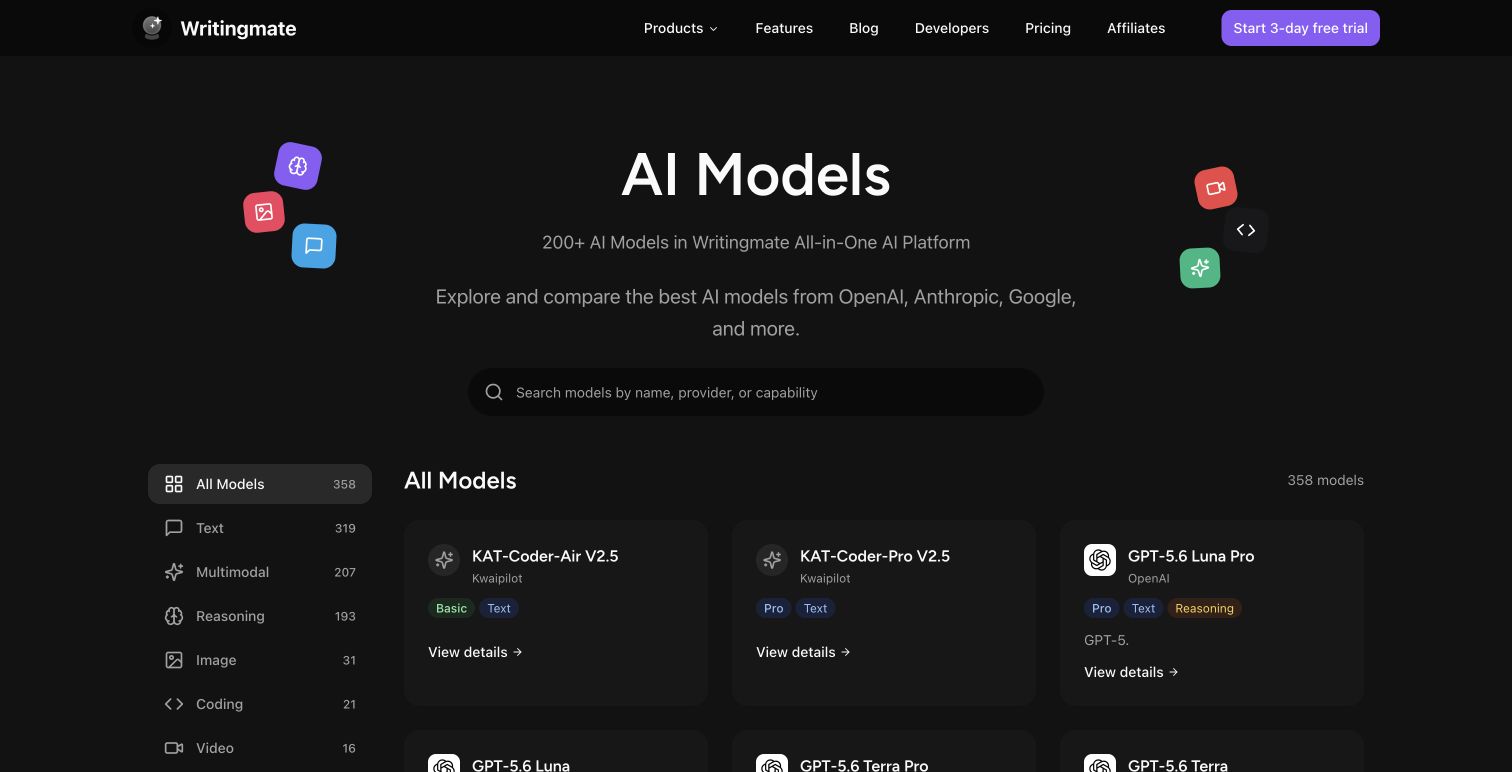
A third path worth knowing: Writingmate gives you Grok 4 Fast alongside 200+ other models — Claude, GPT-4o, Gemini, Mistral, and more — under a single subscription. If you're already paying for one AI platform, consolidating usually makes more financial sense than running three separate accounts.

The Smartest Way to Evaluate Grok: Run Your Own Comparison
Here's the thing about model comparison articles — mine are based on my tasks, my prompts, my judgment calls. Your workflow is different. The only comparison that actually matters is running your real work through multiple models and seeing what comes back.
That's exactly what Writingmate's comparison feature is built for. Head to writingmate.ai/models/compare/x-ai/grok-4.5-vs-anthropic/claude-opus-4.8, enter your prompt once, and Writingmate sends it to Grok 4 Fast alongside whatever other models you select. Outputs appear side by side in real time — no tab switching, no copy-pasting, no trying to remember what each model said.
Comparisons worth running on your actual tasks:
- Current events query: Ask about something from the past week. See if Grok's X data or Gemini's Google data gives you the more complete picture for your use case.
- Writing brief: Give Grok 4 Fast, Claude, and GPT-4o the same prompt and compare tone, structure, and the output you'd actually send.
- Code generation: Run a specific function request and check which model's output you'd use without editing.
- Research question: Ask something nuanced in your domain. See which model gives the most accurate, well-reasoned answer rather than just the most confident-sounding one.
After five or six rounds of this with your own prompts, you'll have a personal benchmark — not based on my experience, but yours. That's more useful than anything I can write here.
The bottom line on Grok: it's a real model worth having in your toolkit. The real-time X integration is genuinely unique — no other frontier model has it natively. Grok 4 Fast is fast in practice, not just in the marketing. And xAI has been shipping improvements at a serious pace. It doesn't replace Claude for sustained writing quality or GPT-4o for general-purpose reliability, but it fills a real gap for speed and social data that the others can't match. The smartest move is access to all of them — and a tool that lets you switch without friction.
See you in the next one!
Artem
Frequently Asked Questions
Sources
Written by
Artem Vysotsky
Ex-Staff Engineer at Meta. Building the technical foundation to make AI accessible to everyone.

Reviewed by
Sergey Vysotsky
Ex-Chief Editor / PM at Mosaic. Passionate about making AI accessible and affordable for everyone.