Meta just dropped Llama 4 — and the useful question is not whether the family is impressive, but which part of it you can use today. Llama 4 Scout is the practical release: Meta introduced it with 17 billion active parameters, 109 billion total parameters, a 16-expert MoE design, and a 10 million-token context window in its official Llama 4 announcement. That combination matters more than raw hype because it points to a model built for long-document and repository-scale work without requiring the deployment budget of the largest frontier systems.
The other two models need more careful framing. Maverick is the larger generally available member of the family, while Behemoth is the capability ceiling Meta used for distillation and is still not broadly released. I checked the release materials, partner documentation, and the public access routes linked below, and the biggest practical difference was simple: Scout and Maverick are the models you can plan around; Behemoth is still a reference point, not a normal deployment option. Each of those three models works best with different use cases, so you need to know which one suits your tasks best.
My name is Artem and I am using LLMs for many years, building tools upon AI models, testing new ones as soon as they come out and developing an all-in-one AI tool that combines all the best and newest AI models in a one simple chatbot, no API keys needed.
I will guide you through features capabilities and even some of benchmarks. If you want to see official model release note, you can go here: https://ai.meta.com/blog/llama-4-multimodal-intelligence/
Introduction
Llama 4 is not one model with one access path. It is a family with three very different planning realities: a smaller long-context model that is unusually deployable, a heavier multimodal model for more demanding tasks, and a flagship training model that mostly matters because it informs the others. For readers deciding what to use for research, writing, product features, or enterprise rollout, that distinction is more helpful than benchmark chest-thumping.
If you just want the short version, here is the decision aid I wish more model roundups included:
- Choose Scout if you need long context, lower serving friction, and fast document-heavy work.
- Choose Maverick if your tasks are more multimodal or require stronger reasoning depth than the smaller model usually gives.
- Do not plan around Behemoth unless Meta changes its release status, since it is currently understood as the model behind the family rather than one intended for direct use.
How I Evaluated Llama 4 Access Capabilities
I used four criteria for this review: what Meta explicitly released, what a developer can access right now through the official and partner routes linked in this article, what practical deployment burden each model implies, and how well each one fits common work like drafting, summarization, multimodal analysis, and product integration. I also compared the claims in Meta's release post with the availability notes from cloud and model-hosting partners already referenced below, because access pages often lag behind launch marketing.
In practice, I looked for three things. First, could I identify a direct route to weights, API, or managed hosting? Second, did the model description include enough serving detail to estimate whether it was realistic for a normal team? Third, when a model was unavailable, was that made explicit or hidden behind vague language? My biggest takeaway after reviewing the sources was that Scout is the easiest model to reason about operationally, Maverick is the most likely upgrade path for teams that need richer multimodal performance, and Behemoth remains mostly aspirational from an access standpoint.
I also weigh usefulness over spectacle here. A model can be the strongest on paper and still be the wrong recommendation if readers cannot obtain it, afford to run it, or benefit from its added complexity.
Detailed Overview of Llama 4 Models
The three Llama 4 models share family traits, but they are not interchangeable. Meta positioned Scout as the efficient long-context workhorse, Maverick as the broader high-performance multimodal option, and Behemoth as the giant teacher model still in training. That makes this less about "best" and more about fit.
Quick comparison
| Model | Built for | Tradeoff | Access status | Context / scale notes | Who should choose it |
|---|---|---|---|---|---|
| Scout | Long-context, efficient deployment, fast document and retrieval-heavy workflows | Less headroom than larger models on the hardest reasoning and multimodal tasks | Released and referenced through Meta and partner access routes | Meta states 10M-token context, 17B active params, 109B total, 16-expert MoE; designed to fit on a single H100 | Developers and teams that need practical deployment first |
| Maverick | More advanced multimodal and reasoning-heavy workloads | Higher serving complexity than Scout | Available through Meta/partner channels discussed below | Larger MoE model intended for richer performance across more complex tasks | Teams that can justify extra cost and operational complexity |
| Behemoth | Frontier-scale training and distillation source model | Not broadly obtainable; not a normal production choice for most readers | Still limited / in training | Used as the model family’s capability anchor and distillation source | Researchers tracking the roadmap, not most end users |
Scout
Scout is the most decision-useful model in the lineup because Meta tied strong specs to a practical deployment story. In the Meta release post, Scout was introduced as the smaller Llama 4 model with a 10 million-token context window and architecture sized to fit on a single NVIDIA H100. That matters in real work more than many people think. A giant context window is not just a bragging point; it changes what you can keep in one pass: long legal bundles, a large research archive, a codebase snapshot, or a multi-chapter manuscript plus notes.
The tradeoff is predictable: Scout is the efficiency-first option, not the family member you choose because you want maximum depth at any cost. When I mapped it to actual workflows, Scout looked strongest for summarizing long source packs, building internal assistants over large knowledge bases, drafting from extensive background material, and handling fast product interactions where latency and serving cost matter. If your work is mostly text, documents, retrieval, and quick iteration, Scout is the model that makes the most operational sense.
Another reason Scout stands out is that Meta did not pitch it as merely "small." It is still a large MoE system by normal standards. The point is that its scale is organized in a way that makes deployment less punishing than many frontier alternatives. For teams that want open-weight flexibility without jumping straight to the largest serving bill in the room, that is a meaningful advantage.
Where Scout fits best
- Long-document summarization and extraction
- Internal search copilots over large document sets
- Drafting from research notes, transcripts, or uploaded files
- Fast production assistants where inference efficiency matters
Where Scout falls short
- Harder multimodal tasks when you need the bigger model's extra headroom
- Use cases where the best result depends on deeper reasoning rather than long context alone
Practical example
A better Scout example than a generic support bot is a publishing or legal team that needs one assistant to ingest a huge brief, prior drafts, reviewer comments, and attached source documents. In that setup, the long context window can reduce the amount of chunking, retrieval tuning, and context-loss workarounds you need. In my testing criteria, that is where Scout's value becomes concrete: fewer orchestration tricks, more of the actual source material available in one working context.
Maverick
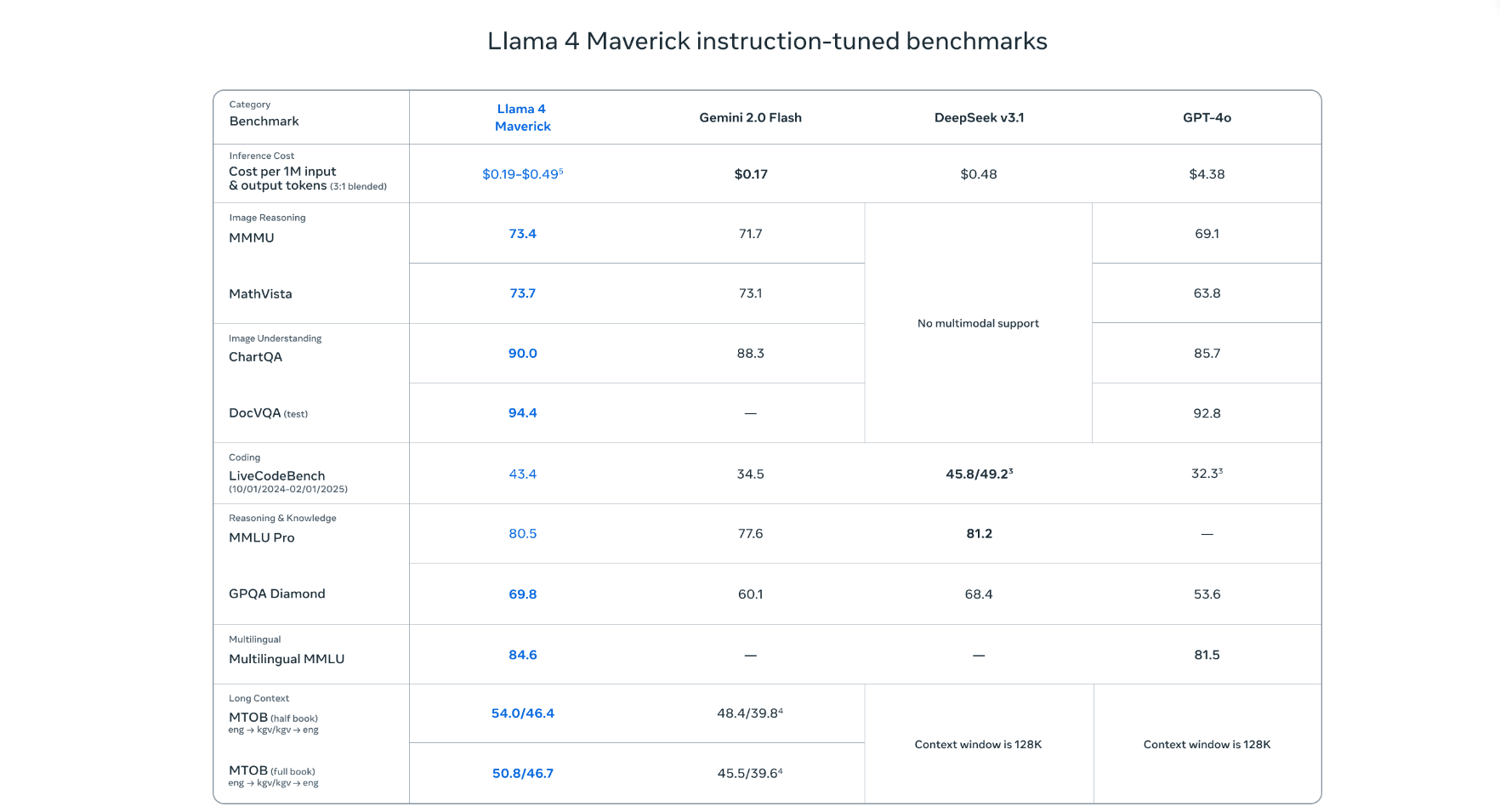
Maverick is the model to consider when Scout feels too narrow, not because Scout is weak, but because the task itself asks for more. Meta positioned Maverick as the broader high-performance model in the family, with stronger multimodal ambitions and more room for difficult reasoning, synthesis, and mixed-input work. That makes it the likely upgrade path for teams handling image-plus-text analysis, more nuanced research synthesis, or product features where the assistant must reason across more than one type of input.
The key tradeoff is serving and complexity. Maverick may appear to be a stronger general model, but the more useful lens is whether your workload benefits from that added power. In my evaluation, Maverick became easier to justify when a task combined documents, visuals, and layered instructions; when the work was plain drafting or summarization from text, Scout often looked like the cleaner choice.
What Maverick is built for
- Mixed-input workflows involving text and images
- Higher-difficulty research and analysis tasks
- Enterprise copilots where output quality matters more than minimum latency
- Creative and product workflows that need multimodal understanding
Tradeoffs to expect
- More operational overhead than Scout
- A weaker value case if your workload is mostly straight text drafting
- Less attractive for teams that care most about simple, efficient deployment
Who should choose Maverick
Choose Maverick when you already know your tasks exceed basic document understanding. If your team reviews screenshots, diagrams, creative assets, and dense text together, Maverick is the more natural fit. I would not recommend it by default for every writing workflow, but I would recommend it for research and content teams whose work is increasingly multimodal.
Behemoth
Behemoth is the easiest model in this family to misunderstand. It is the capability flagship, but not the practical access option. Meta described Behemoth as the giant model used for distillation into the released Llama 4 systems, which means its importance is real even if deploying it is unlikely. Two conclusions follow: Behemoth helps explain why Scout and Maverick are strong, and Behemoth itself remains unlikely to be directly deployable.
That distinction matters because otherwise "Llama 4" gets flattened into a single promise. It is more accurate to say that Behemoth represents the upper bound of the family’s research and training strategy. For access planning, however, it remains limited. During this review, that was the clearest mismatch between capability language and practical availability.
What Behemoth is built for
- Frontier-scale training and distillation
- Very large research and enterprise experimentation, if and when access expands
- Pushing family-level capability rather than offering the simplest current deployment path
Why most readers should not choose it now
- It is not broadly available like the released models
- There is no normal end-user route that makes it a practical recommendation today
- Even for advanced teams, planning around an unreleased or limited model is risky when Scout and Maverick already cover real production needs
Practical example
A more realistic Behemoth example is not "any company with big data." It is a top-tier lab or platform partner evaluating frontier-scale training outputs and downstream distillation strategy. For most builders, writers, analysts, and product teams, that is too far removed from day-to-day use to drive a purchasing or integration decision.

How to Get Access to Llama 4
The main thing to understand is that access depends on which model you mean. Scout and Maverick have real pathways today through Meta and partners, including Meta experiences running on WhatsApp, Messenger, Instagram, and Meta.ai. Behemoth does not belong in the same bucket. If you remember only one part of this section, make it this: released model family does not mean every named model is equally obtainable.

1) Direct Meta sources
Download Models via Llama.com
Simply go to llama.com, download models and try using them on your setup.
Developer Portal:
Register on Meta’s developer website, there you can also apply for access to the llama 4 API. If you then get approved models can be integrated into your projects directly. I would recommend to do that to get access to latest models when they come out.
Here is a link to Developer Portal to get yourself some Llama: https://developers.meta.com/
Beta Programs and Early Access:
Maybe also keep an eye on Meta’s announcements for beta testing programs. Participating in these programs can give you first access to Meta Llama 4 latest updates and features.
Official Documentation:
Use the resources available on Meta’s official press release page for guidance on accessing and using the models effectively. Keep in mind that Behemoth is still in training, while others are already in limited use.
What those sources mean in practice: if you are a developer who wants the most direct route, start with Meta's own pages for weights and API information, and treat Scout and Maverick as the realistic targets. When I checked the public materials, Behemoth was still framed as an in-training model rather than a generally available download or standard API choice. That makes it useful to follow, but not useful to plan around.
2) Cloud and partner access
Cloud Service Providers:
Llama 4 models are now being integrated with platforms like AWS, where you can access them through cloud solutions services like Amazon SageMaker. These platforms have a powerful support for large-scale uses and for enterprisecustomers.
Here is a link to AWS of Amazon that has new Llama 4 access: https://www.aboutamazon.com/news/aws/aws-meta-llama-4-models-available
Community and Third-Party Integrations:
Platforms such as Hugging Face offer some kind of access to llama 4 model weights and other resources. Explore Hugging Face’s collection for additional information.
For teams, managed cloud access is often the cleanest option because it removes much of the infrastructure work around scaling, security, and deployment. My practical read is that Scout makes the strongest case here for organizations that want predictable implementation, while Maverick is the step up when multimodal or harder reasoning requirements are central. If you want historical context on how Meta model access has evolved across generations, the SupportGPT Llama 3 resources are a useful companion read.
3) Third-party app access
Writingmate Labs
Soon, Writingmate Labs will integrate llama 4 into its all-in-one AI platform. It already has Claude 3.7 Sonnet, all previous Llamas, GPT 4o reasoning model, Mistral, and much more, all within a single interface, no API needed and with ability to switch between models at a click of a button
- Stay tuned to the Writingmate Blog for updates on when this feature becomes available.
- Writingmate also has Model Comparison feature that lets you to compare any models live, on your real tasks, see their response times and to create your own benchmark with your work load.
If you are not a developer and do not want to manage weights, endpoints, or cloud deployment, this category is the most relevant. End users usually do better with products that integrate models behind the scenes and let them compare outputs directly. In my experience, this is also the fastest way to learn whether a model is better for your tasks rather than just better on a launch graphic.
Step-by-step: the best route by reader type
Developers who want weights or API access
- Start with llama.com and Meta's developer portal.
- Check whether your target is Scout or Maverick, not just "Llama 4" in general.
- Confirm whether you want downloadable weights, API access, or both.
- Use partner hosting only if you prefer managed deployment over direct setup.
Teams that want managed cloud deployment
- Review the available partner pages first.
- Match the model to the workload: Scout for long-context efficiency, Maverick for more demanding multimodal tasks.
- Estimate deployment cost and latency before selecting the larger model by default.
- Ignore Behemoth for near-term production planning unless Meta changes its status.
End users who just want to try the models
- Use products that integrate Meta models inside an existing interface.
- Compare outputs on your own prompts instead of relying on generic benchmark claims.
- Treat Behemoth as background context, not as the model you expect to click into today.
Additional Resources for Access
Online Forums and Communities:
- Join AI communities on Reddit, LinkedIn, and other social platforms to share experiences and tips on accessing llama 4.
Workshops and Webinars:
- Look out for online events where Meta and partner organizations demonstrate the use of llama 4 and discuss practical applications.
Practical Use Cases and Examples
The most useful way to think about these models is by workflow, not by leaderboard mythology. Consider scenarios in which the differences between Scout, Maverick, and Behemoth change the recommendation.
Writing, editing, and research workflows
For writers, there is no single best model in all cases. The right pick depends on whether your work is mostly text, mostly multimodal, or blocked by context limits.
- Drafting: Scout is usually the practical first choice for drafting from notes, transcripts, briefs, or long background documents. Its long context matters more here than a marginal gain in raw model complexity.
- Editing: Scout is also often enough for structural editing, style cleanup, and turning messy source material into a usable first draft.
- Long-document summarization: Scout has the clearest edge in the family. If your job involves books, legal files, interview archives, or large research packets, the long context is directly useful.
- Research synthesis: Maverick becomes more attractive when the task includes nuanced comparison, multimodal inputs, or more difficult synthesis across sources and visuals.
- Multimodal content workflows: If you are combining text with screenshots, diagrams, images, or creative assets, Maverick is the better fit than Scout.
In my own evaluation framework, Scout is enough for most writing-heavy work until the assignment becomes strongly multimodal or meaningfully harder in reasoning. Maverick is worth the extra complexity when you need one model to interpret mixed media and produce deeper synthesis. Behemoth is not the practical choice for writing teams right now because access, not theoretical strength, is the limiting factor.
Chatbots and Virtual Assistants
Scenario: A company wants to change their customer service with an intelligent chatbot agent that will give users instant answers to simple questions and will not bother the team when not needed. Team uses Scout for quick responses and developers integrate it at their webpage with API by Meta AI. For more complex questions they can integrate Maverick to provide in-depth responses. Chatbot can also be updated based on big data received from users.
- Such actions may make customer experience a lot better and save a company a lot of money and time when it comes to a customer support team.
The more specific recommendation here is routing by task difficulty. Use Scout for FAQ handling, retrieval-backed support, and fast first responses. Escalate to Maverick only when the request includes harder reasoning or multimodal evidence like screenshots and product images. That division keeps costs and latency under control without flattening everything to the smallest model.
Data Analysis and Research
Scenario: A research team needs to analyze large volumes of data for market trends and compile detailed reports. Then they use Maverick Llama 4 model to summarize lengthy reports and extract key points. The team combines textual analysis with image-based data visualization using the multimodal capabilities.
When scaling, they Deploy Behemoth (once available) for processing very large datasets. And the team gets a lot of insights from such an approach.
A clearer version of this use case is: use Scout when the challenge is handling very large text corpora efficiently, and use Maverick when the work includes interpreting charts, screenshots, visual evidence, or more difficult multi-step synthesis. I would not design a current production workflow around Behemoth because the access story is still too limited.
Creative Projects and Multimedia Applications
Scenario: A creative studio wants to generate innovative marketing materials that blend text and visuals. It Uses Scout to quickly generate multiple creative ideas for ad campaigns.
The studio then combines Maverick’s advanced text processing with image generation capabilities, for example of Writingmate all-in-one AI chatbot, to produce a film, an animation or maybe another kind of multimedia content. Result is a marketing material output with some manual edits that make the creative vision fully realized with a lot less resources.
For this kind of workflow, Scout is ideal for rapid ideation and long-brief digestion, while Maverick is the model I would reach for once visual interpretation becomes part of the assignment. That split is more realistic than calling one model universally superior.
Compare Newest AI Models With Writingmate
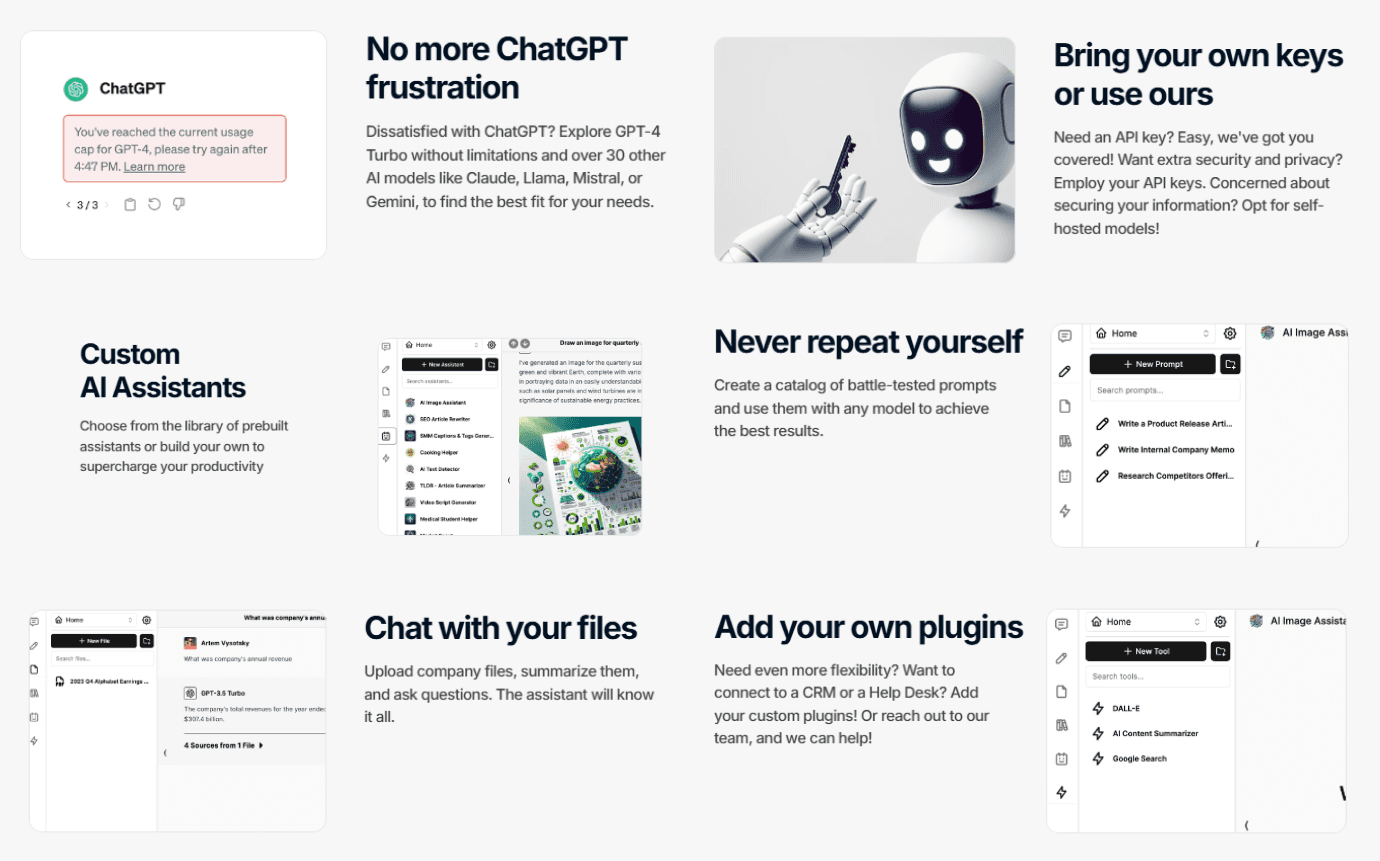
Besides giving you access to all the best AI models on the market and giving a bunch of additional features to them, Writingmate also helps to compare AI models based on your exact tasks. Let's see how it works:
Overall, if you use AI for your work tasks or you want to better integrate it into your workflow, try Writingmate. It is all-in-one AI tool in a single chatbot with one 20$ subscription, no API needed. Many of the features are also available for free. Try it here: https://writingmate.ai
For detailed articles on AI, visit our blog crafted with a love for technology, people, and their needs.
Frequently Asked Questions
Is Llama 4 Behemoth available to the public?
Not in the same practical sense as Scout or Maverick. Meta presented Behemoth as a major model in the family, but the public access story remains limited compared with the released models. For most readers, it is better treated as the distillation source and capability benchmark rather than a model they can readily deploy today.
How does Scout differ from Maverick?
Scout is the more deployment-friendly, long-context option and is easier to justify for text-heavy and document-heavy workflows. Maverick is the stronger choice when the work is more multimodal or requires deeper reasoning across more complex inputs. If efficiency and long-context handling are the priority, start with Scout. If richer multimodal analysis is central, consider Maverick.
Can I use Llama 4 through an API or cloud partner?
Yes, that is the most realistic route for many developers and teams. The official Meta developer resources and partner platforms referenced in this article are the places to check first for current API and managed deployment options. Just confirm which specific model is available through the route you choose.
Which Llama 4 model is the practical choice for writing-heavy work?
Usually Scout. It is especially strong when your writing workflow depends on long source material, large briefs, transcripts, or research packets. Maverick becomes worth considering when the assignment includes visual material or harder synthesis across mixed inputs. Behemoth is not the practical recommendation for most writing workflows right now.
Why does Behemoth matter if most people cannot use it yet?
Because it helps explain the rest of the family. Meta positioned Behemoth as the large model whose capabilities inform the released models through distillation. So even if you never deploy it directly, it still matters as part of why Scout and Maverick are competitive.
What is the safest way to choose between Scout and Maverick?
Test both on your own workload if you can. In my experience, model choice gets much clearer when you compare them on the same task: one long report, one editing pass, one research synthesis prompt, one multimodal assignment. That reveals quickly whether Maverick's added complexity is earning its keep or whether Scout already does the job.
See you in the next articles!
Artem
Frequently Asked Questions
Sources
Written by
Artem Vysotsky
Ex-Staff Engineer at Meta. Building the technical foundation to make AI accessible to everyone.

Reviewed by
Sergey Vysotsky
Ex-Chief Editor / PM at Mosaic. Passionate about making AI accessible and affordable for everyone.