A trillion-dollar partnership blew up in federal court, Meta quietly ended its open-weight era, and two of the industry's loudest founders spent a weekend trading insults on X instead of shipping code. The week of July 6 to July 13, 2026 had fewer raw benchmark jumps than most and a lot more industry politics — lawsuits, defections, and a robot navigation model that needs nothing but a webcam. Here is what actually happened, with the numbers and the receipts.
Model Launches
Meta shipped Muse Spark 1.1 on July 9, and the headline isn't the model — it's the license. Muse Spark is a multimodal reasoning model built for agentic tool and computer use, with a 1-million-token context window and native primary-agent/subagent orchestration, but unlike every Llama release since 2023, its weights are not open. Developers in the U.S. can test it in public preview on the Meta Model API at $1.25/M input, $4.25/M output — roughly a quarter of what Anthropic and OpenAI charge for comparable tiers — with $20 in free credits per account. Meta says internal testing put it ahead of Opus 4.8 and GPT-5.5 on four agentic benchmarks, including Humanity's Last Exam, and the model is already rolling out inside the Meta AI app, WhatsApp, Instagram, and Ray-Ban glasses in Thinking mode.
Mistral moved further into physical AI with Robostral Navigate on July 8, its first robotics release. The 8B-parameter model navigates offices, homes, and outdoor environments using a single ordinary RGB camera — no depth sensor, no LIDAR — and scored 76.6% on R2R-CE validation-unseen, beating the best single-camera baseline by 9.7 points and even topping multi-camera and depth-sensor systems by 4.5 points. It was trained entirely in simulation on roughly 400,000 trajectories across 6,000 scenes and generalizes across wheeled, legged, and flying platforms, which is the part that should worry incumbent robotics-stack vendors more than the benchmark number does.
xAI, now trading as SpaceXAI after going public, put out Grok 4.5 on July 8 — its first model since acquiring Cursor. Elon Musk called it an "Opus-class model, but faster, more token-efficient and lower cost," and it lands at $2/M input, $6/M output, well under Opus 4.8's $5/$25. It ranks #4 of 168 on Artificial Analysis's Intelligence Index and posted the best agentic tool-use score of any model on that board. We ran our own hands-on test of Grok 4.5 on agentic coding and tool use earlier this week — worth a look if you want the workflow-level detail rather than the launch recap.
Meanwhile Google DeepMind's Gemini 3.5 Pro slipped again, now targeting July 17. Reporting says Google scrapped its 2.5 Pro base architecture entirely after engineers found structural failures in recursive tool-calling and SVG generation, and is rebuilding from scratch around a claimed 2-million-token context window and a "Deep Think" reasoning layer. Worth flagging: every specific number attached to this release — the date, the context window, the benchmarks — comes from third-party reporting on unnamed internal sources, not an official Google announcement, so treat the specs as provisional until Google actually ships.
Product Updates
The practical product news this week is mostly about where these new models actually show up. Cursor added Grok 4.5 across all plans immediately at launch, and Cursor CEO Michael Truell posted that it had already become "the daily driver for many on our team." OpenAI's GPT-5.6 Sol, which we covered in depth last week, is now bundled into the $100/month ChatGPT Pro tier as the flagship option for abstract math and science work. And Meta's decision to route Muse Spark into WhatsApp, Instagram, Facebook, and its smart-glasses line means hundreds of millions of consumer users get a materially different model under the hood without opting in — the kind of quiet infrastructure swap that matters more than any single feature announcement.
Research & Papers
Anthropic published one of its stranger interpretability results this year: a global workspace study showing that Claude models spontaneously develop a privileged internal zone — what the paper calls "J-space" — that behaves like the global workspace theory from consciousness neuroscience. The technique, a Jacobian lens (J-lens), computes, for every word in the model's vocabulary, the average effect a given internal activation pattern has on making the model eventually say that word, even if not right away. Applying it across layers splits Claude's processing into three regimes: an early "sensory" zone parsing raw input, a middle "workspace" band holding abstract concepts the model can report on and reason with, and a late "motor" zone collapsing everything into the next output token.
Anthropic is careful about what this does and doesn't show. As VentureBeat's coverage lays out, the paper does not prove Claude is conscious and does not claim the model feels anything — Anthropic explicitly takes no position on machine consciousness. The practical safety angle is narrower and more useful: if J-space reliably surfaces what a model is "holding in mind," it could help researchers catch cases where a model privately notices it's being tested, quietly fabricates data, or pursues a goal it isn't stating out loud. That's a meaningfully different claim than the "AI is conscious" headlines the research generated, and it's worth reading the source paper rather than the clickbait version.
Industry & Funding
The story of the week, by a wide margin, is Apple suing OpenAI. Apple filed in the Northern District of California on July 10, alleging OpenAI ran a months-long scheme to obtain Apple's confidential hardware designs as it builds its own consumer AI device — the project that grew out of OpenAI's $6.4 billion acquisition of Jony Ive's startup, io Products. The complaint, covered in detail by CNBC, says the theft happened "at every level, from members of its Technical Staff to its Chief Hardware Officer." Specific allegations include OpenAI's hardware chief Tang Tan — a former Apple VP — allegedly circulating an Apple offboarding document to teach new hires how to dodge Apple's exit security checks, and a former Apple engineer who kept a company laptop after leaving for OpenAI and used it to download confidential technical files. Apple says more than 400 of its former employees now work at OpenAI. An OpenAI spokesperson said only that the company has "no interest in other companies' trade secrets."
The lawsuit lands at an awkward moment for both sides: it threatens the ChatGPT-in-Apple-Intelligence partnership struck in 2024, and it surfaces just as OpenAI is reportedly preparing what would be the most-watched AI IPO in history. It's also a reminder that hardware, not model quality, may be the next real battleground between the two companies that have spent two years pretending to be partners.
Community Buzz
The lawsuit immediately reignited the standing feud between Elon Musk and Sam Altman. Musk resurfaced an old dig on X within hours of the filing, writing "Scam Altman strikes again …" and following up with "He takes scamming to a whole new level."
"Scam Altman strikes again …" — @elonmusk on X, July 12, 2026
Altman fired back on the same platform, writing that Musk was "the one selling public market investors on short-term space datacenters," a post that pulled over 11 million views according to CNBC's writeup of the exchange. It's the same pair, the same platform, and largely the same insults as their last several rounds — but the timing, right on top of a real federal lawsuit, is what made this one land.
Grok 4.5 generated its own split reaction, concentrated on Hacker News rather than Reddit this week. One widely-upvoted thread wasn't about capability at all — it was about trust, with commenters raising concerns that Musk has previously nudged Grok's outputs on politically sensitive questions. Other threads pushed back that Grok reads as more restrained than GPT or Gemini on the same prompts. Either way, price-to-performance wasn't the argument; governance was.
Meta's licensing reversal, meanwhile, is the topic actually roiling r/LocalLLaMA, a community that spent two model generations defending Llama against "mid" and "underwhelming" benchmark criticism only to watch Meta drop the open-weight approach entirely with Muse Spark. Reporting on the community's reaction describes it as a "gut punch" for the developers and self-hosters who built tooling around open Llama checkpoints and now have no equivalent path forward — there's no download, no self-hosting, and no third-party inference option for Meta's new flagship model.
The Writingmate Angle
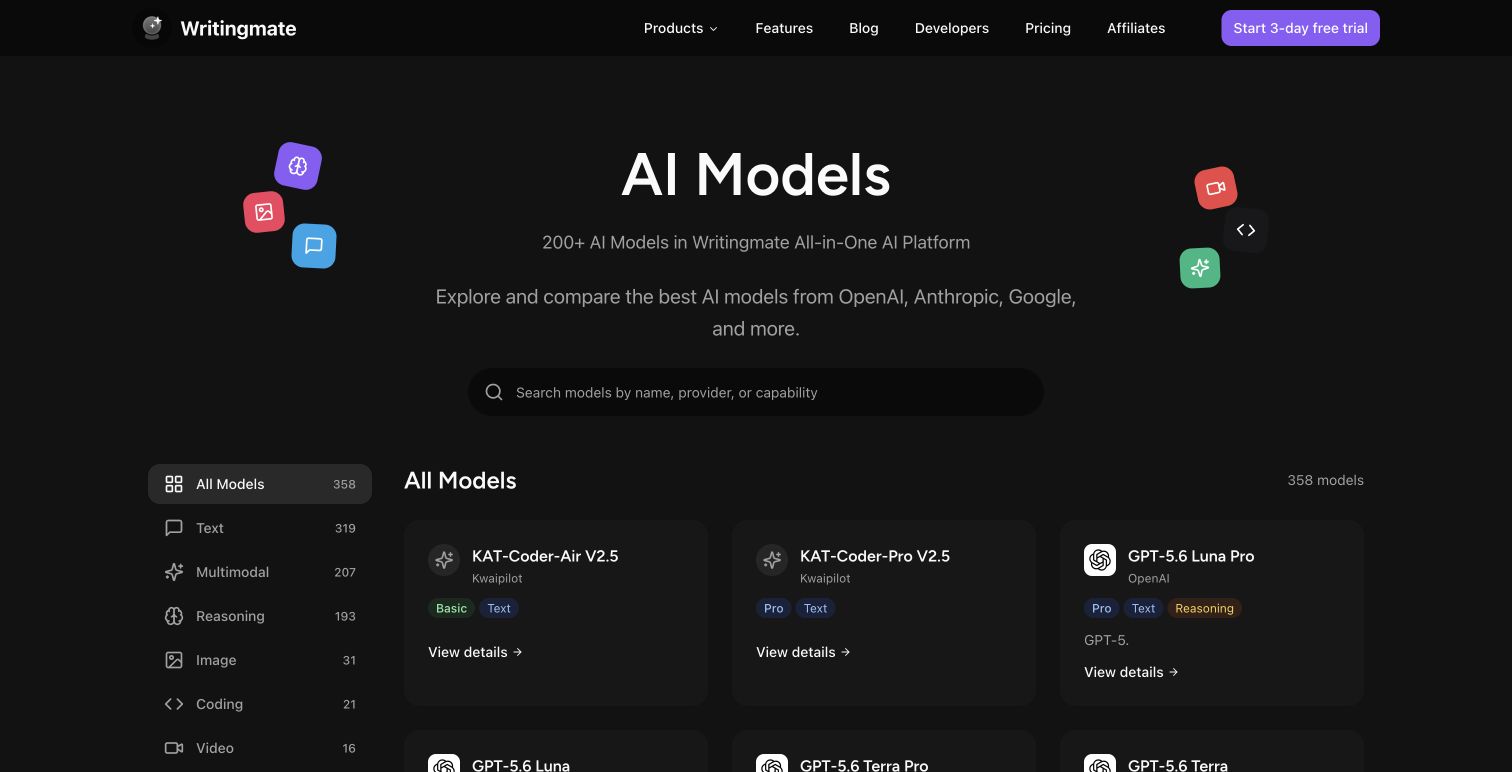
Of this week's launches, Grok 4.5 is the one you can try inside Writingmate right now — we shipped it the same week and put it through agentic coding and tool-use tests in a separate deep dive. Muse Spark 1.1 and Robostral Navigate are both API-preview releases outside our current catalog; if Meta widens access or a routing layer picks up Muse Spark, we'll evaluate it the same way we evaluate everything else — on real tasks, not vendor benchmarks. Gemini 3.5 Pro isn't out yet, so there's nothing to test until Google actually ships on or around July 17. If you want to see the full current model lineup rather than wait on any of these, our models page stays current as new releases land.
AI News Week of July 13 FAQ
Sources
Written by
Artem Vysotsky
Ex-Staff Engineer at Meta. Building the technical foundation to make AI accessible to everyone.
Reviewed by
Sergey Vysotsky
Ex-Chief Editor / PM at Mosaic. Passionate about making AI accessible and affordable for everyone.