I tested the same founder workflow across ChatGPT, Claude, Gemini, and Writingmate because “best AI app” advice gets vague fast.
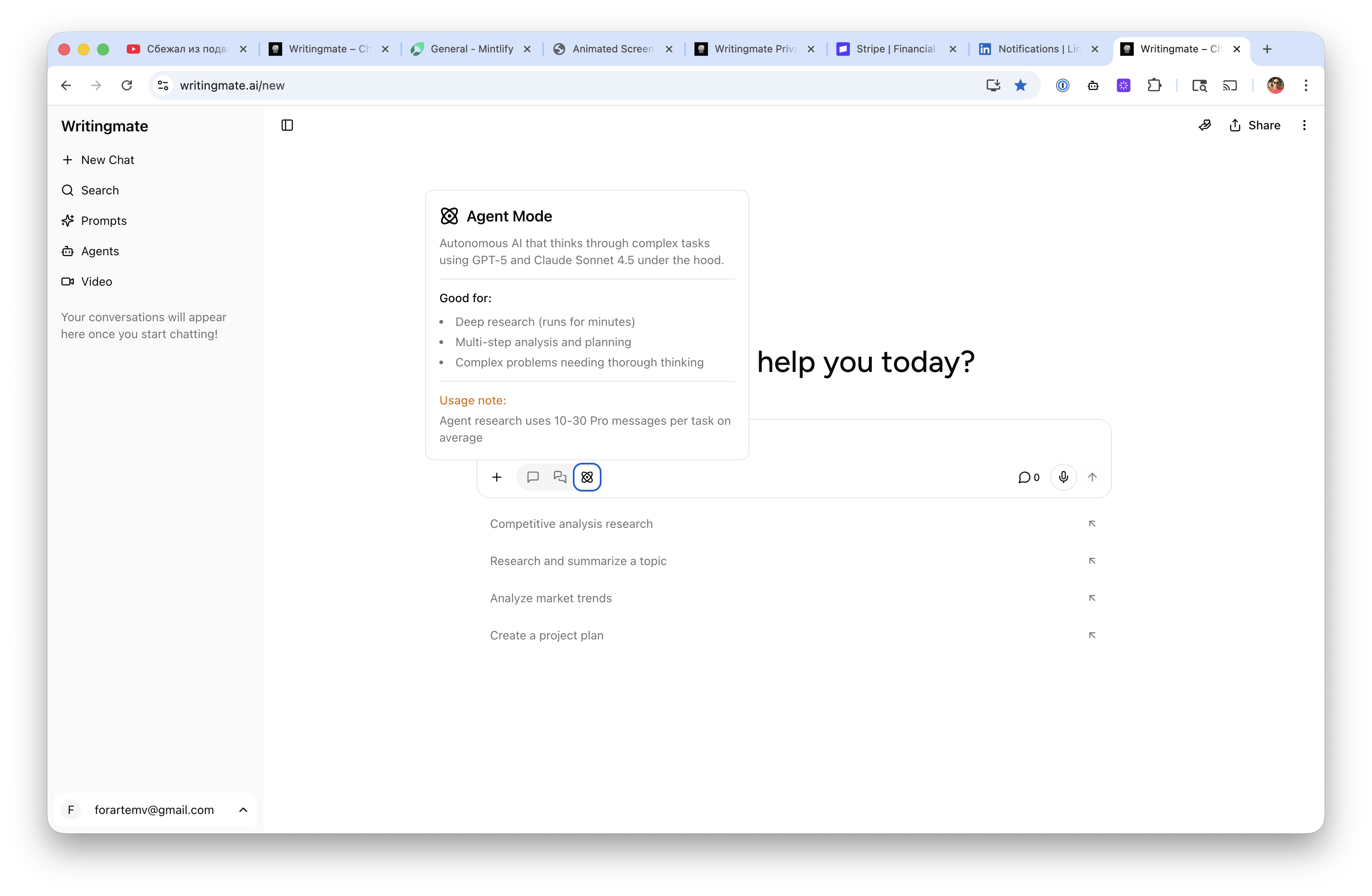
My name is Artem, and I test AI tools from the perspective of someone who has to ship real work. For this post I narrowed the question to one buyer: a founder who starts with strategy, moves into launch copy, creates visual direction, and then needs a video outline from the same source brief. That is the reader this guide is for: someone who wants fewer tabs, fewer bills, and a clearer way to finish the work.
The short version is simple: no single model won every step, so the workflow winner is the setup that lets you compare and reuse context with the least friction. If you are comparing options, start with the Writingmate vs ChatGPT Plus guide, check the model directory, compare pricing, and then look at text-to-image tools or text-to-video tools if your work moves beyond text.
"Best utilize each AI for their particular strengths." — a Reddit user discussing AI options

The exact founder workflow I tested
The source brief was a SaaS feature idea: a dashboard that shows which AI model produced the best answer for a recurring team workflow. I asked each setup to produce positioning, an email, creative direction, and a short video outline.
I did not score tools by brand awareness. I scored them by whether they helped finish the whole job: plan the work, draft the content, compare model output, create a visual direction, and turn the result into something a real person could publish or send.
The core problem with most AI comparisons is that they isolate one prompt. Real workflows do not behave that way. A founder might start with product positioning, move into customer email copy, ask for a sharper rewrite, generate a visual, then need a short video concept. Every handoff creates friction.
ChatGPT moved fastest at the start. Claude produced the cleanest long memo. Gemini was useful for structured planning. Writingmate was strongest when I wanted to compare approaches without turning the workflow into a copy-paste marathon.
Results table: which app handled each stage best?
Option | Best use | Main limitation | Why it matters |
|---|---|---|---|
Positioning memo | Claude was strongest | ChatGPT had punchier alternatives | Compare both from one brief |
Launch email | ChatGPT drafted fastest | Claude improved tone | Switch models without losing source notes |
Creative direction | Gemini-style multimodal planning helped | Text-only tools needed more prompting | Move directly into image workflows |
Video outline | Grok-style punch helped hooks | Polish still needed another pass | Use text-to-video after scripting |
Final workflow | No single winner | Different models won different stages | Reduce copying across the stack |
The result was not a trophy for one model. It was evidence that founder work is a chain, and a model-switching workspace can make that chain less brittle.
"I've tested every AI model: Claude, ChatGPT, Gemini." — @aiedge_ on X

What this means for real founder work
Broad AI app lists usually miss the part that matters: the work does not stop after one answer. A founder might need planning, writing, model comparison, images, and video in a single session. The best setup is the one that keeps that chain moving with the least rework.
For the reader, the useful question is more concrete: what breaks in your current workflow? If the problem is writing quality, test Claude. If the problem is research, test Perplexity. If the problem is using several tools in one project, test a workspace that keeps those steps together.
Writingmate is strongest when the buyer already feels the pain of using several AI tools at once. The point is not to attack ChatGPT. The point is to show when one assistant stops being enough for the full job.
Writingmate content should keep using tests like this. A direct comparison with screenshots, a table, and a source video gives the page information gain that a generic roundup cannot match.
What to check before you switch
Before you switch, check three things: whether the models you care about are available, whether the price replaces tools you already pay for, and whether the workspace supports the next output you need, such as an image, video, or reusable workflow.
If you are still unsure, compare one real task instead of reading more summaries. Run the same brief through your current setup and through the alternative, then judge which path gets you closer to something you would actually publish or send.
For workflow tests, the best next step is to repeat the test with your own work. A founder workflow, a customer email, or a product launch brief will reveal more than generic benchmarks.
My recommendation after the test
If you only ask isolated questions, use whichever assistant you like. If you ship projects, test the whole workflow. The best answer at step one may not be the best answer at step four.
The practical takeaway is consistent: if your world is mostly ChatGPT, ChatGPT Plus may be fine. If your work already crosses GPT, Claude, Gemini, Grok, images, videos, and agents, compare the whole workflow instead of one assistant.
The value of the test is that it shows the tradeoff in motion. Different models can win different stages, so the setup matters as much as the individual model.
The practical test is whether your setup helps you make a decision without opening five more tabs. If the work crosses models, files, images, videos, and agents, compare the workflow rather than one isolated answer.
Use the next page based on the question you are trying to answer. If you are choosing against ChatGPT Plus, read the comparison guide. If you need proof of model coverage, open the model directory. If the decision is budget, check pricing. If the task becomes visual, test image and video tools.
I would avoid generic listicles for my own buying decision. A short test, a comparison table, screenshots, a source video, and a clear recommendation are far more useful than ten app names with recycled descriptions.
The use case is specific on purpose. Writingmate is most useful when a ChatGPT user realizes they also need Claude-style writing, Gemini-style multimodal work, Grok-style freshness, image generation, video generation, and agents without rebuilding the workflow in separate tools.
That is a better buying moment than a vague search for AI tools. The reader is already comparing subscriptions, so the useful question is what an all-in-one workspace changes in a normal workday.
The practical test is whether your setup helps you make a decision without opening five more tabs. If the work crosses models, files, images, videos, and agents, compare the workflow rather than one isolated answer.
Use the next page based on the question you are trying to answer. If you are choosing against ChatGPT Plus, read the comparison guide. If you need proof of model coverage, open the model directory. If the decision is budget, check pricing. If the task becomes visual, test image and video tools.
I would avoid generic listicles for my own buying decision. A short test, a comparison table, screenshots, a source video, and a clear recommendation are far more useful than ten app names with recycled descriptions.
The use case is specific on purpose. Writingmate is most useful when a ChatGPT user realizes they also need Claude-style writing, Gemini-style multimodal work, Grok-style freshness, image generation, video generation, and agents without rebuilding the workflow in separate tools.
That is a better buying moment than a vague search for AI tools. The reader is already comparing subscriptions, so the useful question is what an all-in-one workspace changes in a normal workday.
The practical test is whether your setup helps you make a decision without opening five more tabs. If the work crosses models, files, images, videos, and agents, compare the workflow rather than one isolated answer.
Use the next page based on the question you are trying to answer. If you are choosing against ChatGPT Plus, read the comparison guide. If you need proof of model coverage, open the model directory. If the decision is budget, check pricing. If the task becomes visual, test image and video tools.
When you run this test yourself, pay attention to editing time. A flashy first draft can still be a poor choice if it takes twenty minutes to make usable. The winning setup is the one that gets you to a publishable result with fewer false starts, fewer repeated explanations, and fewer tabs open.
Also test the handoff into assets. A founder workflow rarely ends with text. If the launch copy needs a visual concept, a product image, or a video outline, include that in the test. That is where a tool that keeps models and media workflows near each other starts to feel different from a single chat window.
Finally, use the same source brief for every model. If you change the brief halfway through, you are no longer comparing the tools; you are comparing different instructions. Keeping the input consistent makes the result much easier to trust.
See you in the next one!
Artem
Frequently Asked Questions
Sources
Written by
Artem Vysotsky
Ex-Staff Engineer at Meta. Building the technical foundation to make AI accessible to everyone.

Reviewed by
Sergey Vysotsky
Ex-Chief Editor / PM at Mosaic. Passionate about making AI accessible and affordable for everyone.