ChatGPT can generate Anki-ready flashcards, but the quality depends far more on your notes and prompt structure than most guides admit. The workflow that worked best for me was simple: clean the source notes, ask for a strict CSV output, then import and spot-check a few cards in Anki before studying.
I’ve tested this with messy lecture notes, copied textbook summaries, and slide decks. The biggest difference wasn’t the model—it was whether the source material was organized enough for ChatGPT to turn into atomic cards instead of vague trivia. If you want fewer duplicates and less cleanup, treat ChatGPT as a card-writing assistant, not as a replacement for your source.
If you want to try the workflow with medical study material, Writingmate is one option alongside ChatGPT. For review itself, Anki works because spaced repetition consistently beats cramming; one research summary reports better learning across 254 articles and 317 experiments, and Anki’s own documentation explains how its scheduling and review data work in practice on the Anki stats page.
At first, we recommend you watch this video to understand how to create Anki flashcards using AI. The video is a simple guide on how to use ChatGPT to create Anki flashcards quickly, for medical students who want to efficiently prepare for their exams. The tutorial shows how to use this AI tool to generate study cards, helping students save time and study more effectively.
How I Evaluated This ChatGPT-to-Anki Workflow
I judged this workflow on five things: factual fidelity to the source notes, card atomicity, duplicate rate, import cleanliness, and how much manual cleanup was still needed at the end. In practice, a “good” output meant each card tested one idea, the answer stayed close to the source, and the CSV imported into the right fields without broken rows.
I also deliberately tested failure cases. I used dense notes, sparse slides, and badly pasted outlines to see where ChatGPT started filling gaps with guesses. In my experience, the workflow breaks down fastest when the notes are incomplete but written as if they were complete; the model then tries to smooth over missing context. That produces cards that look polished but are risky to memorize.
What would disqualify the workflow? A high duplicate count, vague prompts that generate broad essay-style answers, or imports that require fixing every tenth row by hand. If the output needs heavy editing, it’s usually faster to improve the source notes and rerun the prompt than to salvage a weak batch card by card.
Can ChatGPT Generate Anki Flashcards? Yes — Here's the Fastest Workflow
Yes—ChatGPT can generate Anki flashcards efficiently if you give it structured notes and ask for a plain CSV with one question and one answer per row. The fastest reliable workflow is:
- Clean your notes into short bullet points.
- Paste one chunk at a time into ChatGPT.
- Ask for atomic front/back cards in CSV format.
- Save the result as a UTF-8 CSV file.
- Import into Anki, map the fields, and preview a few rows.
That last step matters more than people think. The fastest workflow is not “paste 40 pages and pray.” The fastest workflow is the one that avoids cleanup. I consistently got better results from 300-800 words of cleaned notes per batch than from huge pasted documents. If you want the system to be useful long term, pair it with a spaced-review habit; this short spaced repetition overview from Kohru's page is a good refresher on why short, repeated reviews work.
Step 1: Prepare Your Notes
Most bad flashcards start with bad source material. Before you ask ChatGPT to write anything, turn your notes into something the model can parse cleanly.
What to clean before you paste
- Remove duplicated bullets and repeated definitions.
- Convert tables, charts, and diagram labels into plain text sentences.
- Split long lecture notes into smaller chunks by topic.
- Mark facts that must stay verbatim, such as drug dosages, staging criteria, or exact definitions.
- Delete filler like “important,” “know this,” or lecture jokes that don’t belong in cards.
Here’s the kind of cleanup that improves results immediately.
Messy notes:
- RAAS maybe starts with kidney low perfusion
- renin -> angiotensin stuff
- ACE lungs??
- aldosterone sodium water up potassium down
- same as slide 14
- blood pressure increases
- BP increases
ChatGPT-ready notes:
- Reduced renal perfusion stimulates renin release from the kidney.
- Renin converts angiotensinogen to angiotensin I.
- ACE converts angiotensin I to angiotensin II, mainly in the lungs.
- Angiotensin II increases aldosterone secretion.
- Aldosterone increases sodium and water reabsorption and increases potassium excretion.
- Net effect: blood pressure increases.
That second version gives ChatGPT a fair shot at creating clean, non-duplicative cards. When I tested rough lecture notes against cleaned bullets, the cleaned version produced fewer merged concepts and far fewer duplicate cards.
Source-prep checklist
Use this quick pass before generation:
- Deduplicate: if the same fact appears twice, ChatGPT often creates two cards for it.
- Linearize visuals: rewrite tables and figures as plain text facts.
- Chunk the material: keep each batch focused on one topic, chapter, or lecture objective.
- Flag exact wording: label anything that must not be paraphrased with a note like “keep verbatim.”
- Fix ambiguity: replace pronouns like “it” or “this” with the actual term.
When raw notes are not enough
Sometimes the problem is not formatting; it’s missing information. Sparse slides with headings like “Causes,” “Symptoms,” and “Treatment” are not enough on their own because the model will try to infer what belongs under each label. In those cases, add textbook bullets, lecture transcripts, or your own summary first. Better inputs lead to fewer hallucinations, cleaner CSV rows, and less rework after import. I’ve found that if I can’t understand the notes without the lecture in my head, ChatGPT usually can’t turn them into reliable cards either.
Step 2: Crafting the Perfect Prompts
A good Anki set has atomic cards: one fact per card, specific wording, no duplicates, and no questions so vague that several answers could be correct. If your prompt doesn’t ask for that structure, ChatGPT tends to produce broad review questions that look helpful but review badly.
Before you generate a full deck, decide what shape you want the export to take. For a basic Anki import, the model should output one row per card. A simple CSV looks like this:
What enzyme converts angiotensin I to angiotensin II?,ACE
What hormone increases sodium reabsorption in the distal nephron?,Aldosterone
If you want tags, add a third column:
What enzyme converts angiotensin I to angiotensin II?,ACE,RAAS cardiology
What hormone increases sodium reabsorption in the distal nephron?,Aldosterone,RAAS renal
Prompt template: basic front/back cards
Create Anki flashcards from the notes below.
Output as CSV with exactly 2 columns:
1) Front
2) Back

Rules:
- Make atomic cards with one fact per card.
- Write clear, specific questions.
- Avoid duplicates.
- Keep answers short unless the source requires more detail.
- Do not include headings, explanations, or code fences.

Notes:
[PASTE NOTES HERE]
Prompt template: cards with tags in a third column
Turn the notes below into Anki flashcards.
Output as CSV with exactly 3 columns:
1) Front
2) Back
3) Tags

Rules:
- One fact per card.
- No duplicate cards.
- Tags should be short and lowercase, separated by spaces.
- Use topic-based tags such as cardiology, pharm, renal, exam1.
- Do not add any text before or after the CSV rows.

Notes:
[PASTE NOTES HERE]
Prompt template: strict source-only mode
Create Anki flashcards using only the information in my notes.
Do not use outside knowledge, assumptions, or textbook additions.
If a note is incomplete or ambiguous, skip it rather than guessing.
Output as CSV with 2 columns: Front, Back.

Rules:
- Atomic cards only.
- One answerable fact per card.
- No duplicates.
- No vague prompts like "Explain" or "Discuss."
- Preserve any line marked "keep verbatim."

Notes:
[PASTE NOTES HERE]
That strict version is the one I trust most for exams. It creates fewer cards, but the hit rate is better because it stops the model from filling in missing context. If your first batch comes back too wordy, add one more line: “Limit each answer to one sentence unless the source requires a list.”
With the right prompts, Writingmate can speed up flashcard drafting for med studies. The useful part is not hype; it’s the ability to keep a repeatable prompt, generate structured CSV output, and then verify the cards before import.
Step 3: Moving Notes Into Anki
Flashcards ready? Great! Now, let's get them into Anki.
- Save the file correctly: Put the output into a spreadsheet or text editor and save it as CSV in UTF-8 encoding. This helps prevent weird character issues during import.
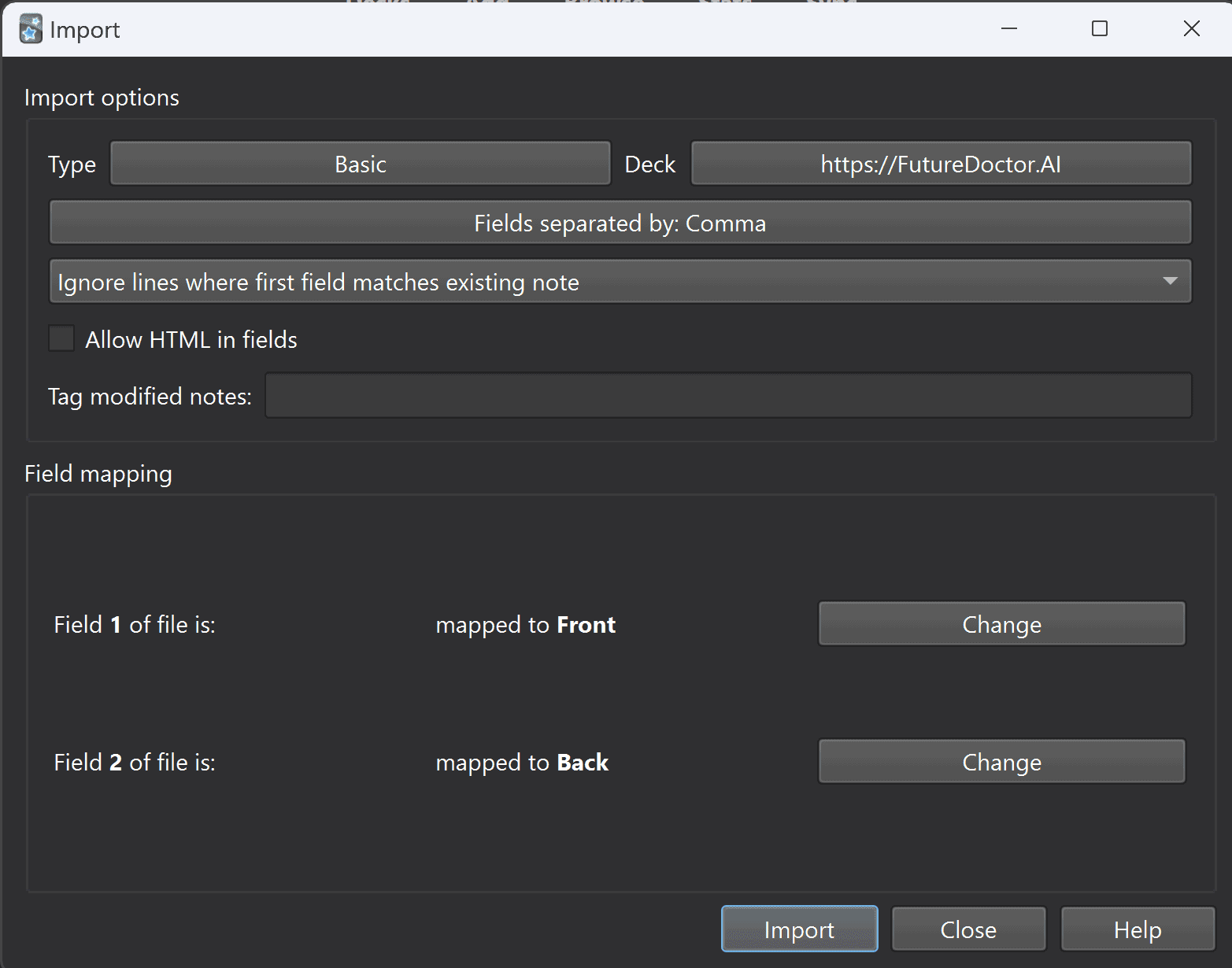
- Open Import in Anki: In Anki, go to File → Import and choose your CSV file.
- Map the fields: Make sure column 1 goes to Front and column 2 goes to Back. If you added tags, map the extra column to Tags.
- Choose the right delimiter: If your file used tabs or semicolons instead of commas, set that in the import options.
- Preview before importing: Check a few rows in the preview window so you can catch misaligned columns early.
- Verify one sample card: After import, open one card in Browse and make sure the front, back, and tags landed where you expected.
I learned this the annoying way: a CSV can look fine in a text editor and still import badly if the delimiter or encoding is off. Spending 30 seconds in the preview window is faster than deleting and re-importing 300 broken cards.
- Pick a card style: Anki's got a bunch of card styles. You can stick with the basics or mix it up with a custom style. I go for my own style, adding extra info on the back.
- Tag 'em up: If you've got a ton of cards, tags are useful once your deck grows beyond a single class unit. Ask ChatGPT to add a tag column in your CSV when you want to sort by system, exam block, or resource. If you’re importing separate subjects into one collection, you can also include a deck-name column—but only if you already know how you want the cards organized.
For the official behavior of imports, field mapping, and note types, Anki’s own importing guide is the best reference.
Common import problems and fixes
- Broken line breaks: If a single answer spills into multiple rows, clean the CSV and remove accidental line breaks inside a cell before importing.
- Columns in the wrong fields: Reopen the import dialog and remap the columns. This is common when a third tag column is present but not assigned.
- Duplicate cards: If ChatGPT repeated a fact, deduplicate the CSV before import or use Anki’s duplicate-checking tools afterward.
- Formatting issues: Quotation marks and commas inside answers can break rows if the CSV is not properly escaped. If this keeps happening, generate shorter answers or ask for tab-separated values instead.
- Weird symbols or accented characters: Re-save the file as UTF-8 and import again.
My own rule is simple: after every import, I inspect five cards in Browse before I study anything. That catches almost every structural mistake early.
Step 4: AI Tips to Boost Your Flashcards
You've got the basics down, but let's kick it up a notch. Here are some more tips to really get AI to flex its muscles for your flashcards:
- Get ChatGPT to check your work: After AI rolls out your flashcards, get it to go over them again. It can catch slips or things you might have missed. This way, you’re sure your flashcards are top-notch and you're not skipping any vital info.
- Have a chat about your cards: Stumble upon a card that’s a bit off or missing a detail? No stress. Just ask Writingmate or ChatGPT to fix it up or fill in the gaps. You’ll get flashcards that make more sense and do more for your study time.
- Jazz up your cards with media: Flashcards with pictures or videos? Yes, please. They're like a gold mine for your brain, especially with tough medical stuff.
- Turn pictures into text: Got some cool diagrams in your notes or textbooks? Use an GPT Vision OCR tool to change them into text, and boom, ChatGPT can whip up flashcards from those too.
- Ditch the doubles: If GPT gets a little overzealous and makes copies, just tell it to clean up the clones. You’ll end up with a slick, easy-to-tackle stack of cards.
Conclusion
The practical value of this workflow is straightforward: you can turn cleaned notes into Anki-ready cards faster, reduce manual formatting, and keep tighter control over what gets memorized. ChatGPT helps most when you use it to draft atomic cards from structured source material, then verify the output before import.
If you start small, use strict prompts, and preview every batch in Anki, you can build a study process that is faster than manual card writing and more reliable than dumping raw notes into a model. That advantage comes from combining ChatGPT with Anki.
Frequently Asked Questions
What does this article cover about Creating Anki Flashcards with ChatGPT: A Step-by-Step Guide?
The full workflow is: preparing notes, prompting ChatGPT for Anki-ready CSV output, importing into Anki, and fixing common issues like duplicate cards or broken columns. The goal is not just to generate cards quickly, but to generate cards you can trust and review.
How can Writingmate help with this workflow?
If you already use Writingmate, you can use the same prompting approach there: paste cleaned notes, request a strict CSV format, and review the output before importing. A key benefit is speed, but the same warning applies: better notes produce better cards.
Who is this guide useful for?
It’s most useful for students who already study from notes, slides, or textbook summaries and want to convert that material into review cards faster. It’s especially practical for content-heavy subjects like medicine, biology, pharmacology, and other courses where memory load matters.
Where should I start after reading it?
Start with one small topic, not a full semester’s notes. Clean 1-2 pages of material, use one of the CSV prompts above, and import a test batch first. That gives you a repeatable workflow without creating a huge deck you may need to rebuild.
Can ChatGPT generate Anki flashcards?
Yes. ChatGPT can generate Anki flashcards well when you give it structured notes and a strict output format. It works best as a drafting tool that converts your source into front/back cards, not as a system that invents study content from scratch.
What is the fastest way to create Anki flashcards?
The fastest reliable method is to clean your notes, generate cards in small topic-based batches, ask for CSV output, and import after previewing the rows. In my testing, this beat both manual card writing and giant one-shot prompts because it reduced cleanup time.
Is reviewing 200 Anki cards a day too much?
Sometimes yes, sometimes no. It depends on how mature the deck is, how difficult the cards are, and whether those 200 are mostly reviews or mostly new material. Two hundred simple mature reviews may be manageable; 200 new or poorly written cards usually means overload. If your retention drops or review time spikes, the problem is often card quality rather than the number alone.
Sources
Written by
Artem Vysotsky
Ex-Staff Engineer at Meta. Building the technical foundation to make AI accessible to everyone.
Reviewed by
Sergey Vysotsky
Ex-Chief Editor / PM at Mosaic. Passionate about making AI accessible and affordable for everyone.
I'm a medical student using Anki, a flashcard app that lets you import flashcards from a CSV file. My flashcards are set up with a question on the front and the answer on the back. Please create flashcards from the notes I'll attach below, covering as many topics from the notes as possible. Make sure to use only the information from my notes when creating the CSV flashcards, with the question in the first column and the answer in the second column, and avoid using any of your previous knowledge.
Frequently Asked Questions
Sources
Written by
Artem Vysotsky
Ex-Staff Engineer at Meta. Building the technical foundation to make AI accessible to everyone.

Reviewed by
Sergey Vysotsky
Ex-Chief Editor / PM at Mosaic. Passionate about making AI accessible and affordable for everyone.