GLM 5V Turbo is now available in Writingmate, and this one should not be tested like a plain text model. The interesting part is multimodal work: screenshots, diagrams, video-like inputs, and tasks where the model has to observe something before it plans what to do.
That makes the release useful for product, design, support, and engineering workflows where the prompt is not just words. If you are reviewing a UI screenshot, debugging a visual issue, or turning a video frame into an action plan, GLM 5V Turbo is the kind of model worth putting into a real comparison.
The model availability date in our feed is April 1, 2026. This article was edited on July 2, 2026 so the Writingmate links and catalog details stay current.

What changed with GLM 5V Turbo
GLM 5V Turbo is listed as a Z.ai native multimodal agent foundation model. The metadata points to image, video, and text input, with text output. That combination makes it different from GLM 5.1: this is the model to test when the prompt depends on seeing something.
In Writingmate, I would use the model page to confirm the live catalog entry and the comparison page to run it against a strong baseline. The key is to include at least one visual task. Otherwise you are testing the least interesting part of a multimodal model.
The live model entry is available on GLM 5V Turbo in the Writingmate model directory. Use it to confirm the current catalog details before you compare outputs.
GLM 5V Turbo specs at a glance
Field | GLM 5V Turbo | Reader takeaway |
|---|---|---|
Provider | Z.ai | Useful context if you already evaluate GLM models for agent workflows. |
Availability date | April 1, 2026 | The blog date follows the model feed release date. |
Context window | 202,752-token | Enough room for visual context plus detailed written instructions. |
Input | image, text, and video | Best tested on screenshots, diagrams, visual QA, and mixed-media prompts. |
Output | text | Use it for analysis, plans, QA notes, implementation guidance, and summaries. |
Pricing | $1.20 / $4.00 per 1M input/output tokens on OpenRouter | Worth comparing when visual understanding can prevent manual inspection time. |
How I would test GLM 5V Turbo
Start with a screenshot task. Give it a real UI capture and ask for three things: what the user is trying to do, what looks broken or confusing, and what change would reduce friction. A generic answer is not enough. The model should refer to visible details.
Then test a mixed prompt: image plus requirements. For example, provide a dashboard screenshot and ask it to write QA notes, identify layout risk, and suggest copy changes without redesigning the whole page. That checks whether it can observe, prioritize, and stay inside scope.
- Screenshot test: identify visible UI problems and propose specific fixes.
- Diagram test: explain a workflow chart and list missing edge cases.
- Video/frame test: summarize what changes over time and what action should follow.
- Agent-planning test: turn visual observations into a step-by-step task plan.
For GLM 5V Turbo, the pass/fail test is visual grounding. If the answer could have been written without looking at the image, the model did not earn its place.
For a fair comparison, keep the prompt, files, temperature, and requested format the same. Change only the model. Then compare correctness, formatting, uncertainty handling, and how much editing the answer needs before it is usable.
Where GLM 5V Turbo fits against alternatives
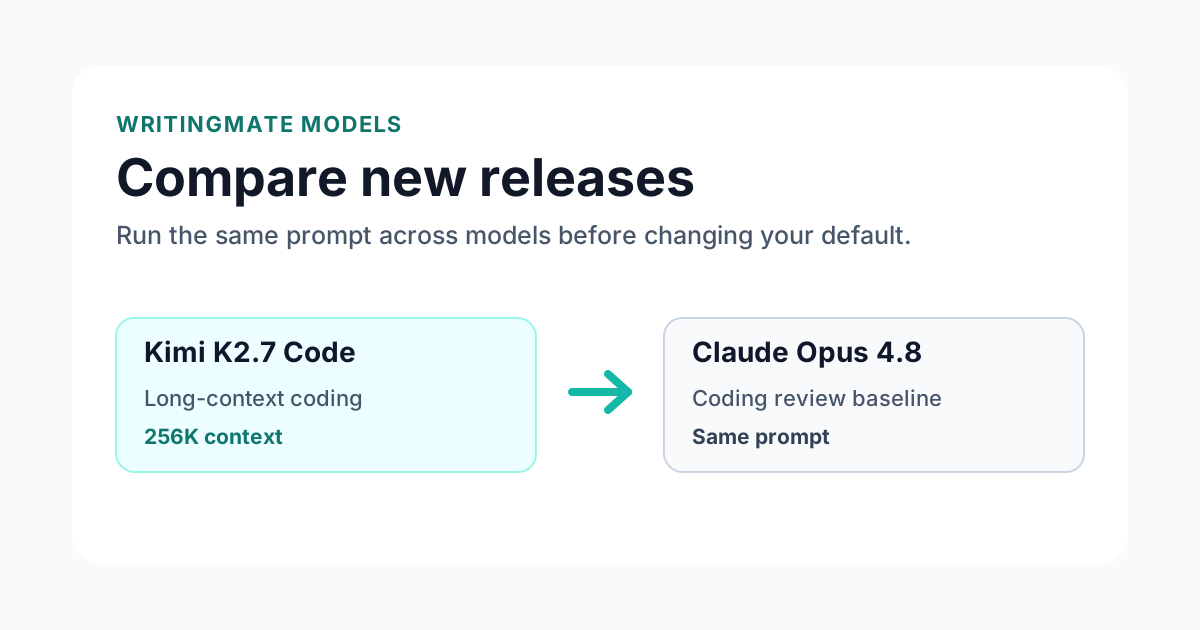
Compare GLM 5V Turbo against another multimodal model, not a text-only baseline. For pure code planning, GLM 5.1 or Kimi K2.7 Code may be the cleaner test. For screenshot-driven work, GLM 5V Turbo gets a fairer chance.
If it wins, save it for the visual jobs where it actually helps: UI review, image-aware support, diagram explanation, and multimodal planning. Do not use it as your default for every text prompt just because it can handle images.
Open the Writingmate comparison page to run the same prompt against a concrete baseline. A complete comparison URL is better than a vague instruction to "try another model" because it gives you a repeatable starting point.
Best use cases for GLM 5V Turbo
Start with jobs where the model has a realistic chance to outperform your current default:
- Screenshot and UI analysis
- Vision-based coding and QA notes
- Diagram or video understanding before planning
- Multimodal agent workflows
After that, test failure modes. Ask for strict formatting. Ask for a second pass. Give it incomplete context and see whether it asks a useful question or guesses. Those behaviors matter more in daily work than a single polished demo answer.
A practical evaluation checklist for GLM 5V Turbo
Before I recommend any new model inside Writingmate, I want it to clear a practical checklist. The checklist is intentionally boring because boring tests catch the problems that show up in real work. First, the model has to follow the exact output format. Second, it has to use the source material instead of paraphrasing the prompt. Third, it has to say what it is uncertain about. Fourth, it has to improve when you ask for a second pass. Fifth, it has to be worth its price compared with the model you already use.
For GLM 5V Turbo, I would start with a UI screenshot review and a visual bug report. Those are concrete enough to expose shallow reasoning, but common enough that the result matters. If the model gives you a generic answer, that is useful information. If it asks one clarifying question, preserves constraints, and gives you a plan you can execute, that is a stronger signal than a leaderboard score.
The comparison page matters here because you can keep the prompt identical. Open the Writingmate comparison page, paste the same task into both sides, and score the outputs with a simple rubric: correctness, completeness, formatting, uncertainty, and edit time. I care most about edit time. A model that sounds impressive but still needs twenty minutes of cleanup is less useful than a quieter model that gives you a clean answer in the format you asked for.
Test | What to watch | Pass signal |
|---|---|---|
Format control | Can it follow table, JSON, or bullet constraints? | The answer matches the requested structure without extra narration. |
Source use | Does it cite or reuse details from the supplied context? | It references specific facts from the input instead of guessing. |
Revision | Does the second pass improve the first? | It tightens the answer without dropping important caveats. |
Failure behavior | What happens when context is missing? | It asks or states uncertainty instead of inventing details. |
What I would not use GLM 5V Turbo for yet
New model releases are easy to over-promote, so it is worth saying where I would be careful. I would not immediately use GLM 5V Turbo for irreversible customer-facing work, unattended production code changes, legal or medical conclusions, or any workflow where you cannot review the output. Even strong models still need a human checkpoint when the cost of a mistake is high.
That does not make the release less useful. It just means the right rollout is staged. Use it first for drafts, analysis, planning, or review. Keep your current default for the work where reliability is already proven. Then move the model into higher-risk workflows only after it wins on your own prompts several times. For GLM 5V Turbo, the value comes from visual context, so include an image or video-derived frame in at least one test.
One more practical note: compare models by job, not by brand. A model can be excellent for multimodal agent workflows and still be the wrong choice for a short marketing caption or a sensitive support reply. The best Writingmate workflow is not one model everywhere. It is a small set of trusted defaults, each attached to the job where it consistently performs well.
How this fits into a real Writingmate workflow
The workflow I would use for GLM 5V Turbo is deliberately narrow at first. Pick one repeatable job, not ten. For this model, the best starting lane is visual or multimodal tasks where screenshots and text need to be understood together. Run the same prompt three times over a week, ideally on real work rather than demo material. If the model saves time on the second and third run, then it has earned a place in your saved workflow.
Here is a concrete example: upload a UI screenshot with component notes, then ask for likely layout causes and the smallest code change. After the first answer, do not stop. Ask for a critique of its own output, then ask for a smaller version that preserves only the parts you would actually use. This second-turn behavior tells you whether the model is merely fluent or genuinely controllable. In my experience, controllability is the difference between an impressive launch and a model you keep using after the announcement fades.
Inside Writingmate, I would save the winning prompt as a reusable pattern only after the comparison is done. That keeps the model release from turning into clutter. The model page gives you the catalog facts, the comparison page gives you side-by-side evidence, and the saved prompt becomes the operational version of what you learned. That is the path from release note to actual workflow.
Bottom line
GLM 5V Turbo is worth testing when the work starts with something visual. Use it on screenshots, diagrams, or video-like inputs, then compare whether its observations are specific enough to save real review time.
Frequently Asked Questions About GLM 5V Turbo
Sources
Written by
Artem Vysotsky
Ex-Staff Engineer at Meta. Building the technical foundation to make AI accessible to everyone.

Reviewed by
Sergey Vysotsky
Ex-Chief Editor / PM at Mosaic. Passionate about making AI accessible and affordable for everyone.