Writingmate has added KAT-Coder-Air V2.5 as a text-first option for sustained engineering work: coding plans, repository analysis, implementation notes, and long-horizon tasks.
The model description points toward work that continues across multiple steps. That makes it interesting for developers and technical teams, but only if it can stay grounded in instructions instead of producing an ambitious plan that drifts from the actual code.
KAT-Coder-Air V2.5 is available in the Writingmate catalog as of July 10, 2026. Treat that as the starting point for evaluation, then confirm the live model page before relying on it for daily engineering work.
What changes for coding workflows
KAT-Coder-Air V2.5 is listed as a Kwaipilot model focused on coding capability and long-horizon task execution. KAT-Coder-Air V2.5 is published by Kwaipilot. The important detail for readers is that this is the model to test where text-only models can still win: planning, code review, repository explanation, and careful step-by-step execution.
In Writingmate, the model page gives you the live catalog entry, while the comparison page lets you run KAT-Coder-Air V2.5 against another current model with the same prompt. That side-by-side view is the fastest way to learn whether it improves your actual workflow.
The live model entry is available on KAT-Coder-Air V2.5 in the Writingmate model directory. Use it to confirm the current catalog details before you compare coding outputs.
KAT-Coder-Air V2.5 specs for engineering tests
Field | KAT-Coder-Air V2.5 | Reader takeaway |
|---|---|---|
Provider | Kwaipilot | Useful if you already test this model family for coding or agentic workflows. |
Availability date | July 10, 2026 | Available in the catalog as of July 10, 2026. |
Context window | 250K tokens | Enough room for larger specs, logs, and source excerpts. |
Input | text | Use text prompts, source excerpts, logs, and written requirements; do not judge it on image tasks. |
Output | text | Best suited for plans, code, review notes, summaries, and structured answers. |
Pricing | $0.15 / M tokens input / $0.60 / M tokens output | A cost-sensitive signal if it performs well on repeated coding tasks. |
A text-first engineering trial for KAT-Coder-Air V2.5
Start with a text-only engineering task. Paste a feature request, a relevant module, and a list of constraints. Ask the model to produce a risk-ranked plan before writing any code. If it skips constraints or invents missing context, do not promote it yet.
Next, test long-horizon discipline. Ask for a multi-step implementation plan, then follow up with a requested change that conflicts with one of the original constraints. A useful model should catch the conflict or explain the tradeoff instead of blindly complying.
- Planning test: feature brief plus constraints, with no code allowed in the first answer.
- Code review test: identify risky assumptions in a source excerpt.
- Debugging test: explain a log trail and propose the smallest likely fix.
- Consistency test: change one requirement in a follow-up and see whether the model preserves prior constraints.
For it, I would judge patience more than flash. A strong answer should preserve constraints, ask when context is missing, and avoid pretending it saw files you did not provide.
For the comparison to mean anything, use the same bug report, files, constraints, and requested patch format for both models. Then judge the result by whether this release found the root cause, respected the constraints, and wrote a test that would catch the regression.
Where the model fits against coding alternatives
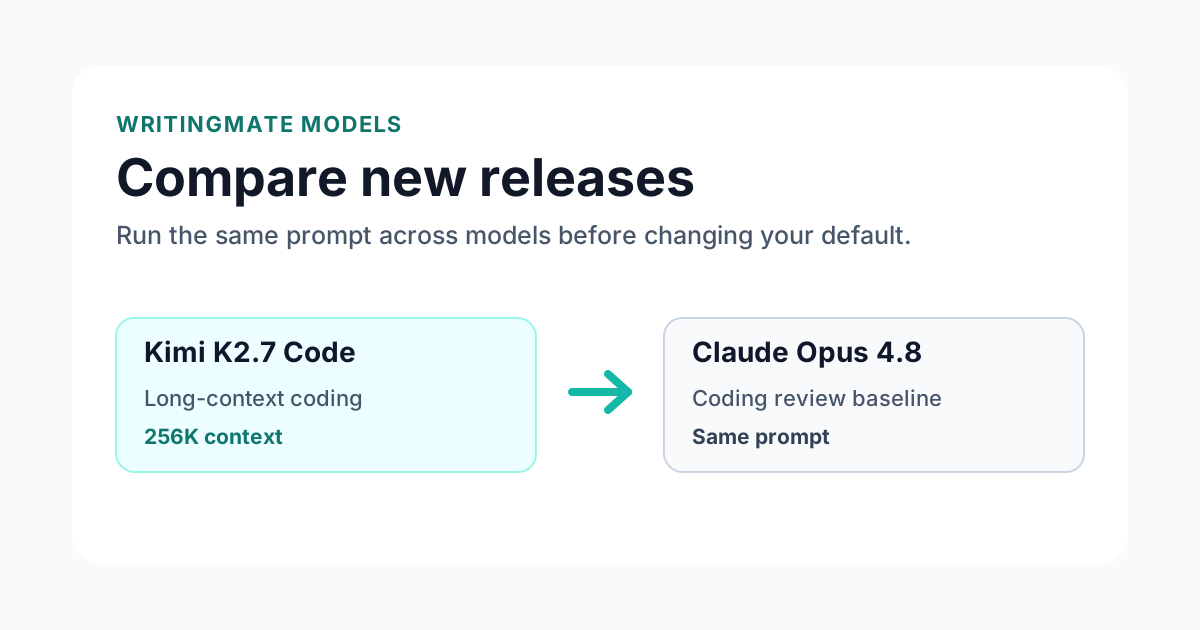
Compare it against GPT-5.5 or another model you already trust on the same text-only engineering prompt. If the task depends on screenshots, choose a multimodal model instead. Keeping the test aligned with the model input type makes the result fair.
If this release wins, it will probably win on cost-sensitive coding plans, long text analysis, or structured implementation notes. If it ties your current default, keep the default until it shows a clear advantage.
Open the Writingmate comparison page to run the same engineering prompt against GPT-5.5, a strong baseline for coding review and planning. A complete comparison URL gives you a repeatable starting point instead of a vague instruction to try another model.
Best engineering tasks for the model
Use it first on engineering tasks where the result can be reviewed quickly:
- Long text-based coding plans
- Repository analysis from pasted source excerpts
- Engineering task breakdowns
- Cost-sensitive technical drafting and review
After that, test failure modes that matter in engineering work: invented APIs, missed edge cases, overbroad patches, and code that ignores a stated constraint. This release only belongs in the workflow if it fails in ways your team can catch and correct quickly.
How to evaluate the release in Writingmate
The practical way to test this release is to start from the Writingmate models catalog, open the model, and run the same prompt against at least one nearby alternative. Keep the task narrow: a real support reply, a code review, a data summary, or a document rewrite usually reveals more than a generic benchmark prompt. Then compare the answer for structure, factual discipline, latency, and how much editing it still needs before it can ship.
For teams, the comparison page is the safer default because it keeps model choice tied to a specific workflow instead of a headline. Save the winner only after it performs well on the prompts your team repeats every week. That makes the release useful for day-to-day work without turning every new model announcement into a manual migration project.
Bottom line
It is worth testing as a text-first coding and planning model. Judge it on constraint handling, long-context discipline, and practical implementation notes rather than visual or multimodal prompts.
Frequently Asked Questions About KAT-Coder-Air V2.5
Sources
Written by
Artem Vysotsky
Ex-Staff Engineer at Meta. Building the technical foundation to make AI accessible to everyone.

Reviewed by
Sergey Vysotsky
Ex-Chief Editor / PM at Mosaic. Passionate about making AI accessible and affordable for everyone.