



You finally got a great image out of Perchance AI. Sharp enough for a YouTube thumbnail, unique enough for a merch design, clean enough to drop into a client deck. Then, somewhere between saving the file and deploying it, a small but important question surfaces: wait — am I actually allowed to sell this?
My name is Artem, and I run the Writingmate blog. We track AI tools professionally, and I've been using image generation models daily since mid-2023 — everything from early Stable Diffusion experiments to the current generation of frontier models. The licensing question around AI-generated images is one of the most practically important things creators get wrong, and almost every "perchance ai image generator" guide skips it entirely because output quality comparisons are more exciting to screenshot. This one won't skip it.
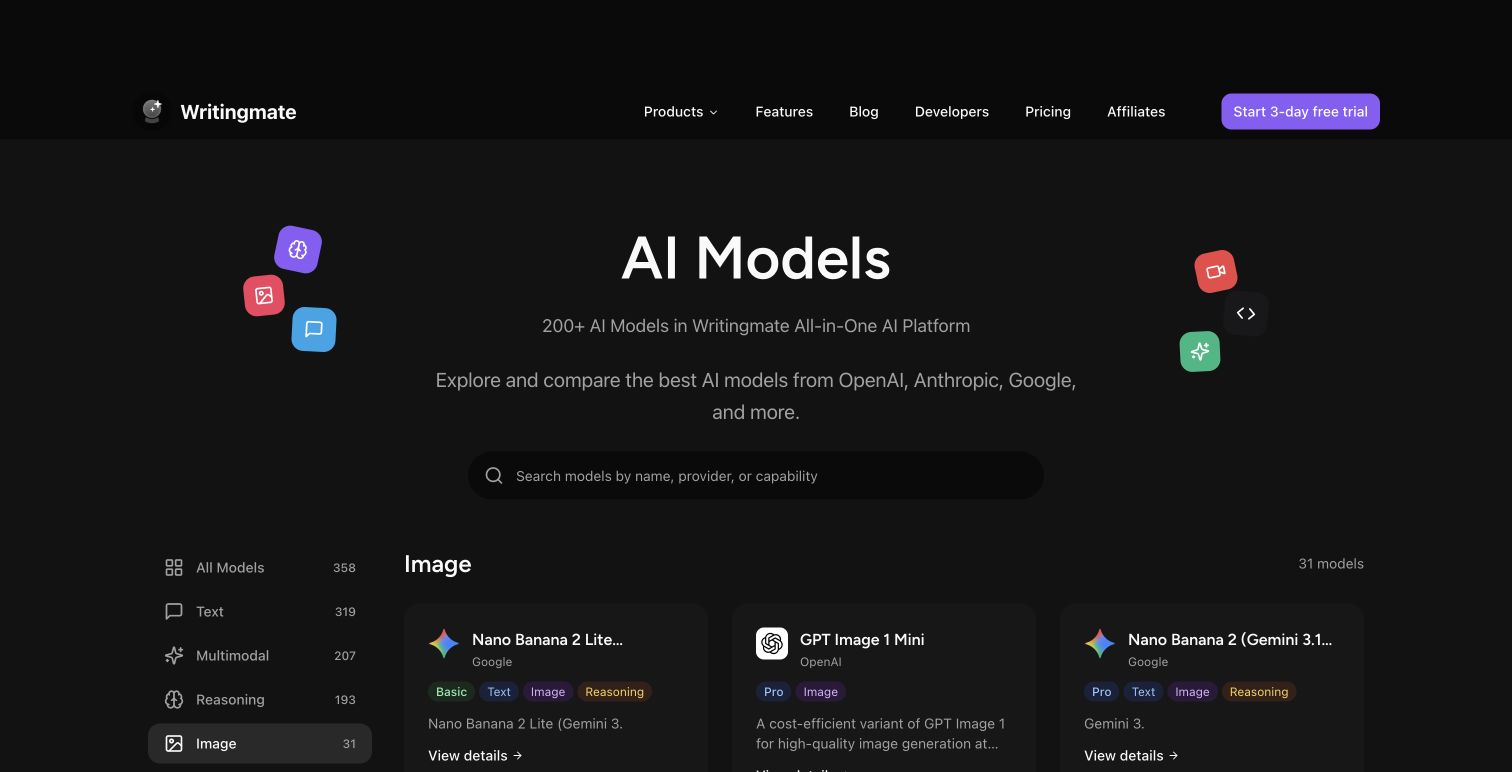
Here's what you'll get from this article: a clear explanation of what Perchance AI's commercial situation actually looks like, why it's murkier than it appears, how the major alternative models handle commercial rights, and how the Writingmate image models directory gives you a practical shortcut to the commercially-safe options. By the end, you'll have a clear framework for knowing when free is fine and when you need to switch to an API-backed tool.
What Perchance AI Actually Says About Commercial Use — and Why It's Complicated
Perchance AI is a browser-based image generator that requires no account, no payment, and no waiting for an invite. You type a prompt, hit generate, and you get an image. That zero-friction experience is genuinely useful — it's why Perchance keeps showing up in searches like "perchance ai image generator" and "perchance image generation" despite being a community tool rather than a commercial product.
But here's the issue: Perchance.org is a platform hosting community-built generators. Those generators run on open-weight models contributed by community members, hosted on shared GPU instances. The licensing terms for your output depend on which underlying model a specific generator happens to be running — and Perchance's interface rarely shows you that information upfront. There's no obvious "powered by FLUX.1 [dev] — non-commercial only" label when you click generate.
Why does the underlying model matter? Because open-weight AI models ship with explicit licenses, and those licenses differ dramatically even within the same model family. FLUX.1 [dev] — one of the highest-quality open checkpoints available, and likely what powers many of the better Perchance generators — carries a non-commercial license. Using images generated from FLUX.1 [dev] in anything you're paid for technically violates that license. FLUX.1 [schnell], the faster lighter variant, uses Apache 2.0 and is commercially usable. FLUX.1 [pro] is the commercial API tier from Black Forest Labs. Same family, three completely different outcomes for your rights.
This ambiguity is the core problem with Perchance for commercial work. It's not a knock on the platform itself — Perchance is a community tool, not a licensed commercial image service, and it's excellent for what it is. But if you're generating assets you plan to monetize, the unclear provenance of which model you're actually using is a real liability.
"I've been using Perchance for months for concept art and never once thought about licensing. Then a client asked for IP ownership documentation and I realized I had no idea what model was running the generator I used. Had to go back and redo everything through a proper API. Expensive lesson." — u/pixel_craft_studio on r/artificial
How Major AI Image Models Actually Handle Commercial Licensing in 2026
The good news: the licensing landscape across major image generators has clarified considerably over the past eighteen months. The common pattern is consistent — free tier means personal use only, paid or API tier carries commercial rights. Here's the full breakdown as of June 2026:
Model / Platform | Commercial Use? | How to Access Commercially | Key Restrictions |
|---|---|---|---|
FLUX.1 [schnell] | Yes (Apache 2.0) | Run locally or via official API | Attribution recommended; no platform restrictions |
FLUX.1 [dev] | No | Research and personal use only | Commercial use requires upgrading to Pro tier |
FLUX.1 [pro] | Yes | Black Forest Labs API or Writingmate | Per-image API pricing applies |
GPT-5 Image (OpenAI) | Yes | OpenAI API or ChatGPT Pro plan | Copyright ownership varies by jurisdiction |
Stable Diffusion 3.5 | Yes (paid tiers) | Stability AI API | Free tier restricts commercial use |
Midjourney | Yes (Standard plan+) | Standard plan or higher subscription | Basic plan is non-commercial only |
Ideogram 3 | Yes (paid tiers) | Ideogram subscription or API | Free tier has commercial restrictions |
Nano Banana Pro | Yes (via API) | Google API or Writingmate | Standard API output ownership terms apply |
Perchance AI (free) | Unclear | Depends on underlying community model | No consistent licensing disclosure; varies by generator |
The through-line is consistent: every major image model restricts commercial use at the free tier. When you pay for API access or a commercial subscription, you're not just paying for better quality or faster generation — you're explicitly buying the right to use the output commercially. That distinction is built into the business model of every provider in the table.
Perchance sits in the "unclear" column because it's an aggregator of community-contributed generators rather than a direct service with uniform licensing. That's fine for personal use. For commercial work, "unclear" is a category you don't want to be in.
"Quick PSA for AI creators: FLUX dev, schnell, and pro have completely different commercial licenses. A lot of free tools run FLUX dev because it's the highest quality checkpoint available openly — but that doesn't mean you can sell those images. Cost me a print-on-demand takedown to learn this." — @aiartlicensing on X
Using the Writingmate Image Models Directory for Commercially Safe Generation
This is where the Writingmate image models directory becomes practically useful beyond just output quality comparisons. When you generate through Writingmate, you're accessing models through their official commercial API endpoints — not community-shared instances with opaque model provenance. The commercial terms of each underlying provider apply cleanly, and you're using the commercially-licensed tier by default.
As of June 2026, the directory includes FLUX.1 Pro, GPT-5 Image, Nano Banana Pro, Stable Diffusion 3.5 Large, Ideogram 3, and several specialized fine-tunes. You can switch between them in a single session — testing FLUX.1 Pro for a product shot and GPT-5 Image for an editorial illustration without leaving the platform or managing separate API keys.

For commercial projects, here's a quick practical map of which model to reach for based on the type of work:
- Product photography and e-commerce mockups: FLUX.1 Pro or Nano Banana Pro. Both handle photorealistic product detail well and have clean commercial terms via API. Nano Banana Pro has a slight edge on color accuracy and material rendering.
- Illustrations with readable text — logos, posters, banners: FLUX.1 Pro without question. Text-in-image capability is where FLUX genuinely leads the field in 2026. No other model in the directory comes close on this specific task.
- Character design and concept art: FLUX.1 Pro with a detailed style prompt gives the most control over specific character appearance. For anime and illustrated styles, look for the specialized fine-tunes in the directory — that's the closest equivalent to what Perchance AI Jellymon generators provide, but with explicit commercial rights.
- Marketing and social media content: GPT-5 Image's instruction-following is unusually precise — if your brief is specific about composition, placement, and subject, it follows those constraints more faithfully than most alternatives. Good for campaign creative where you need the output to match a detailed spec.
- Print-on-demand and merch designs: Any of the above, but stick to the API-backed models on Writingmate. For work you'll sell long-term, the clear IP chain matters more than the cost difference — and at typical print volumes, the per-image cost difference between Perchance (free) and API generation (fractions of a cent) is negligible anyway.
A Practical Framework: Four Questions That Tell You Whether You Need a Commercial Tool
Here's the honest take: if you're experimenting, learning prompting, or generating images for personal projects with no money involved, Perchance AI is genuinely fine. I've used it myself for quick concept tests when I don't need to keep the output. The friction-free access is a real advantage for pure experimentation.
But the moment money enters the picture, the calculation shifts. Four questions that clarify it fast:
- Will this image appear in anything you're paid for? Client deliverables, sponsored posts, paid content — all commercial use, even if you're not selling the image directly.
- Are you selling or licensing this image? Print-on-demand, digital downloads, stock imagery — definitively commercial use that requires explicit commercial rights.
- Is this a brand asset? Logos, style guides, brand kit elements — if the image is going to represent a business, you want a clean IP chain behind it.
- Will you ever need to prove your rights to this image? Contract situations, trademark applications, investor materials — a generated image with unknown model provenance is a weak position to defend.
A yes to any of these means Perchance is the wrong tool. Not because the output quality is bad — for some styles, it's perfectly adequate — but because the licensing chain is too murky to build commercial work on top of.
The cost math also works out better than most people expect. FLUX.1 Pro through Writingmate runs a fraction of a cent per image at standard resolution. For a typical commercial project — say, thirty product shots or a month's worth of social media creative — the API cost is a few dollars. Compare that to the risk and rework cost of discovering your assets have a licensing problem after you've built a campaign around them, and the calculus is straightforward.
Practical Habits That Protect You Regardless of Which Tool You Use
Even with commercially-safe tools and explicit API access, a few habits are worth building from day one.
Keep generation logs. Most API platforms, including Writingmate, maintain an image history. Don't delete it. If a licensing question ever comes up — unlikely but not impossible — you need to be able to show which model, which version, and which subscription tier generated the image. The log is your paper trail.
Screenshot your subscription tier when generating for significant commercial work. Provider terms change over time. If you're generating assets for a product or campaign that will run for years, document the subscription level you were on at generation time. Thirty seconds of documentation now is potentially hours of headaches avoided later.
Read the output ownership clause, not just the license type. Some platforms retain rights to outputs generated through their service — this is relatively rare among the major providers but worth checking. OpenAI, Black Forest Labs, and Stability AI all have explicit "you own the output" language in their commercial API terms. Make sure any platform you commit to for long-running commercial work has the same clarity.
Understand the model versus the platform. When you use FLUX.1 Pro through Writingmate, your commercial rights derive from Black Forest Labs' API terms — Writingmate is the access layer, not the licensor. This is normal for API aggregators, but it means that if BFL updates their terms, you need to know about it. Following the model providers' official channels is worth doing if image generation is a regular part of your commercial workflow.
For Perchance specifically: if you love a particular community generator and want to use it commercially, trace which base model it's running and check that model's license directly. If it's FLUX.1 [schnell] or another Apache 2.0 checkpoint, you may be fine. If it's FLUX.1 [dev] or a model with an ambiguous license, switch to the Pro API tier for commercial outputs. The Perchance community often documents which models specific generators use — it just takes a few minutes to find that information.
The bottom line: Perchance AI image generation is excellent for exploration, experimentation, and personal projects. For commercial work — anything where money, contracts, or brand reputation is involved — the Writingmate image models directory gives you access to the right models through their official commercial APIs, with none of the provenance ambiguity that makes community tools risky for business use. The quality is better, the rights are clear, and the cost difference at typical commercial volumes is smaller than most people assume.
See you in the next one!
Artem
Frequently Asked Questions
Sources
- Writingmate image models directory
- Black Forest Labs — FLUX model licensing documentation
- OpenAI — Image generation usage policies and commercial terms
- r/artificial — Community discussion on AI image licensing and commercial use
- X (Twitter) — AI art licensing discussions and creator community
- u/pixel_craft_studio on r/artificial
Written by
Artem Vysotsky
Ex-Staff Engineer at Meta. Building the technical foundation to make AI accessible to everyone.

Reviewed by
Sergey Vysotsky
Ex-Chief Editor / PM at Mosaic. Passionate about making AI accessible and affordable for everyone.