Two new AI video models showed up in my model list this week within about 48 hours of each other, and I nearly missed both of them. Alibaba's Wan 2.7 and ByteDance's Seedance 2.0 (plus a faster Seedance 2.0 Fast variant) quietly landed on OpenRouter, and neither one came with the kind of launch-day noise you'd expect for a real jump in video generation quality. No splashy keynote, just a new entry in the catalog and a handful of early demo clips floating around social media.
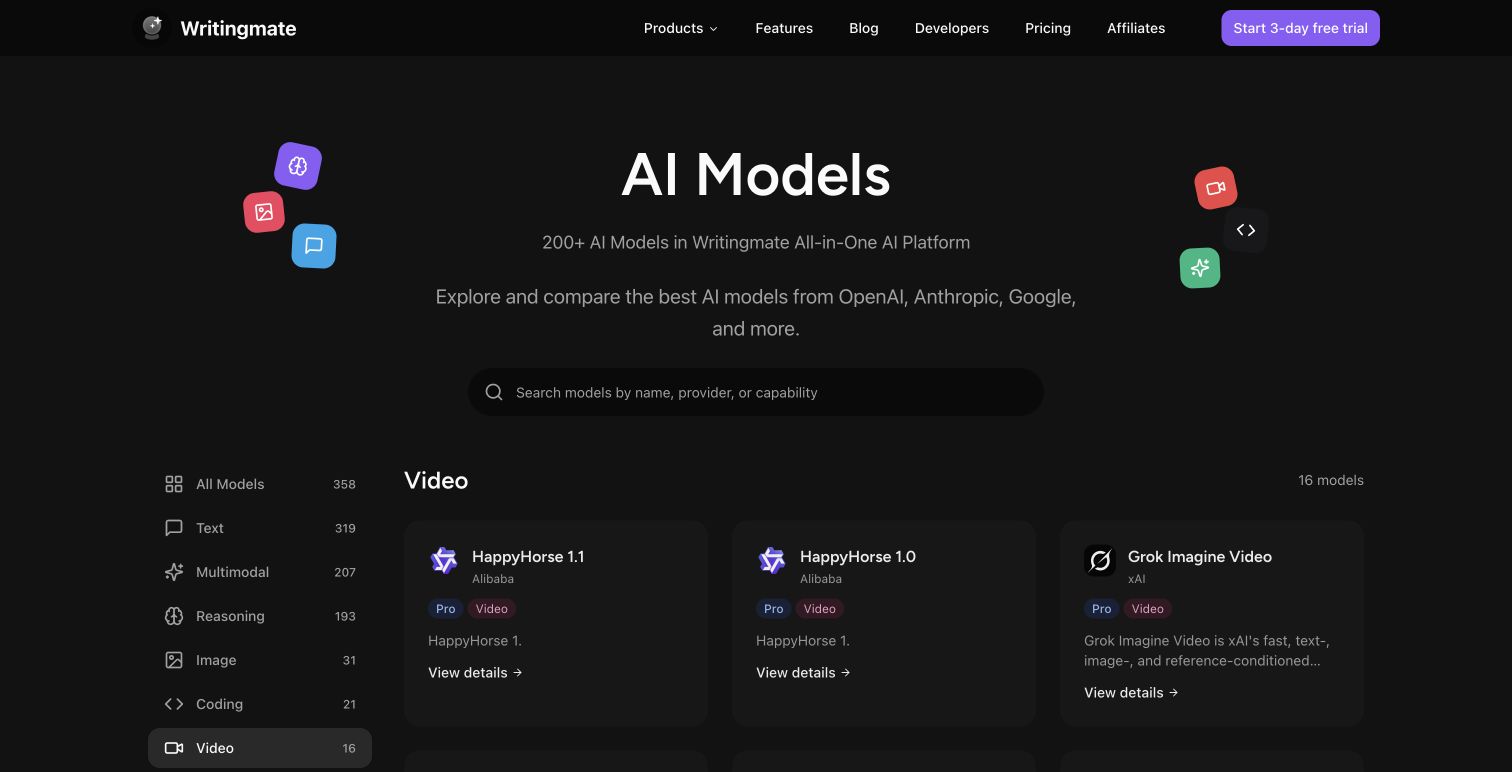
My name is Artem, I run the Writingmate blog, and testing new video and image models the day they show up is basically half my job at this point. So I did what I always do: I stopped reading other people's takes, pulled both models into our text-to-video tool, and ran the same three prompts I use for every new video release — a product demo, a fast-cut social clip, and a cinematic b-roll shot. Here's what actually came out the other end, and where each model earns a real spot next to the video generators you probably already default to.
What Wan 2.7 and Seedance 2.0 Actually Are
Wan 2.7 is Alibaba's latest release in the Wan video family, the same line that's been popular in open-weight circles since Wan 2.1 first showed up. Earlier Wan versions built a reputation for being one of the few video models you could actually run yourself if you had the GPU for it, and Wan 2.7 keeps that lineage while pushing motion coherence and prompt adherence noticeably further. On OpenRouter, you get the hosted version, so you don't need your own hardware to use it.
Seedance 2.0 is ByteDance's follow-up to Seedance 1.0, which already had a loyal following among people making short-form social content because of how well it handled fast camera movement without warping faces or backgrounds. The 2.0 release adds longer clip lengths and a "Fast" variant that trades some fine detail for roughly triple the generation speed — useful when you're iterating on ten versions of a fifteen-second hook instead of committing to one long render.
Neither model is a totally clean-sheet rebuild. Both read as focused iterations: sharper motion, better text rendering inside the frame, and fewer of the melting-hands moments that made earlier versions obviously AI-generated. That's actually the more useful kind of release for day-to-day work — small, testable improvements you can verify yourself instead of a marketing claim you have to take on faith.
How I Tested Them
I kept the test simple on purpose, because most "comprehensive model comparison" posts run twenty prompts and bury the one useful data point under filler. I used three prompts that map to real jobs people actually pay for:
- Product demo: a rotating sneaker on a white background with a soft studio light sweep, 6 seconds
- Social clip: a person walking through a night market, handheld camera energy, vertical 9:16, 8 seconds
- Cinematic b-roll: a slow drone push over a foggy pine forest at dawn, 10 seconds
I ran each prompt through Wan 2.7, Seedance 2.0, and Seedance 2.0 Fast inside Writingmate's text-to-video generator, then generated the same three prompts through Veo and Sora for a reference point, since those are the two models most readers already have some experience with. I scored each clip on three things: how closely it matched the prompt, whether motion stayed physically coherent (no limb-warping, no background swimming), and whether I'd actually ship the raw output or need a second pass to fix something.

Round 1: Product Demo Clip
This is the category where I expected the least separation, since rotating-product shots are the easiest job in AI video right now — clean background, minimal motion, no faces to get wrong. Wan 2.7 delivered a genuinely usable clip on the first try. The rotation speed stayed constant, the light sweep looked intentional rather than random, and the sneaker's stitching detail held up frame to frame instead of smearing on the third rotation like a lot of models still do.
Seedance 2.0 was close but not quite as clean. The full version handled the lighting well but introduced a very slight warp in the sole geometry around the halfway point of the rotation — the kind of thing a casual viewer won't catch but a client reviewing a real product video absolutely will. Seedance 2.0 Fast was noticeably softer in detail, which is the expected tradeoff, but it rendered in about a third of the time, which matters if you're iterating on ten product angles before picking one to polish.
For pure product demo work, Wan 2.7 won this round. It's the one I'd hand to a client without a disclaimer.
Round 2: Social Media Clip
This is where Seedance has always had an edge, and 2.0 kept it. The night market walk-through prompt is a stress test for handheld camera motion, crowd background consistency, and keeping a walking figure's gait from turning into a stop-motion stutter. Seedance 2.0 nailed the handheld shake in a way that felt intentional rather than glitchy, and the background pedestrians stayed coherent instead of dissolving into smeared color blobs, which is still a common failure point for vertical social clips.
Wan 2.7 produced a solid clip too, but the camera motion read as slightly more "smooth gimbal" than "handheld phone," which isn't wrong exactly, just a different energy than what the prompt was going for. If your social content leans toward that raw, phone-shot aesthetic that performs well on TikTok and Reels, Seedance 2.0 matched the brief more precisely.
Round 3: Cinematic B-Roll
The drone-push-over-forest prompt tests something different: sustained, slow camera movement over a long shot where any inconsistency in the terrain or fog behavior gets very obvious very fast because there's nothing else happening in the frame to distract from it.
Both models did well here, honestly better than I expected from a fresh release. Wan 2.7's fog rolled and dissipated naturally across the full ten seconds without the "fog freezing in place" artifact that trips up a lot of video models on longer static shots. Seedance 2.0's version had marginally more dramatic lighting — the dawn color grade looked closer to something you'd actually see in a commercial — but the tree line about seven seconds in showed a brief warp where the drone's implied forward motion didn't quite match the parallax of the trees passing underneath.
Close call, but I'd give cinematic b-roll to Wan 2.7 by a small margin, mostly on physical consistency over the full clip length rather than any one standout frame.

Where They Fit Against the Video Models You Already Use
Neither Wan 2.7 nor Seedance 2.0 dethrones Sora or Veo outright, and I don't think that's really the point of either release. What they do is fill in specific gaps — Wan 2.7 on static, product-focused, physically precise shots, and Seedance 2.0 on kinetic, social-native motion. Here's how the four stack up across the jobs I tested:
Model | Best for | Motion coherence | Speed | Where it slips |
|---|---|---|---|---|
Wan 2.7 | Product demos, static/slow cinematic shots | Very strong | Moderate | Handheld/social motion feels too smooth |
Seedance 2.0 | Social clips, handheld camera energy | Strong on motion, occasional geometry warp | Moderate | Long static shots less precise than Wan |
Seedance 2.0 Fast | Rapid iteration, hook testing | Good, softer detail | Fast (~3x) | Lower fine detail, not final-render quality |
Veo | Longer narrative shots, audio-synced clips | Very strong | Slower | Higher cost per generation |
Sora | Complex multi-subject scenes | Strong | Slower | Less consistent on tight product detail |
If you already have a workflow built around Veo or Sora for hero content, I wouldn't rip that out. What I'd actually do is add Wan 2.7 for anything product-shot related and Seedance 2.0 Fast for the early iteration pass on social content, then finish the winning version in whichever model you already trust for final output.
Verdict: Which One Should You Actually Use
Here's the honest bottom line after running all three rounds twice each to check for consistency: pick Wan 2.7 if your work is mostly product shots, static compositions, or slower cinematic movement where physical precision matters more than raw energy. Pick Seedance 2.0 if you're making short-form social content where handheld motion and crowd scenes are the norm, and reach for Seedance 2.0 Fast specifically when you're testing five or six hook variations before committing to a final render.
Neither model is a reason to cancel a Veo or Sora subscription today. But both are free to try if you already have access to a multi-model video tool, so there's no real cost to running your own three-prompt test before deciding what belongs in your rotation.
How to Try Both Right Now in Writingmate
Both models are live in Writingmate's text-to-video generator today, so you don't need a separate Alibaba or ByteDance account to run your own comparison. Pick a prompt, generate it through Wan 2.7, then switch the model dropdown to Seedance 2.0 or Seedance 2.0 Fast and run the exact same prompt again. Because it's the same account and the same interface, you're comparing outputs instead of comparing two different apps' UI quirks, which is usually where side-by-side tests fall apart.
If you're not sure which plan gives you enough generations to actually run a real test across a handful of prompts, the pricing page breaks down what's included at each tier, and the full model directory shows every video, image, and text model available in one place if you want to bring Veo or Sora into the same comparison.
My actual recommendation: don't take my three-prompt test as gospel. Run your specific use case — your product, your aspect ratio, your typical shot length — through both models this week while they're still fresh, and let the output decide instead of the launch headlines. That's the only test that actually tells you anything.
See you in the next one!
Artem
Frequently Asked Questions
Sources
Written by
Artem Vysotsky
Ex-Staff Engineer at Meta. Building the technical foundation to make AI accessible to everyone.

Reviewed by
Sergey Vysotsky
Ex-Chief Editor / PM at Mosaic. Passionate about making AI accessible and affordable for everyone.