
You searched "deepseek v3" and landed on a wall of benchmark tables, arXiv paper links, and Reddit threads arguing about whether it finally beats GPT-4o. I've been there. The confusion is real: "deepseek v3" can refer to the original model from late 2024, the V3 0324 update from March 2026, or the technical report describing how the whole thing was built — and most articles don't bother explaining which one they're actually talking about.
My name is Artem, and I run the Writingmate blog. I've spent months testing every major AI model release for the platform, and DeepSeek V3 is one of the more interesting stories we've covered. Not because it's the best model by every measure, but because of what it achieves per dollar spent. The economics are genuinely surprising when you look at the numbers in the technical report.
Here's what this article covers: what the DeepSeek V3 technical report actually reveals about how the model was built, what changed in the 0324 update, how it compares against ChatGPT, Claude 3.5 Sonnet, Gemini 1.5 Pro, and Qwen3 — and when you'd realistically choose one over the other. At the end, I'll show you how to run your own side-by-side tests on Writingmate in about 30 seconds so you can answer the question for your specific workload rather than relying on benchmarks designed by someone else.
What the DeepSeek V3 Technical Report Actually Says
The DeepSeek V3 technical report (arXiv 2412.19437, published December 2024) caused a real reaction in the AI community when it dropped. Not because it announced superhuman performance, but because of the cost-to-capability ratio it documented.
Here's the core architecture: DeepSeek V3 is a 671-billion parameter Mixture-of-Experts (MoE) model, but only about 37 billion of those parameters activate per token. That's the key insight behind MoE design — you get the knowledge capacity of a massive model without paying the inference cost of running all those parameters on every single query. Training used Multi-Token Prediction (MTP), FP8 mixed-precision, and ran on 2,048 NVIDIA H800 GPUs over a roughly two-month window.
The number that made people stop scrolling: DeepSeek reported a total training compute cost of approximately $5.5 million. GPT-4 reportedly cost over $100 million. Even accounting for different hardware generations and what each company actually includes in their "training cost" figure, that gap is hard to dismiss.
The V3 0324 update (released March 2026) targeted three specific areas: coding tasks, complex math reasoning, and long-form instruction following. It also walked back some of the refusal behaviors that made the original V3 frustrating for creative use cases. When you see "DeepSeek V3" in benchmark comparisons published in mid-2026, they're almost always referring to V3 0324 — that's the version being tested against GPT-4o now.
One honest caveat from the report itself: the $5.5 million figure doesn't include exploratory experiments, failed runs, or hardware amortization. The real cost to DeepSeek was higher. But even with that, the efficiency argument holds up.

DeepSeek V3 0324 vs ChatGPT: What the Numbers Mean in Practice
Let's look at the benchmarks side by side. These figures are from the DeepSeek V3 technical report and publicly available evaluations for each model, with API pricing current as of May 2026.
Model | MMLU | HumanEval (Coding) | MATH-500 | Context Window | API Cost (per 1M input tokens) |
|---|---|---|---|---|---|
DeepSeek V3 0324 | 88.5% | 82.6% | 90.2% | 128K | ~$0.28 |
GPT-4o | 88.7% | 90.2% | 76.6% | 128K | $2.50 |
Claude 3.5 Sonnet | 88.3% | 92.0% | 71.1% | 200K | $3.00 |
Gemini 1.5 Pro | 85.9% | 84.1% | 67.7% | 1M tokens | $1.25 |
Qwen3 235B (MoE) | ~87% | ~84% | ~89% | 128K | ~$0.14 |
The headline is hard to ignore: DeepSeek V3 0324 is essentially tied with GPT-4o on MMLU and genuinely outperforms it on MATH-500 — 90.2% vs 76.6%. That's a meaningful capability difference for math-heavy workloads, not statistical noise. All of this at roughly one-ninth the API cost.
Where GPT-4o earns its price: instruction adherence. In my own testing, when I gave GPT-4o a complex multi-step prompt with strict output formatting requirements, it followed them more consistently than DeepSeek V3. For automated pipelines where the output needs to be predictable and structured every time, that reliability is worth something real. DeepSeek V3 is capable, but it has a slightly higher variance on edge cases.
The community reaction has matched what I see day-to-day:
"DeepSeek V3 is honestly wild for the price. I've been using it for data analysis scripts and it keeps up with GPT-4o on most tasks. Sometimes the code it generates is actually cleaner. The math benchmark scores match what I experience day-to-day." — u/throwaway_ml_dev on r/LocalLLaMA
The practical call on ChatGPT vs DeepSeek V3 0324: if cost matters and your workload leans toward math, data analysis, or coding at volume, DeepSeek V3 changes the economics significantly. If you need reliable instruction following for structured pipelines or you're already embedded in the OpenAI ecosystem, GPT-4o's edge in that area may be worth the price difference.
DeepSeek V3 vs Claude 3.5 Sonnet, Gemini, and Qwen3
The ChatGPT comparison gets all the coverage. But some of the more useful matchups are against the other major models — and the right choice depends a lot on what you're actually building.
DeepSeek V3 vs Claude 3.5 Sonnet: Claude consistently wins on writing tasks that require nuance — tone matching, long-form editing, anything where the output needs to sound like a specific person or fit a particular brand voice. Claude's training also makes it more predictable for business applications where unexpected refusals mid-pipeline are a real problem. DeepSeek V3's advantages are math, structured data outputs, and cost. If writing quality is your primary need, Claude 3.5 Sonnet is worth the premium. If you're processing data at scale, DeepSeek V3's cost advantage compounds fast — we're talking roughly 10x the queries for the same budget.
DeepSeek V3 vs Gemini 1.5 Pro: Gemini's headline feature is the 1M token context window. If you're feeding entire codebases, large contract repositories, or document archives into the model, that capacity matters in ways no benchmark captures. On per-task quality for typical workloads, DeepSeek V3 is competitive or better. Gemini also has native multimodal capabilities that DeepSeek V3 doesn't — if you need image understanding in the same model, Gemini wins by default regardless of benchmark scores.
DeepSeek V3 vs Qwen3 235B: This comparison doesn't get enough attention. Alibaba's Qwen3 235B uses a nearly identical architectural philosophy to DeepSeek V3 — massive parameter count, small active footprint, cheap inference. On coding and math benchmarks the two are very close (Qwen3's ~89% on MATH-500 vs DeepSeek V3's 90.2%). Where they diverge: DeepSeek V3 0324 tends to be stronger on English-language tasks with precise formatting requirements, while Qwen3 has a real edge on multilingual workloads and creative or roleplay scenarios. People searching for comparisons in roleplay use cases are picking up on a genuine difference — Qwen3's creative persona handling tends to feel more natural and less restricted. If character writing or creative fiction is your primary use case, that's worth testing side by side before committing.

DeepSeek V3 0324 vs DeepSeek R1 0528: Which One Should You Use?
A lot of people searching "deepseek v3" are actually trying to sort out the difference between V3 and R1, since both models get mentioned in the same threads. They're different model families built for different jobs, and conflating them leads to bad choices.
DeepSeek R1 is a reasoning model. It runs internal chain-of-thought processing before generating a response — working through the problem step by step before committing to an answer. This makes it slower and more token-expensive, but it produces better final answers on problems that genuinely require multi-step reasoning: complex mathematical proofs, debugging non-obvious logic errors, legal analysis, deep research synthesis where the answer isn't obvious from surface patterns.
DeepSeek V3 is a general-purpose model. Fast, cheap, and capable enough for the vast majority of everyday tasks. The 0324 update specifically improved math performance to the point where, for practical math problems, V3 gives you roughly 90% of R1's accuracy at a fraction of the latency and cost. For most users, V3 0324 is the right default.
The R1 0528 update (May 2026) improved R1's instruction following and reduced some of the verbose chain-of-thought traces that made it awkward to deploy in production. But the fundamental tradeoff is the same: V3 for volume and speed, R1 when the model needs to genuinely think through a hard problem from first principles.
"DeepSeek-V3-0324 is a significant upgrade to our base model — stronger across coding, math, and instruction following while keeping the speed and cost profile that makes it practical at scale. Pair it with R1 for tasks that need deep reasoning." — @deepseek_ai on X
My working rule: if a smart generalist could handle the task well, use V3. If you'd normally want to bring in a specialist who takes their time, use R1.
How to Run Your Own DeepSeek V3 Comparison on Writingmate
Benchmarks answer the "what does research show" question. The only comparison that actually matters for your work is the one you run with your real prompts on your actual tasks.
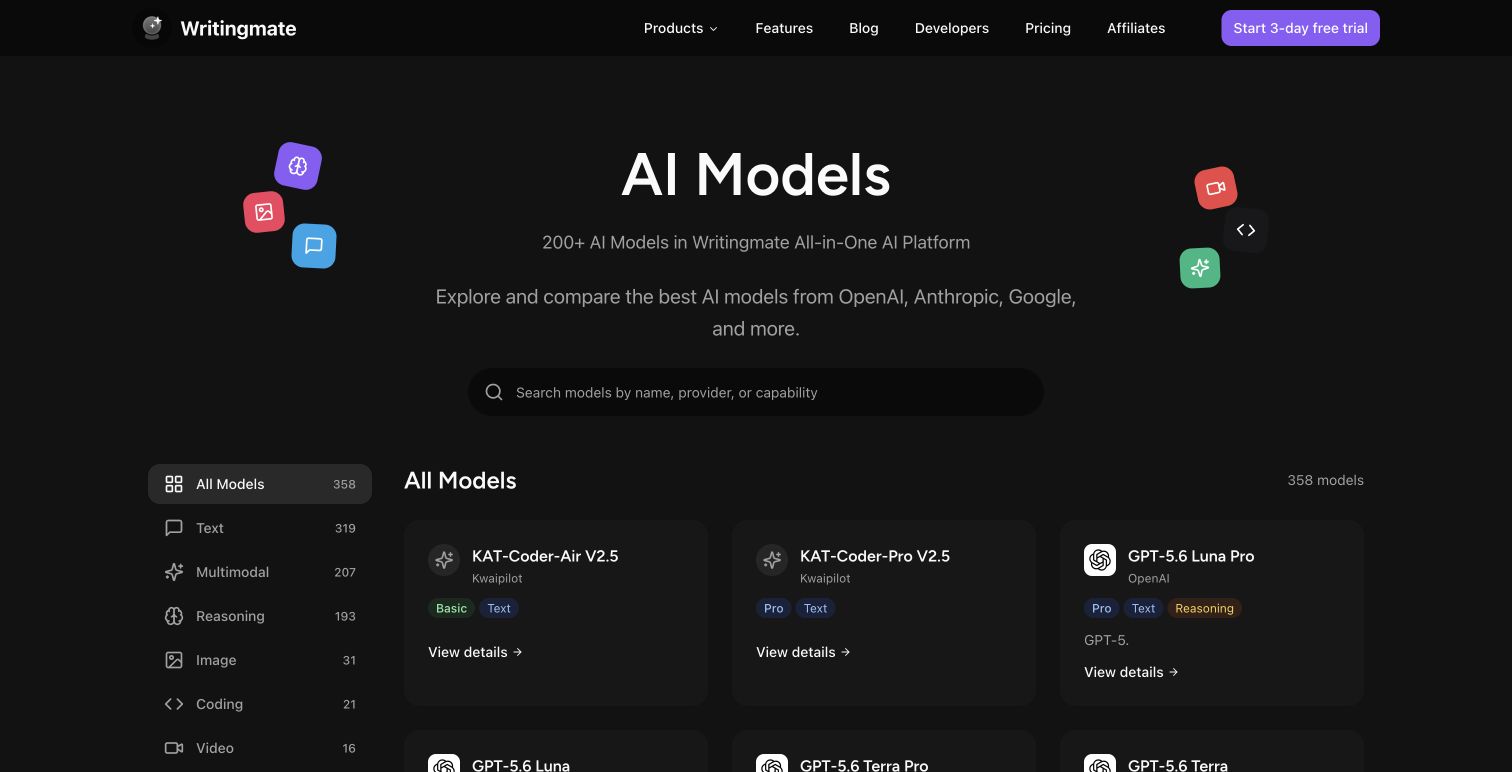
Writingmate's model compare feature makes this straightforward. Head to writingmate.ai/models/compare/deepseek/deepseek-chat-v3-0324-vs-openai/gpt-5 and DeepSeek V3 0324 is pre-loaded on one side. Pick any model for the other side — ChatGPT, Claude, Gemini, Qwen3, R1, or any of the 200+ models available on the platform — type your prompt, and both responses come back in parallel. Usually within 15–30 seconds.
The workflow I actually use: take a task I'm working on right now — a function I need to write, a document I need to summarize, a data set I need to analyze — and test it against two or three candidates in one sitting. Five minutes of real-task testing gives you more actionable information than any benchmark table, because you're measuring your task distribution, not a standardized evaluation set designed by someone else.
One thing that regularly surprises people: some of the smaller, cheaper models on Writingmate outperform their headline benchmark ranking on specific workloads. The only way to find out which one fits your workflow is to test. The compare tool removes the friction that keeps most people stuck with whichever model they started with by default.
When DeepSeek V3 0324 Is the Right Call (and When It Isn't)
Use DeepSeek V3 0324 when:
- Your workload involves math, statistics, or quantitative analysis at volume
- You need strong code generation without paying GPT-4o or Claude-level API prices
- You're running many parallel tasks where cost compounds quickly
- You want to test open-weight model behavior against proprietary alternatives for your specific prompts
Consider alternatives when:
- You need Claude-level nuance for tone-matched writing or brand voice
- Your use case involves long-context document processing (Gemini 1.5 Pro's 1M context window is genuinely hard to replace)
- You're building automated pipelines that require strict, predictable output format reliability
- You're doing multilingual work or creative roleplay where Qwen3 may be a better fit
- You need deep chain-of-thought reasoning on genuinely hard problems — that's what R1 is for
DeepSeek V3 0324 earns a spot in any serious AI toolkit. It's not a replacement for every model, but for math and coding at scale, the cost-performance ratio is hard to argue with. The technical report backs that up, and day-to-day testing confirms it.
See you in the next one!
Artem
Frequently Asked Questions
Sources
Written by
Artem Vysotsky
Ex-Staff Engineer at Meta. Building the technical foundation to make AI accessible to everyone.

Reviewed by
Sergey Vysotsky
Ex-Chief Editor / PM at Mosaic. Passionate about making AI accessible and affordable for everyone.