The popular advice is simple: use an AI agent when you need more autonomy, and use an LLM when you only need chat. That framing is convenient, but it leads teams toward the wrong architecture. The difficult question in AI agents vs LLM isn't whether a system can act. It's whether the additional planning, tool calls, memory, and orchestration can complete a long workflow reliably enough to justify its cost and latency.
An LLM can produce a strong answer in one call. An agent can inspect a goal, choose tools, execute actions, evaluate results, and continue. That extra loop creates capabilities a plain model doesn't have, but it also creates more opportunities for tool errors, bad plans, accumulated context, duplicated work, and governance failures. A clinical benchmark found that tool-using systems delivered only modest gains over baseline LLMs while consuming more than 10× the tokens and more than 2× the latency (Nature Digital Medicine study).
The right choice depends on the workflow, not on which label sounds more advanced. This guide builds a practical model from the underlying LLM to the agent layer, compares them across autonomy, tools, memory, reliability, cost, and governance, then maps each architecture to real tasks. The conclusion is deliberately narrower than “agents are the future”: plain LLM prompting often wins for bounded work, while agents earn their overhead in repetitive, tool-bound workflows with a clear success condition.
Table of Contents
- Introduction Why AI Agents vs LLM Confuses Everyone
- What an LLM Actually Is and How It Works
- What an AI Agent Is and How It Extends an LLM
- AI Agents vs LLM Head to Head Comparison
- Real World Use Cases and When to Choose Each
- Decision Framework and Cost Reliability Tradeoffs
- Implementing Both Options in a Unified Workspace
Introduction Why AI Agents vs LLM Confuses Everyone
The confusion starts because both systems may use the same underlying language model. A chatbot that answers a question and an agent that updates a CRM record can therefore appear to be versions of the same product. Technically, they solve different problems. The chatbot generates an output from an input, while the agent manages a process whose result may depend on several decisions and external actions.
That distinction matters for anyone deciding what to build or buy. If a task involves drafting an email, extracting themes from a document, or rewriting text, adding an autonomous loop may create complexity without adding useful capability. If the task requires checking records, calling an API, editing a file, testing the result, and deciding what to do next, a single response may be insufficient.
The capability trap
Calling an agent a “better LLM” hides the cost of the wrapper. The model still supplies language understanding and reasoning, but another layer determines when to invoke it, what tools it can access, how it stores state, and when it considers the job complete. Every additional step can introduce another model call, another tool response, and another chance for the system to misunderstand its environment.
The market now treats agents as a distinct commercial layer above raw language models. One industry estimate valued the global AI agents market at USD 5.43 billion in 2024, projected USD 7.92 billion in 2025 and USD 236.03 billion by 2034, with a projected compound annual growth rate of 45.82%. A separate estimate placed the market at USD 7.63 billion in 2025 and USD 182.97 billion by 2033. These are market estimates, not proof that agents work broadly in production, but they show how vendors position agents around automation and task execution rather than text generation alone (MarketsandMarkets AI agents market analysis).
The practical comparison isn't “chat versus autonomy.” It's bounded inference versus managed execution.
The rest of the decision follows from that distinction. First identify what a plain LLM can do alone. Then examine what the agent layer adds, and finally test whether the added control improves the outcome enough to compensate for operational overhead.
What an LLM Actually Is and How It Works
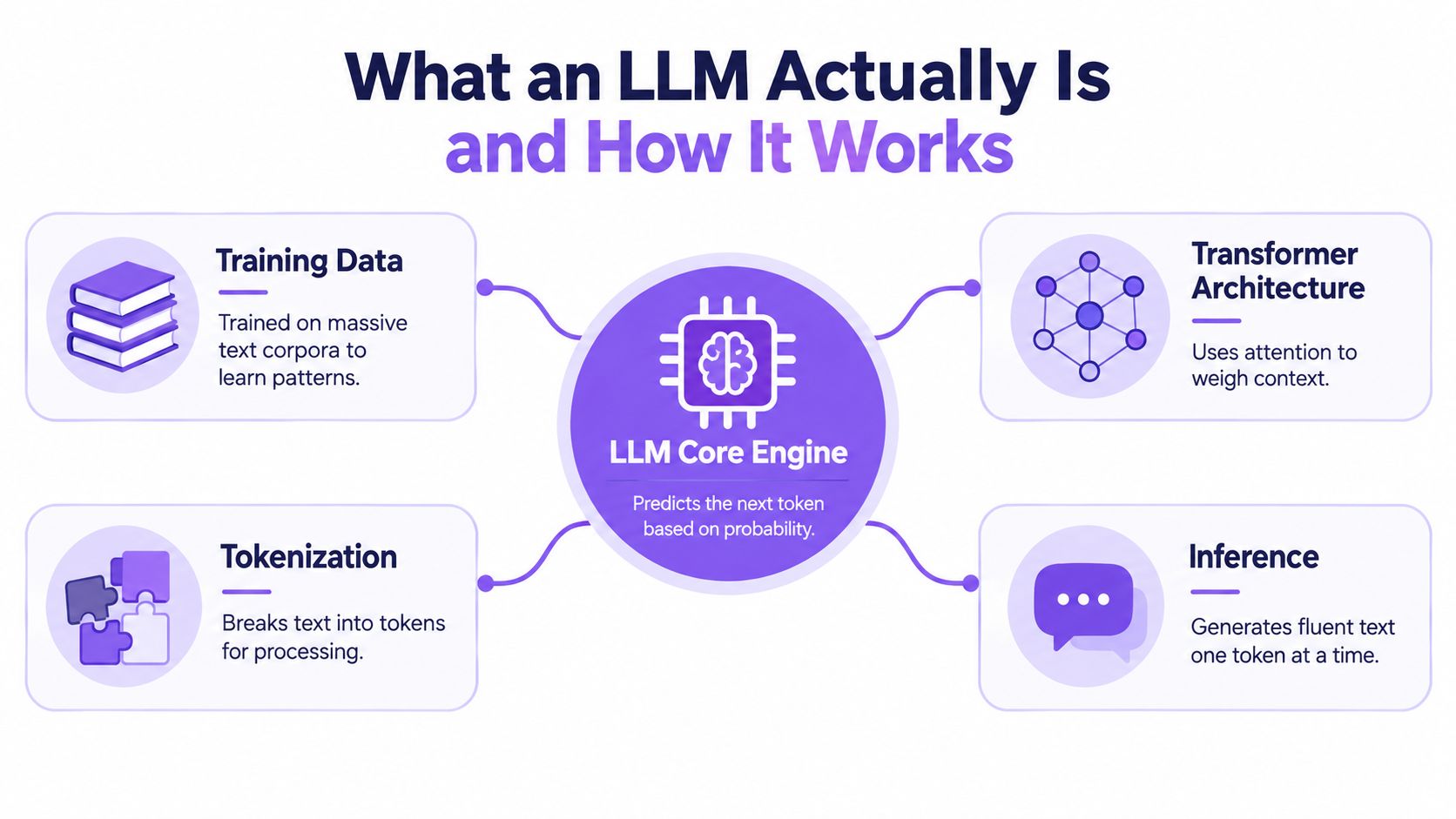
An LLM, or large language model, is a statistical model trained to recognize patterns in text and generate a likely continuation. At inference time, it receives tokens representing the prompt and context, calculates probabilities for possible next tokens, selects one according to its decoding settings, and repeats the process until it produces a response.
That mechanism is powerful because language contains structure. During training, the model learns relationships among words, syntax, styles, concepts, and common reasoning patterns from large text collections. It doesn't need a separate rule for every email, summary, or explanation. The prompt activates relevant patterns, and the model generates a new sequence that fits the requested context.
The basic inference path
A plain LLM call usually follows a compact path:
- Tokenization: The application converts text into tokens, which can represent words, fragments, punctuation, or other symbols.
- Context processing: A transformer uses attention mechanisms to weigh relationships among tokens in the prompt and any supplied history.
- Generation: The model predicts a response sequentially, one token at a time.
- Return: The application sends the generated text back to the user or another system.
The model may appear conversational, but that doesn't mean it has persistent memory or independent objectives. A chat application can store prior messages and include them in later prompts, yet that storage belongs to the surrounding application. The LLM itself doesn't decide to wake up, inspect a database, or continue working after returning an answer unless another system instructs it to do so.
Where plain LLM calls fit
This architecture is well suited to single-output tasks. A user supplies a request, the model produces an answer, and a human or program decides what happens next. Common examples include drafting copy, summarizing a supplied document, translating text, extracting fields, classifying content, and answering questions from provided context.
A useful analogy is a skilled analyst at a desk. Give the analyst a well-defined brief and the relevant documents, and they can produce a memo. They won't automatically open the ticketing system, change a record, run a test, or check whether the change solved the original problem unless someone gives them the access and operating procedure to do that.
That boundary is the foundation for the comparison. An LLM provides language capability. It doesn't, by itself, provide a durable execution environment.
What an AI Agent Is and How It Extends an LLM
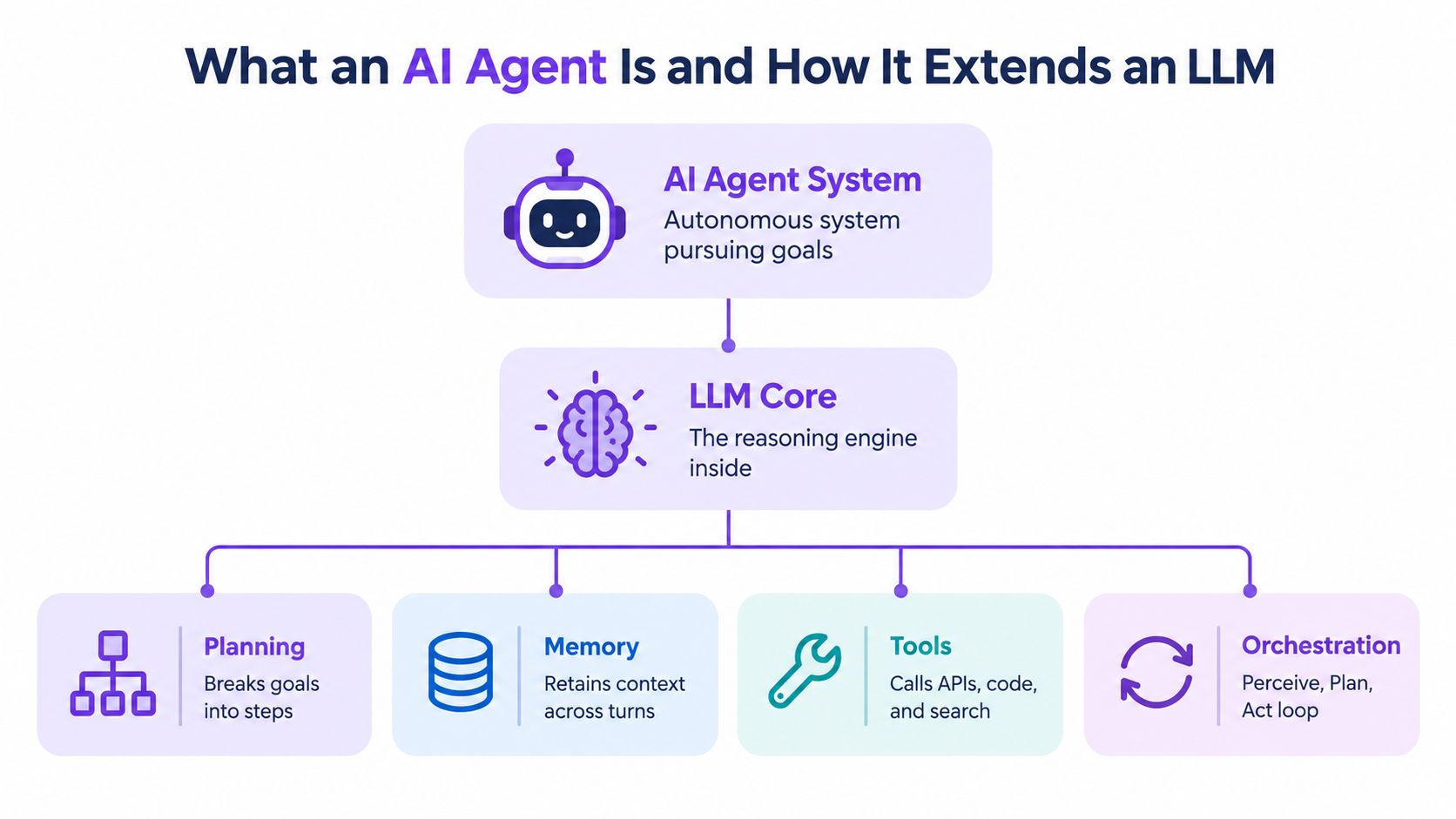
An AI agent is an application that places an LLM inside a controlled execution loop. The model can propose an action, while the surrounding runtime defines available tools, validates parameters, stores state, processes results, and determines whether the task may continue. The distinction therefore concerns reliability and operating cost, not only whether the interface feels autonomous.
A typical loop includes:
- Perceive: Read the request, current task state, and tool results.
- Plan: Choose the next action or divide the goal into sub-tasks.
- Act: Call a web search service, code runner, database, CRM, file editor, or another connected tool.
- Observe: Check the result, error, or changed system state.
- Iterate: Revise the plan, request clarification, continue, or stop.
The layers around the model
The LLM still supplies language generation and much of the reasoning. The agent runtime adds the components needed to operate over time:
- Planning converts a broad objective into actions or decisions.
- Memory retains conversation history, retrieved information, task state, and prior results.
- Tools connect the model to APIs, browsers, code execution, files, and business systems.
- Orchestration manages sequencing, retries, permissions, stopping conditions, and handoffs.
A single-agent design uses one model to manage the workflow. A multi-agent design assigns roles such as research, execution, review, or coordination. Dividing responsibilities can support larger workflows, but it also creates more communication, state-management, and failure points. A synthesis of agent limitations notes that many LLM-based systems still lack core multi-agent abilities, including structured social interaction and Theory-of-Mind-style reasoning, because the models are generally trained as single agents (synthesis of agent limitations).
Key differentiator: An LLM answers a request. An agent manages a process within the limits and safeguards of its runtime.
The boundary is practical rather than absolute. An application can add retrieval, tools, or multiple model calls without being an agent. The stronger test is behavioral: does the system independently select and sequence actions toward a goal, or does the application follow a predetermined call pattern?
That extra control loop can justify its cost for long-running work, especially when checking results or responding to failures matters. It can also make a system harder to test. Engineers must define tool permissions, data access, failure handling, retry limits, and points requiring human approval. An agent has more operational reach, but each additional action adds another opportunity for an incorrect plan or tool call.
AI Agents vs LLM Head to Head Comparison
The practical difference between an LLM and an AI agent is not autonomy as a product label. It is the size of the execution path, the number of components that can fail, and whether that added complexity produces enough value to justify its cost.
| Criteria | Plain LLM | AI Agent |
|---|---|---|
| Primary behavior | Generates an answer or artifact | Pursues a goal through multiple actions |
| Autonomy | Waits for a prompt and application instruction | Selects next steps within defined boundaries |
| Tool use | None by default, tools require application wiring | Core capability, including APIs, search, code, and files |
| Memory and context | Uses supplied prompt and application-managed history | Maintains task state, memory, observations, and plans |
| Planning | Usually implicit or limited to one response | Explicit planning, sequencing, evaluation, and iteration |
| Reliability surface | Mainly prompt, model, and output validation | Model, tools, plans, permissions, state, retries, and stopping logic |
| Latency and cost | Generally lower for a bounded call | Can rise with additional calls and tool operations |
| Governance | Easier to constrain to generated text | Requires action permissions, monitoring, auditability, and guardrails |
Autonomy and control
A plain LLM offers predictability of scope. It receives an instruction and returns text or another generated artifact. An agent offers independent progression, because it can select another action when the current result does not satisfy the task.
That progression depends on more than model quality. Tool descriptions, permissions, state representation, evaluation logic, and stopping conditions all shape the result. A capable model cannot reliably compensate for an ambiguous tool contract or a completion rule that accepts partial work.
For bounded requests, the LLM's shorter path is an advantage. For long-horizon work, an agent can justify its overhead when the workflow requires repeated checks, external actions, or recovery from intermediate failures.
Tools and external state
An LLM can explain how to call an API. An agent can call it when the runtime grants that permission. Language therefore becomes an operational action, and model errors can create operational consequences. A malformed search query may waste time. An incorrect write operation may alter business data.
Memory introduces a related trade-off. An agent can preserve task state across iterations, but each stored observation gives the model more material to interpret. Context accumulation, tool-invocation errors, and planning and constraint-satisfaction failures remain recurring failure categories in agent systems, as described in the agent limitations synthesis. Memory helps only when the system selects, summarizes, and retrieves the right state.
Reliability, latency, and cost
A plain LLM generally wins when one well-specified generation completes the task. An agent may require several model calls, tool responses, validation passes, and retries. In the clinical benchmark discussed earlier, tool-using systems consumed more than 10× the tokens and incurred more than 2× the latency, while producing only modest gains over baseline LLMs, according to the Nature Digital Medicine study.
The relevant question is therefore not whether agents are more capable in the abstract. It is whether orchestration replaces enough manual coordination or enables work a single call cannot perform. If the output is only a slightly improved paragraph, the extra calls are difficult to defend. If the system must inspect results, invoke tools, and continue until a defined condition is met, the additional runtime may pay for itself.
Governance
A plain LLM still needs privacy controls and output validation, but its action boundary is narrower. An agent requires explicit permissions, tool allowlists, approval gates, logs, error handling, retry limits, and tests for unsafe action sequences.
Governance belongs in the architecture from the start. Every added tool expands the system's operational reach and its reliability surface. The strongest design is often a constrained agent with narrow permissions, rather than an unrestricted loop that appears autonomous but is difficult to audit or stop.
Real World Use Cases and When to Choose Each
Architecture follows the work, not the product label. Define the required outcome first, then identify whether completion requires only a model response or changes outside the model.
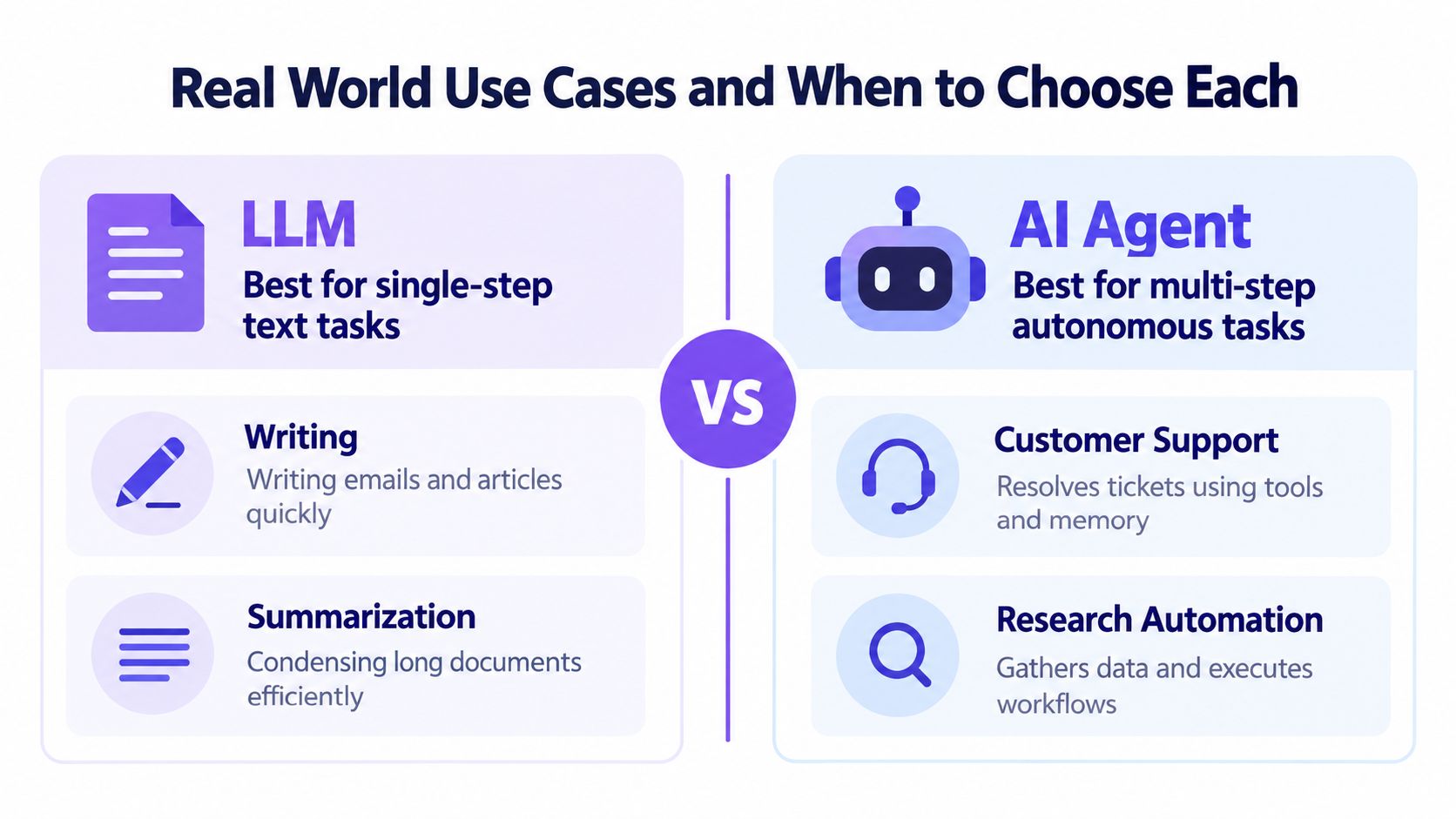
A marketing manager requesting five subject-line variations usually needs a plain LLM. One prompt can include the audience, brand voice, constraints, and examples. The model returns candidates, and the manager chooses or revises them. Long-report summarization follows the same pattern: the input is supplied, a person evaluates the output, and no external system changes.
A developer reviewing a pasted stack trace may also prefer an LLM. It can analyze the error and suggest likely causes without browsing a repository or editing files. The shorter execution path reduces operational overhead while leaving the next action with the developer.
Where an agent earns its overhead
A software issue involving code discovery, repository analysis, multi-file edits, test execution, failure inspection, and patch revision exceeds the scope of a static answer. SWE-bench measures actual GitHub issue resolution across 12 Python repositories, so performance depends on planning, code changes, validation, and iteration rather than suggested code alone (SWE-bench benchmark overview).
Customer operations present the same distinction. An agent can retrieve an account, inspect prior interactions, apply a policy, draft a response, update a record, and escalate an exception. Its value lies in completing the connected workflow, not merely producing a more fluent reply. AI agent examples for practical workflows show task patterns suited to this design.
The strongest case for orchestration appears when manual coordination is repetitive and the completion condition is measurable. The weakest case is a polished text output that a person must still route, verify, or act on manually.
The multi-step penalty
Longer workflows can reduce reliability as quickly as they increase capability. Enterprise CRM evaluations have found that agent performance is stronger on isolated tasks than on dependent sequences, with confidentiality awareness remaining a problem. The result is a practical warning: autonomy can introduce failure points that a short demonstration does not expose.
Choose an agent for repetitive, tool-bound work with a defined end state and escalation path. Choose a plain LLM when the task is primarily generation, a human controls the next action, or external actions add little value. The decision should follow the workflow's reliability requirement and expected coordination savings, not the appearance of autonomy.
Decision Framework and Cost Reliability Tradeoffs
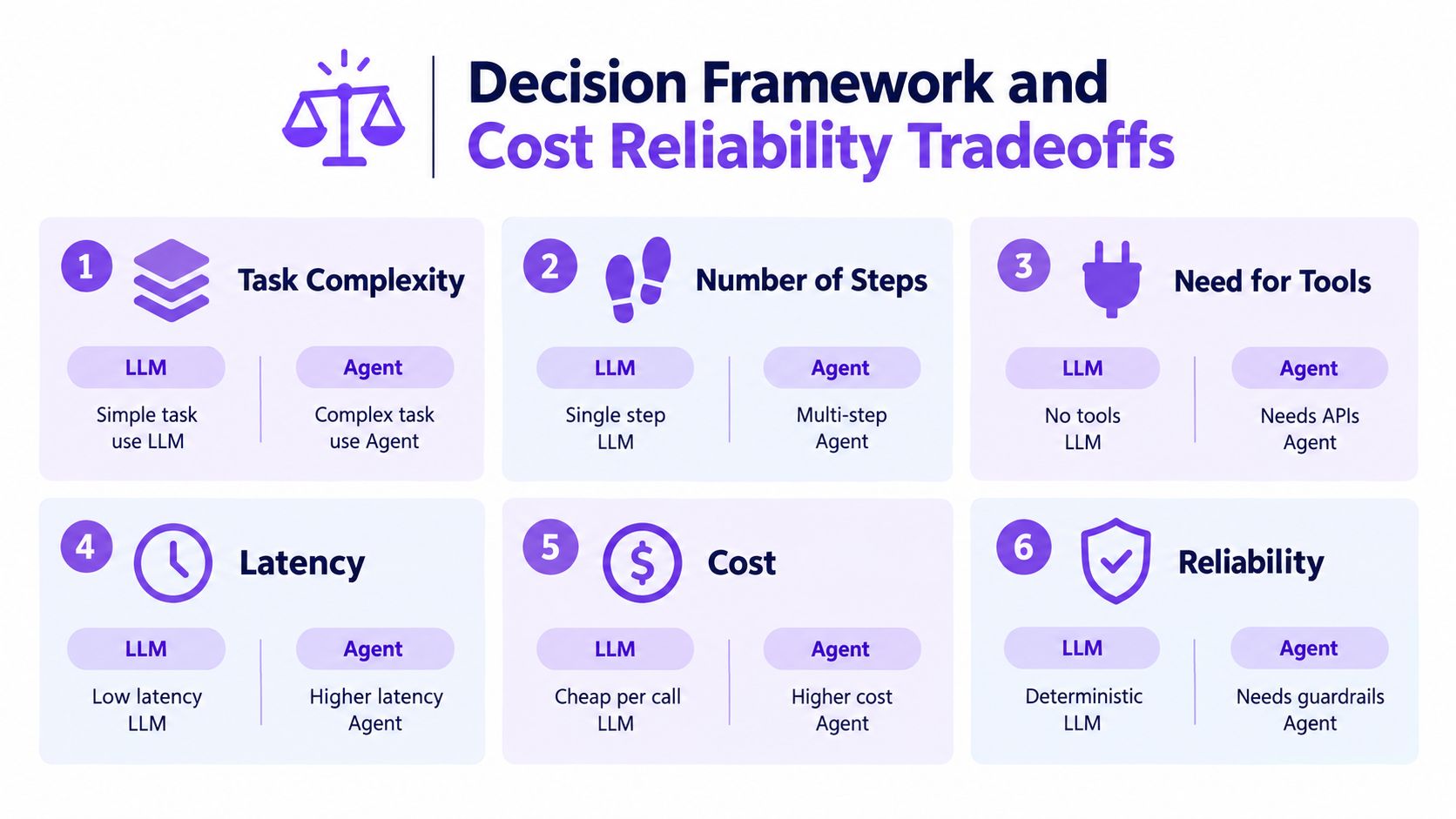
The right architecture depends less on whether a system appears autonomous than on whether it can complete a workflow reliably at an acceptable cost. Start with the task's horizon, the number of dependent decisions required before completion. Horizon also reflects uncertainty at each step, dependence on earlier observations, and the consequence of a wrong action.
Use this checklist to compare the options:
- Task boundary: For a document, answer, classification, or transformation, begin with a plain LLM. If the result must change an external system, assess an agent.
- Step dependency: Independent subtasks can use separate LLM calls with fixed application logic. Dependent actions, such as inspecting, modifying, testing, and revising, are better candidates for an agent.
- Tool requirement: Add tools only when they provide current data, computation, retrieval, file access, or an API required for the outcome.
- Latency tolerance: Direct model calls usually suit users waiting for a short answer. Background workflows can justify longer execution when they deliver a completed result.
- Cost boundary: Compare total workflow cost, including planning calls, tool calls, retries, validation, storage, and human review, rather than the price of one request. The AI pricing models and cost structures provide useful context for this comparison.
- Risk and permissions: Separate read actions from write actions. Require approval for irreversible changes, sensitive data exposure, and actions affecting customers, finances, or production systems.
Reliability is the hidden multiplier
An agent can fail while producing a plausible final answer. It may choose the wrong tool, carry a false assumption into later steps, or stop after completing only part of the objective. As context accumulates across a long workflow, the first incorrect decision becomes harder to locate, and the final output may not reveal where the process diverged.
Enterprise evaluations show a clear gap between isolated actions and dependent sequences, with confidentiality awareness also remaining a concern. Test the complete path, not only each tool separately. Log every model decision, argument, result, retry, and stopping decision so engineers can identify the first failure and estimate repair effort.
A more useful break-even rule
Orchestration pays when the human coordination it removes exceeds the added cost of planning, execution, monitoring, and recovery. A narrow support workflow with stable tools, clear policies, and a measurable completion condition can meet that threshold. Open-ended research may not, because each observation expands the context and makes completion subjective.
The practical measure is cost per successfully completed workflow. Include the model calls, tool use, retries, validation, storage, and human work required to detect and repair failures. Plain LLM prompting wins when generation is the main task and a person controls the next action. Agent orchestration earns its place when connected actions repeat, external systems must be updated, and success can be checked.
Implementing Both Options in a Unified Workspace
Teams don't need to choose one architecture for every request. A practical workspace can route bounded generation to a plain model and reserve agents for repeatable jobs that need files, search, APIs, or business integrations. This separation keeps simple work fast while giving longer workflows their own permissions, logs, and completion criteria.
Start by defining reusable prompts for tasks that need no external action. Store the input requirements, output format, examples, and review rules. For recurring operational work, create an agent with a specific instruction set, selected model, knowledge files, tools, integrations, and conversation starters. The agent should have the narrowest permissions that still allow it to complete the job.
Writingmate provides a unified environment where users can compare responses across models, chat with files, perform web research with citations, and create custom agents for repeated tasks. Its MCP integrations connect workflows to external tools, while built-in fallbacks can help maintain access when a selected model is slow or unavailable. Teams evaluating an implementation can also use this guide to create an AI agent with defined instructions and tools.
Keep the control plane explicit
A production setup should record which model handled a request, which tools were called, what data entered the context, and why the system stopped. Route high-risk actions through human approval, redact sensitive fields before model calls, and test failure cases such as invalid tool arguments, unavailable APIs, incomplete records, and contradictory instructions.
Use side-by-side model comparison for bounded prompts before assigning a model to an agent. A model that writes excellent prose may not be the right choice for structured tool calls, long context, or strict output validation. The final selection should follow measured workflow performance, not the model's reputation.
Plain LLMs and agents belong in the same operating strategy. The LLM is the efficient default for language work. The agent is an orchestration layer for carefully bounded execution. Treating that distinction as an engineering decision, rather than a maturity ranking, produces a system that's easier to control and cheaper to operate.
Writingmate brings multi-model chat, file analysis, web research with citations, reusable prompts, custom agents, and external tool integrations into one workspace, so you can test a direct LLM workflow before adding orchestration. Visit Writingmate to compare both approaches on your own tasks and build the smallest system that reliably completes the work.
Frequently Asked Questions
Sources
Written by
Artem Vysotsky
Ex-Staff Engineer at Meta. Building the technical foundation to make AI accessible to everyone.

Reviewed by
Sergey Vysotsky
Ex-Chief Editor / PM at Mosaic. Passionate about making AI accessible and affordable for everyone.