In 2025, public GitHub exposed 28,649,024 new secrets, a 34% year-over-year increase and the largest single-year jump recorded by GitGuardian, as reported in the API key security overview from Akeyless. An API key is only a string, but that string may authorize access to production data, paid services, infrastructure, or a customer-facing application.
A key-management program treats that credential as a controlled asset from creation through retirement. It assigns an owner, limits permissions, stores the value centrally, rotates it without interrupting consumers, records its use, and provides a response path when exposure is suspected. That lifecycle is the difference between finding a leaked key quickly and discovering it after an attacker has used it.
Table of Contents
- Why API Keys Management Matters More Than Ever
- Generating and Storing API Keys Securely
- Access Controls Rotation and Least Privilege in Practice
- Monitoring Usage and Detecting Suspicious Activity
- Responding to a Leaked or Compromised API Key
- Your API Keys Management Checklist and Next Steps
Why API Keys Management Matters More Than Ever
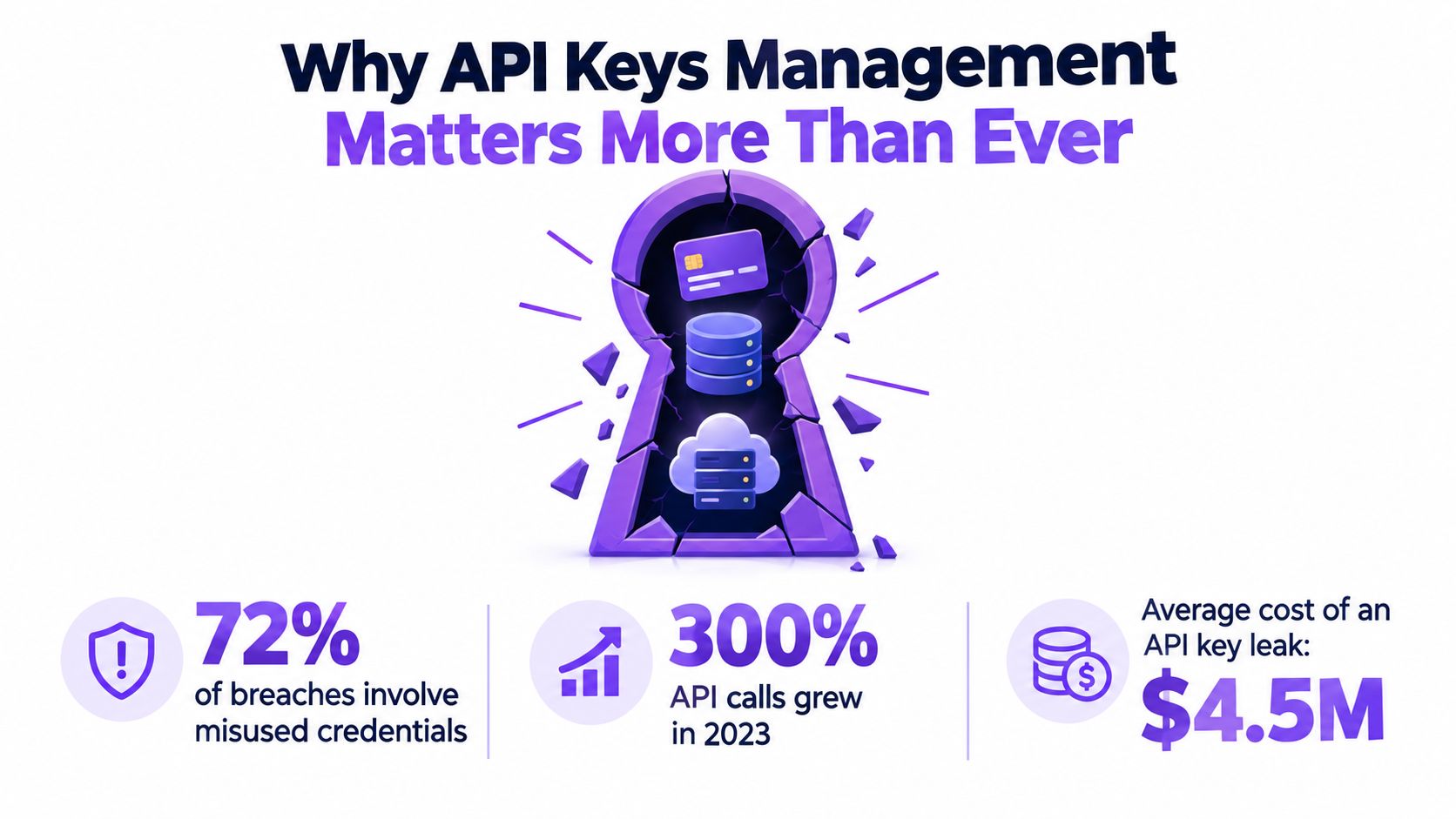
86% of organizations spend up to 15 hours each week provisioning, managing, and dealing with secrets, according to the Corsha API secrets management report. That time usually appears as scattered ownership records, manual approvals, emergency replacements, and investigations after a credential behaves unexpectedly. API key management is therefore an operating discipline, not a task reserved for security teams.
At 2 a.m., a leaked key rarely announces itself as a security incident. A build fails, a billing alert appears, or an engineer spots requests from an unfamiliar location. The credential may have been copied into a local configuration file, pasted into a ticket, committed to a repository, or printed by a verbose deployment log. By the time those clues connect, someone may already be using the key.
API keys remain attractive because they are simple. A service accepts a bearer token or header value, and an application can begin making requests without a larger identity system. That convenience makes the key an authorization boundary, even when teams treat it as ordinary configuration.
GitGuardian's State of Secrets Sprawl report describes millions of secrets exposed annually. API keys are among the exposed secret types, so repositories, pipelines, notebooks, support systems, and production hosts all belong in the threat model. Exposure is not limited to source code.
The same Corsha survey found that 53% of respondents had experienced a breach involving unauthorized access caused by compromised API secrets. It also reported that 42% managed up to 250 API tokens, keys, or certificates across their environments. At that scale, a spreadsheet and informal memory cannot provide reliable ownership or timely revocation.
The lifecycle teams need to govern
Effective API key management governs the credential from creation to retirement:
- Create: Generate a credential with sufficient entropy and a documented purpose.
- Register: Record its owner, service, environment, permissions, creation date, and expiration policy.
- Store: Keep it in a centralized manager, away from source code and shared documents.
- Use: Deliver it only to the workload or operator that needs it.
- Rotate: Replace it through a tested overlap process before it becomes stale.
- Monitor: Compare requests with the key's intended scope, service, location, and behavior.
- Revoke: Disable it promptly after exposure, role changes, or suspicious activity.
- Retire: Remove unused credentials while preserving the relevant audit record.
Rotation should be the default workflow, not an emergency procedure. Centralized management also prevents credential sprawl in systems such as Writingmate, where automated activity needs an identifiable owner, purpose, and audit trail. The AI agent accountability and audit trail explains why those records matter for automated actors.
Practical rule: If nobody can identify who owns a key, what it accesses, and how to revoke it, the organization does not manage that key. It merely possesses it.
For developers building or reviewing an API, the top API security tips for developers offer complementary guidance on authentication, validation, and defensive implementation. A lifecycle approach adds the operational controls that keep those protections effective after deployment.
Generating and Storing API Keys Securely
Start with generation, but don't stop there. A cryptographically strong key can still become a liability if a developer commits it to Git or a CI job prints it into logs.
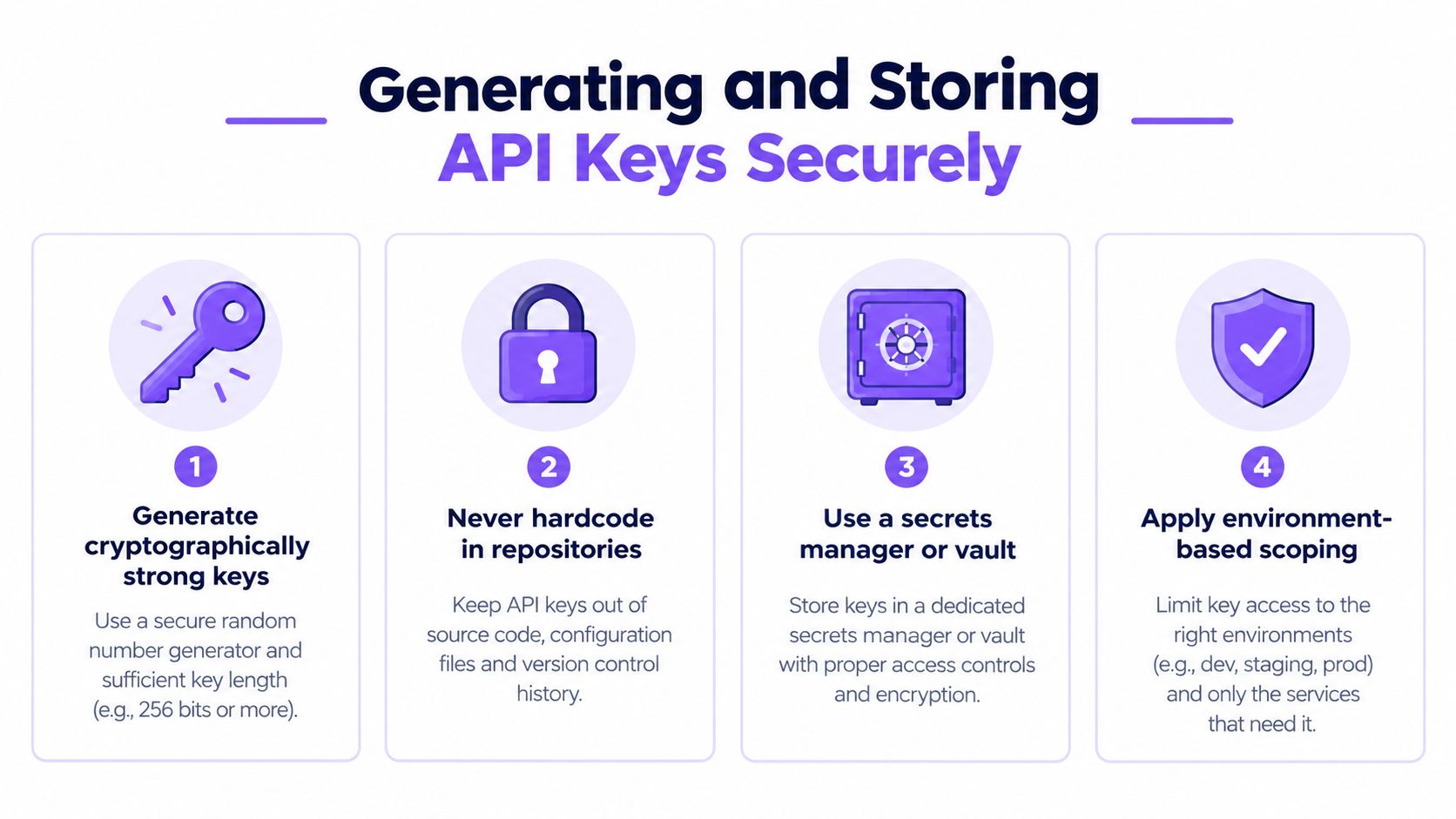
Use the provider's credential-generation mechanism where possible, or a cryptographically secure random source appropriate to your platform. Don't derive keys from usernames, project names, timestamps, predictable hashes, or manually edited strings. Give every integration its own credential, because one shared key prevents meaningful attribution and forces a broad replacement when any consumer changes.
Remove keys from code and configuration
A repository is a distribution system. Once a secret enters Git history, deleting the current line doesn't remove every clone, fork, pull request, cache, or build artifact that may contain it. The same applies to plaintext configuration files shared through chat, tickets, cloud drives, or email.
OWASP-aligned API key guidance from Snappwd recommends using a centralized secrets manager instead of hardcoding keys in source code, configuration files, or plaintext environment variables. Environment variables can be useful as a delivery mechanism at runtime, but they shouldn't become a team's permanent secret store. The application should retrieve the value from an approved secret system, inject it only where needed, and prevent it from appearing in logs or diagnostic output.
A useful repository policy has three layers:
- Prevent: Add secret scanning to pre-commit hooks, pull requests, and CI pipelines.
- Detect: Scan current files and historical revisions, including generated artifacts.
- Contain: Treat a detected credential as exposed, replace it, and revoke the old value. Don't rely on deleting the commit.
Use separate paths for local, CI, and production
Local development needs safe access without copying production credentials to laptops. Give developers sandbox or development-scoped keys, authenticate the local secret tool through their identity provider, and keep production values inaccessible by default.
CI/CD should request secrets at job runtime through a trusted identity or secrets-manager integration. Mask values in logs, restrict which jobs can access them, and avoid passing broad credential sets to every pipeline stage. Production workloads should use workload identity or short-lived credentials when the provider supports them. If a static API key is unavoidable, store it centrally, scope it narrowly, and make replacement routine rather than exceptional.
Team sharing is where otherwise careful systems often fail. Don't send a key in a message and assume the recipient will delete it later. Share access to the secret reference, not the secret value, and make the authorization temporary or role-based.
For Writingmate users configuring access for supported developer workflows, the Writingmate API key setup documentation describes the supported API-key configuration path. The same principle applies regardless of vendor: centralize ownership and retrieval so each application doesn't grow its own undocumented copy.
Access Controls Rotation and Least Privilege in Practice
Treat every API key as a credential with a lifecycle. Define who may use it, which operations it may perform, and how long it should remain valid before issuing it. “The whole team, everything, indefinitely” is not an access policy. It is a predictable incident waiting for a leaked value.
Start with separate credentials for development, staging, and production, even when all three environments call the same provider. Then separate access by service or workload. A reporting worker should not share a key with a deployment tool, and a read-only integration should not receive write access because creating another credential takes effort.
Build a permission matrix
Document the intended access before creating the key. A small matrix exposes privilege expansion more clearly than a generic “API access” label.
| Use Case | Recommended Scope | Rotation Frequency |
|---|---|---|
| Local development | Sandbox project, test data, read-only or narrowly selected operations | On a regular schedule and immediately after suspected exposure |
| CI validation | Non-production environment, only the endpoints required by tests | On a regular schedule and after pipeline ownership changes |
| Production worker | Single service, minimum required operations, no interactive administration | On a defined schedule with automated replacement |
| Temporary migration | Specific dataset or operation, explicit owner and end date | After the migration completes or sooner if activity looks unusual |
| Vendor integration | Dedicated service account, restricted resources, documented contact | On a schedule agreed with the vendor and after personnel changes |
Give each key a searchable label without exposing its value. Record the application, environment, owner, purpose, and rotation status in the secret manager. Tags and inventory records should let an on-call engineer identify the responsible workload during an incident.
Rotate without breaking consumers
Rotation should run through deployment automation, not depend on someone remembering a calendar task. Use this sequence:
- Generate a replacement key with the same or narrower permissions.
- Store it in the central manager and associate it with the correct owner and workload.
- Update consumers through a normal deployment or configuration rollout.
- Verify requests succeed with the replacement and confirm that the old credential is no longer needed.
- Revoke the old key after the consumer transition is complete.
- Record the change in the inventory and deployment trail.
Applications that fetch credentials dynamically at startup can complete this process with zero downtime. Teams pinned to static configuration files should plan an overlap window of at least one full deployment cycle, then remove the old value after every consumer has moved.
A rotation-first workflow also gives you a clean response to changing risk. Rotate immediately after suspected exposure, a team or vendor change, or unusual activity. A fixed schedule cannot account for events that make a credential unsafe today.
Prefer identity-based alternatives where they fit
Static keys are only one authentication option. Cloud workload identities, temporary role credentials, OAuth flows, signed requests, and mutual TLS can reduce the number of long-lived secrets distributed across systems. They also introduce implementation and operational complexity. Use them when the provider and workload support them, but keep the design operable. A system that blocks delivery will be bypassed.
Least privilege requires review after launch. Compare actual calls with the original matrix as applications gain features, then remove unused operations. A key that needed write access during a migration may require only read access afterward. Centralized management, including a Writingmate API configuration where supported, keeps ownership, retrieval, and replacement in one controlled path instead of allowing each application to create an undocumented copy.
Monitoring Usage and Detecting Suspicious Activity
Storage controls prevent many leaks, but they don't tell you whether an issued key is behaving as intended. Monitoring turns a credential inventory into an operational signal.
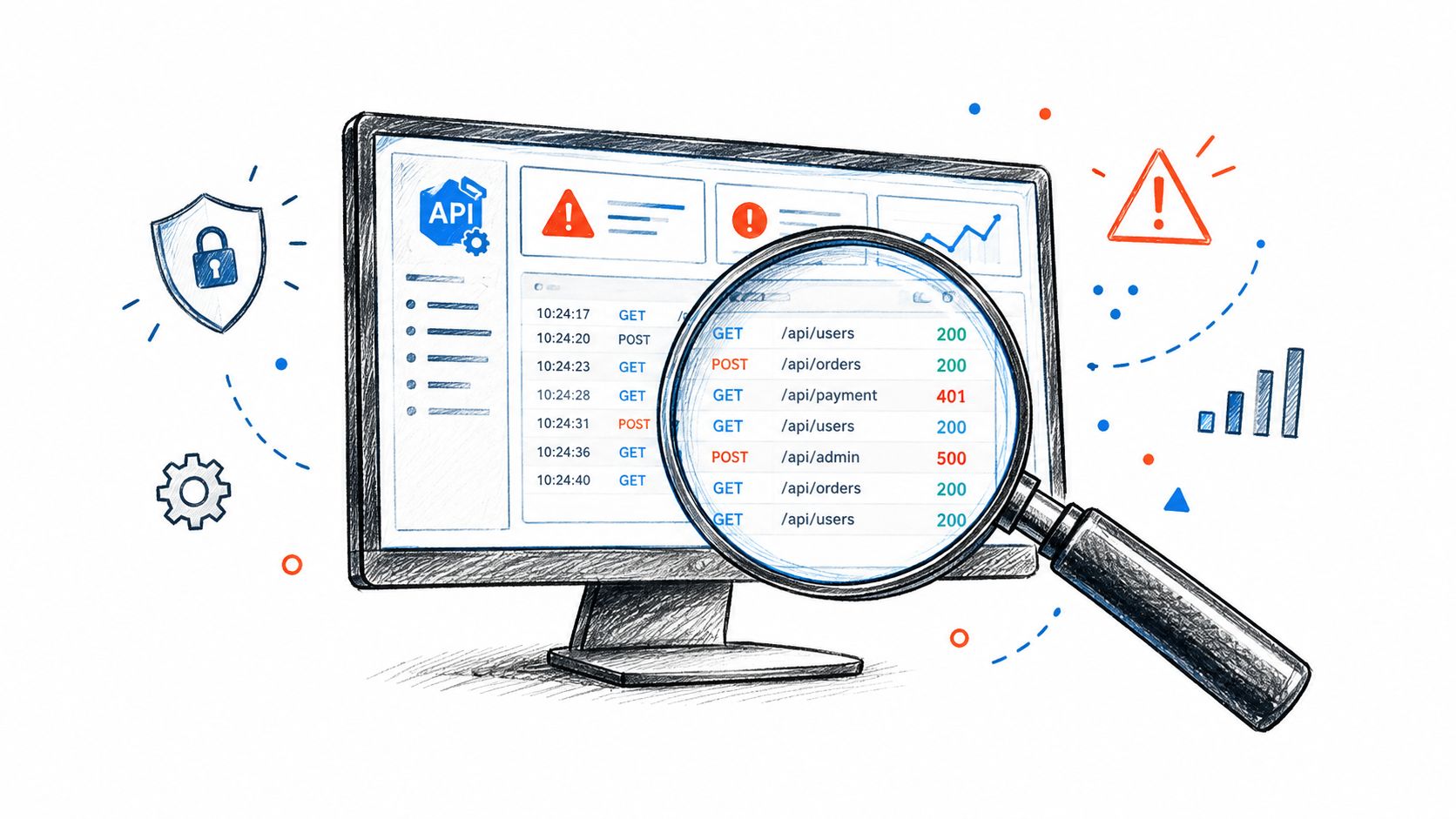
Log each request with a key identifier or safe alias, never the secret itself. Capture the owning application, endpoint or operation, response status, latency, request volume, source location where available, and the environment. Centralize those records in the platform logging system or a SIEM so an on-call engineer can correlate key use with deployments, tickets, and identity events.
Establish a useful baseline
A baseline doesn't need machine learning. Start with the normal behavior of each workload:
- Request pattern: Which operations does the key normally call?
- Timing: Does usage occur continuously, during deployments, or only during business processes?
- Location: Which regions, networks, or execution environments are expected?
- Failure profile: What error responses are normal, and what repeated failures need investigation?
- Volume: What level of activity fits the application's function?
Alert on deviations that carry meaning. A production ingestion key suddenly calling administrative endpoints deserves immediate attention. A development credential making requests from an unfamiliar environment should be investigated even if the request succeeds. A sharp error burst may indicate guessing, an incompatible deployment, or a provider-side change, so the alert should route to someone who can distinguish those cases.
Centralized gateways can help enforce rate limits, collect consistent request logs, and apply policy before traffic reaches downstream services. For teams evaluating that pattern, the OpenAI-compatible API gateway guide offers relevant implementation context for a compatible API layer.
Make inventory review part of operations
Review the inventory during normal engineering work, not only during audits. Confirm that every key has an owner, a purpose, a current consumer, an appropriate scope, and a replacement path. Delete credentials that no longer serve a workload, and investigate keys that have no recent legitimate use.
Don't alert on every unusual event without ownership context. That creates noise and trains responders to ignore the system. A strong alert names the key alias, owner, service, observed behavior, expected behavior, and first containment action. The alert should help an engineer decide, not force them to reconstruct the entire environment under pressure.
Responding to a Leaked or Compromised API Key
Treat a suspected leak as real until you can establish otherwise. The first mistake teams make is debating whether the credential was used while the credential remains active. Preserve evidence, but contain access quickly.
A key pushed to GitHub illustrates the correct sequence. Stop new deployments that might distribute the value, identify the affected key from the repository scan, and generate its replacement through the approved secret system. Update the application or pipeline, verify successful requests with the replacement, revoke the exposed key, and then inspect provider logs for activity during the exposure window.
The incident procedure
Contain first. Revoke or deactivate the exposed key if the provider supports immediate invalidation. If the application still depends on it, use a temporary access denial, disable the affected integration, or deploy a replacement path. Don't wait for the normal rotation date.
Determine impact. Search API logs by key identifier, owner, consumer, operation, source location, and time. Look for unfamiliar resources, unexpected operations, abnormal failures, and usage that continued after the suspected exposure. Record what the logs can prove and what remains unknown.
Notify the right people. Include the service owner, security contact, incident lead, and any team responsible for billing or data affected by the credential. Keep the report factual. State when the key was found, where it appeared, when it was revoked, which consumers were updated, and what evidence has been reviewed.
Replace downstream access. If the exposed key granted access to another system, rotate related credentials and invalidate sessions or tokens that may have been derived from it. Update deployment variables, local development references, scheduled jobs, and vendor configurations. One replacement in production isn't enough if an old copy still runs elsewhere.
Remove the source and prevent recurrence. Purge the secret from active files and repository history where appropriate, add or tune secret-scanning rules, and review access to the system where the leak occurred. Narrow the key's permissions if the original scope was broader than necessary.
Incident habit: Revoke the credential, then investigate. Logs are valuable, but an active secret is more urgent than a perfect timeline.
Document the recovery
Write a short timeline with detection, containment, replacement, verification, revocation, impact findings, and follow-up owners. A post-incident review should ask why the value was available at the point of leakage, why prevention didn't block it, whether monitoring produced a useful signal, and whether the rotation procedure required risky manual work.
Don't punish the engineer who made the mistake while leaving the system unchanged. People will eventually paste the wrong value into the wrong place. Mature API keys management assumes human error and makes the resulting credential short-lived, narrowly scoped, observable, and easy to replace.
Your API Keys Management Checklist and Next Steps
A workable program is easy to describe and demanding to maintain. Use this checklist as an operational reference, then attach each item to a named owner and an existing engineering workflow.
Create and register
- Generate safely: Use a cryptographically strong provider or system mechanism.
- Assign ownership: Record the application, environment, responsible team, purpose, and emergency contact.
- Classify access: Document the exact services and operations the credential requires.
- Choose the right identity: Prefer workload identity or temporary credentials when the platform supports them.
Store and deliver
- Centralize secrets: Use a dedicated manager or vault rather than repositories, tickets, chat, or shared documents.
- Separate environments: Keep development, staging, and production credentials independent.
- Protect pipelines: Retrieve values at runtime, restrict job access, and mask logs.
- Scan continuously: Check commits, pull requests, build artifacts, and historical repository content.
Govern the lifecycle
- Rotate routinely: Use the replacement, consumer update, verification, and revocation sequence.
- Rotate after events: Act immediately after suspected exposure, team changes, vendor changes, or suspicious activity.
- Review permissions: Remove operations and resources the workload no longer needs.
- Retire cleanly: Revoke unused keys and update the inventory instead of leaving dormant access behind.
Detect and respond
- Centralize telemetry: Log safe key identifiers, owners, operations, outcomes, and source context.
- Alert on meaningful deviations: Focus on unexpected scope use, location, volume, timing, and error behavior.
- Keep a playbook: Document containment, replacement, impact review, notification, and recovery.
- Test the procedure: Confirm that the on-call team can replace a key without guessing which consumers need an update.
Tool choice should follow the control problem. HashiCorp Vault, AWS Secrets Manager, Azure Key Vault, and Google Cloud Secret Manager can provide centralized storage and access controls, while an API gateway can add consistent request policy and telemetry. Writingmate can also centralize API access for supported AI workflows through its API key settings, including a Writingmate Developer Key for its OpenAI-compatible API or MCP endpoint, so teams can manage an integration through a defined platform path rather than scattering provider credentials across applications.
Measure maturity by behavior, not by whether a secrets product has been purchased. You're improving when every credential has an owner, applications can rotate without downtime, scans block accidental commits, alerts identify abnormal use, and an engineer can revoke and replace a key during an incident without reconstructing undocumented dependencies.
Schedule the next inventory review and rotation exercise now. Pick one production integration, document its scope, test the replacement path, and remove one unnecessary copy of its credential. Repeating that routine is how API keys management becomes a dependable engineering control instead of a periodic cleanup project.
Writingmate provides a unified workspace for AI chat, web research, files, agents, and an OpenAI-compatible API, with API key settings for connecting supported workflows. Visit Writingmate to review how its centralized access options could fit your credential lifecycle and developer tooling.
Frequently Asked Questions
Sources

Written by
Artem Vysotsky
Ex-Staff Engineer at Meta. Building the technical foundation to make AI accessible to everyone.

Reviewed by
Sergey Vysotsky
Ex-Chief Editor / PM at Mosaic. Passionate about making AI accessible and affordable for everyone.