What if the best prompt question examples aren't really examples of clever wording at all? They're examples of repeatable structures that help an AI understand the job, the context, the limits, and the form of the answer you need.
That distinction matters. “Write better marketing copy” leaves too many decisions unresolved. A structured question can ask the model to explore options, compare alternatives, analyze evidence, follow a workflow, or revise an existing draft. The ten formats below turn prompt questions examples into a practical selection toolkit for creative writing, marketing, research, debugging, data analysis, and chat-assistant workflows.
Use the same reading pattern for every format: identify the prompt purpose, adapt the example, understand its strength, account for its limitation, and take one concrete next action. The best format depends on the outcome you want, not on which wording sounds most polished.
Writingmate can support that testing process through multi-model comparison, web search with citations, file analysis, reusable prompts, prompt builders, and AI agents. Those features are useful when you need to compare interpretations, work from source material, or turn a successful question into a repeatable team workflow.
Table of Contents
- 1. Open-Ended Discovery Prompts
- 2. Constraint-Based Prompts
- 3. Role-Playing and Perspective Prompts
- 4. Comparative Analysis Prompts
- 5. Problem-Solution Framework Prompts
- 6. Iterative Refinement Prompts
- 7. Data-Driven Analysis Prompts
- 8. Systematic Instruction Prompts
- 9. Research and Synthesis Prompts
- 10. Customization and Personalization Prompts
- Comparison of 10 Prompt Question Types
- Turn Good Questions Into Reusable Prompt Systems
1. Open-Ended Discovery Prompts
Open-ended questions are useful when you haven't defined the solution yet. They invite the AI to explore a topic through causes, possibilities, perspectives, and emerging themes instead of forcing it toward a predetermined answer.
Try:
Explore the question: What are emerging trends in AI content generation for 2025? Group them by practical use case, explain why each matters, and identify questions a content team should investigate next.
Other useful versions include:
- Workflow exploration: How can independent creators use AI to improve workflow efficiency without sacrificing editorial judgment?
- Cause analysis: Why do marketing teams struggle with content consistency across channels?
- Idea generation: What content angles could explain prompt engineering to software developers, marketers, and researchers?
The strength of this format is breadth. It works well at the beginning of a content brief, during research planning, or when a team needs perspectives it hasn't considered. Asking “what,” “how,” or “why” encourages the model to generate a wider field of possibilities than a tightly constrained production prompt.
The trade-off is that breadth can produce generic answers. An open question about AI trends may return familiar categories unless you add an audience, time frame, evidence requirement, or business context.
How to make discovery useful
Use Writingmate's guide to asking AI questions as a starting point, then run the prompt with web search when freshness and citations matter. Compare responses across models when you want to see whether an idea is broadly recognized or depends on one model's interpretation.
Save prompts that consistently produce useful directions in a prompt library. After discovery, follow with a narrower question such as: “Which three ideas are most relevant to independent writers, and what evidence would validate each one?”

2. Constraint-Based Prompts
A constraint-based prompt tells the AI what the answer must fit. Instead of asking only for an idea, you specify the audience, length, tone, format, channel, and exclusions that define an acceptable result.
For example:
Write a 300-word LinkedIn post about AI productivity tools for independent creators. Use a professional but approachable tone, open with a practical problem, avoid exaggerated claims, and finish with one question for readers.
Or:
Create 5 blog post headlines under 60 characters for independent creators interested in workflow efficiency. Make each headline specific, avoid clickbait, and label the angle used.
These questions work well for publication-ready drafts, campaign assets, metadata, sales enablement copy, and recurring editorial tasks. They reduce the amount of correction required because the model receives a target instead of a blank space.
The limitation is overconstraint. If you specify too many stylistic rules, the output can become stiff, repetitive, or technically compliant without being persuasive. A word limit also controls space, not quality. You still need to define what the answer should accomplish.
Build constraints that people can test
Store a reliable template in Writingmate's prompt builder and separate fixed rules from variables such as topic, audience, offer, and channel. That makes the prompt easier to reuse and easier to diagnose when an output misses the mark.
A practical constraint set might include:
- Audience: Who will read this?
- Outcome: What should the reader understand or do?
- Voice: What tone fits the context?
- Format: Should the answer use bullets, headings, a table, or JSON?
- Quality control: What must the model avoid or verify?
Run the same constrained question across models before standardizing it. A prompt that works for a short social post may need different instructions for a research brief or a technical explanation. Document the constraints that improve consistency, not every instruction you happened to try.
3. Role-Playing and Perspective Prompts
Role and perspective prompts change the lens through which the AI approaches a question. They can make an answer more relevant by specifying the reader's experience, professional priorities, or decision context.
Try:
As a software developer evaluating AI tools, what are the top features I should look for in a unified AI platform? Separate essential capabilities from convenient extras, and explain the trade-offs for a technical workflow.
Another example is:
From the perspective of a small business owner with a limited budget, how should I approach AI tool selection? Prioritize reliability, switching costs, data handling, and ease of adoption.
The useful part isn't the theatrical persona. It's the decision frame. A developer may care about API compatibility, file handling, and model behavior. A small business owner may care more about simplicity, predictable workflows, and avoiding fragmented tools. The same product question produces different useful answers when the evaluation criteria change.
Role prompts can also support creative work. Ask an editor to challenge a draft, a skeptical buyer to identify objections, or a beginner to flag unexplained terminology. These perspectives are more useful when you define the expertise level and the task clearly.
Avoid invented authority
A role doesn't make the model a real expert or guarantee accurate information. “Act as a leading researcher” may produce confident language without stronger evidence. For current claims, pair the perspective with web search and request citations. For internal decisions, provide the relevant documents instead of relying on a persona to fill gaps.
Writingmate's roleplay AI chatbot guide offers a useful way to think about persona-based interactions. Save effective persona prompts as team templates, and compare how different models interpret the same role before using the output in customer-facing material.
Practical rule: Use a role to define priorities and perspective, not to manufacture credentials.
4. Comparative Analysis Prompts
Comparison prompts turn an unstructured choice into an evaluation. They ask the AI to apply the same criteria to multiple options, which makes differences easier to inspect and discuss.
For example:
Compare GPT-4, Claude Opus, and Gemini 3.5 for content generation. Evaluate instruction following, long-form coherence, research support, speed, and cost-effectiveness. Present strengths, weaknesses, and the best fit for a small marketing team.
A platform comparison could ask:
What are the key differences between using a unified AI platform such as Writingmate and maintaining separate subscriptions? Compare workflow continuity, model choice, file analysis, research, and operational complexity.
The main strength is decision clarity. A comparison question forces you to name the criteria that matter, rather than accepting a vague “which is best?” answer. It also exposes trade-offs. One model may write more naturally, another may handle a particular file workflow more conveniently, and a third may fit a developer's integration needs.
The danger is false precision. If you don't define the evidence or evaluation context, the model may rank tools using assumptions that aren't relevant to your team. Product capabilities and model versions also change, so current comparisons require current sources.
Use comparison as a testing method
Writingmate's multi-model comparison feature lets you place responses side by side for the same question. That doesn't automatically reveal which answer is correct, but it helps you identify agreement, disagreement, missing criteria, and model-specific preferences.
Add a ranking only after requesting the underlying reasoning and assumptions. You can also upload a requirements document and ask the model to score each option against the actual workflow. The best comparison prompt doesn't just produce pros and cons. It gives decision-makers a transparent basis for choosing.
5. Problem-Solution Framework Prompts
Problem-solution questions resemble the way teams handle operational work. They describe a situation, identify the impact, and ask for practical interventions rather than general advice.
Try:
We struggle to manage multiple AI tools and rising subscription costs. What are the best solutions? Identify the root causes, compare possible approaches, recommend a path, and list the risks we should review before implementation.
For a content team:
Our writers waste time switching between AI platforms for research, drafting, file analysis, and image creation. How could we streamline this workflow? Separate quick wins from process changes, and explain what information we'd need before choosing a solution.
The prompt becomes stronger when you provide the failed attempts, available resources, users affected, and essential constraints. A solution that works for a solo creator may be unsuitable for a team that needs permissions, shared templates, or an API.
Move from advice to an operating plan
Use Writingmate's file upload to provide process documents, tool inventories, customer feedback, or previous experiments. Then combine that context with web search when the recommendation depends on current tools or practices. Ask for implementation stages, owners, dependencies, and fallback options.
A recurring problem can become an AI agent instruction. For example, an agent might review a new brief, identify missing inputs, propose a research plan, and return a structured handoff for a writer. Keep human review where the decision involves confidential material, brand risk, or a significant operational change.
6. Iterative Refinement Prompts
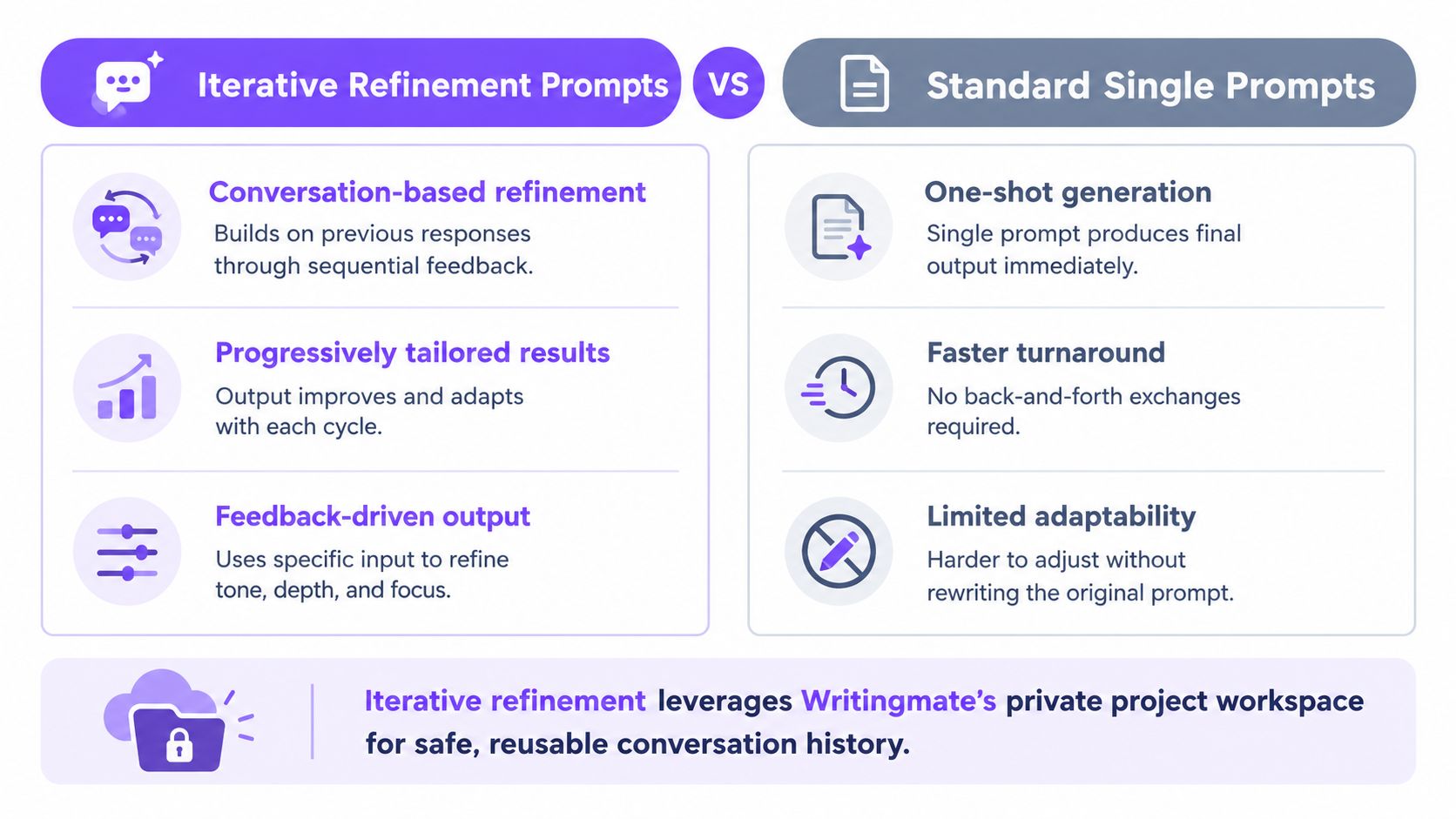
Some tasks improve when you separate exploration, critique, revision, and production. Iterative prompts let the AI respond to feedback instead of forcing every requirement into one oversized instruction.
A practical sequence might look like this:
Initial: Create an outline for a blog post about AI productivity tools.
Refinement: Make the outline more relevant to small business owners, and add the questions they need answered before choosing a tool.
Further refinement: Add a section on research, file analysis, and model comparison. Remove claims that would require unsupported statistics.
Final: Expand the approved outline into a practical article with examples, short paragraphs, and clear headings.
This structure works particularly well for marketing briefs, creative writing, content updates, debugging, and research synthesis. Each turn has one job, so you can identify whether the problem came from the direction, the context, or the execution.
The trade-off is drift. If you keep adding changes without preserving the original objective, the draft can become inconsistent. Conversation history can also carry forward an early mistake, so important facts and constraints should be restated or checked before publication.
Give feedback the model can act on
“Make it better” is weak feedback. “Reduce jargon, add a concrete example for a marketing manager, and keep the original three-part structure” gives the model observable changes.
Writingmate's prompt generator for writing can help generate starting structures, but refinement still depends on editorial judgment. Keep intermediate versions in a project workspace, compare revised outputs across models when useful, and use agents for repeatable multi-step workflows only after the manual sequence is stable.
“Improve the draft” describes a desire. “Change these three properties while preserving these two” describes a task.
7. Data-Driven Analysis Prompts
Data prompts ask the AI to extract, classify, summarize, or interpret information supplied in files or structured text. They work best when the question tells the model what evidence to use and what form the answer should take.
Examples include:
Analyze this customer feedback spreadsheet and identify the top pain points. Group similar comments, include representative evidence, distinguish frequency from severity, and recommend follow-up questions.
Review this competitor analysis document and summarize each competitor's strengths, weaknesses, positioning, and unresolved gaps.
Extract the key data points from this PDF report and create an executive summary. Flag missing context and separate direct findings from interpretation.
The important distinction is between extraction and inference. Extraction asks what the document says. Inference asks what the information might mean. Combining both in one prompt can be useful, but label the difference so readers don't mistake a model's interpretation for source evidence.
Require traceable outputs
Ask for page numbers, row references, quoted excerpts, or source fields where the workflow supports them. Request a table or structured JSON when another system will consume the result. If the file contains ambiguous categories, define the classification rules before asking the model to count or group items.
Writingmate's file analysis tools support document uploads for summaries, answers, and structured analysis. Web search can add external context, but don't let outside information replace the supplied evidence. Review sensitive files under your organization's privacy and access requirements.
A useful follow-up is: “Which conclusions are directly supported by the file, which are reasonable interpretations, and what additional data would change the recommendation?”
8. Systematic Instruction Prompts
Systematic prompts convert a complex task into an ordered procedure. They're useful when the same workflow must be performed repeatedly, especially for research operations, content production, technical support, and AI agents.
For example:
Create a five-step process for researching a new market segment: define the target audience, search for market data, analyze competitor presence, identify gaps, and summarize findings. For each step, list the required input, expected output, quality check, and fallback if information is unavailable.
Another version is:
Provide detailed instructions for creating a monthly content calendar. Include the inputs needed, research steps, editorial decisions, tools required, approval checkpoints, and final quality review.
The strength is consistency. A sequence makes hidden assumptions visible and gives a team something to test. It also helps an agent know when to stop, what to return, and what to do when an input is missing.
The limitation is rigidity. A workflow that works for one type of brief may fail when the topic, audience, or source quality changes. Long instructions can also bury the most important rule.
Design for failure, not just the happy path
Define success for each stage. Say what counts as a usable source, how the agent should handle conflicting information, and whether it should ask for clarification or continue with a stated assumption. Specify the final output format, naming conventions, and escalation conditions.
Test systematic instructions with different models and varied inputs. If an agent repeatedly fails at the same step, revise that step rather than adding unrelated instructions to the entire prompt. Reusable workflows should remain understandable to the humans responsible for checking them.
9. Research and Synthesis Prompts
Research prompts ask the AI to gather information, assess sources, and combine multiple perspectives into a coherent answer. They differ from open-ended discovery because they impose a stronger evidence and synthesis requirement.
Try:
Research current best practices for AI prompt engineering and synthesize the findings into a practical guide. Use recent, credible sources, identify areas of agreement and disagreement, explain limitations, and cite each factual claim.
Or:
Find recent case studies about unified AI platforms and team productivity. Summarize the reported outcomes, describe the methods used, and separate verified findings from promotional language.
A good research question names the topic, audience, scope, source expectations, time frame, and final format. It also asks the model to deal with disagreement rather than flattening every source into one confident conclusion.
Treat citations as a verification starting point
Writingmate's web research and search features can return cited information for current topics. Still, citations don't remove the need to inspect the source. Check whether the linked page supports the claim, whether the source is primary or promotional, and whether the wording overstates what the evidence says.
Research is often more useful when you ask for a source matrix containing the claim, source, evidence, confidence, and unresolved question. That structure makes gaps visible before the material becomes a blog post, strategy document, or executive recommendation.
Evidence discipline: Ask the model to distinguish what a source states, what it infers, and what remains unknown.
For difficult subjects, a second prompt can act as a cross-examination. Ask a skeptical reviewer to challenge the synthesis, identify unsupported conclusions, and propose questions that would test the argument. A resource such as this guide to cross-examination for students can help you frame that review as a sequence of answerable questions rather than a general request to “fact-check.”
10. Customization and Personalization Prompts
Personalization prompts adapt an answer to a specific reader, role, use case, or stage of expertise. They work because they give the AI a reason to choose certain examples, vocabulary, objections, and calls to action over others.
Try:
Create a guide to AI productivity tools for independent writers with limited technical experience. Explain the workflow in plain language, focus on research and drafting, address concerns about losing editorial control, and include a simple evaluation method.
For sales content:
Write an email pitch about a unified AI platform for a CMO at a mid-size marketing agency. Focus on workflow fragmentation, model comparison, team consistency, and research with citations. Use an informed, concise tone and avoid unsupported performance claims.
For product onboarding:
Develop an onboarding email sequence for software developers explaining an AI platform's API, file analysis, model selection, and integration options. Assume the reader understands APIs but hasn't used this platform before.
Personalize the decision, not just the wording
Include the audience's role, experience, pain points, goals, objections, available resources, and desired next action. “For marketers” is a broad label. “For a content lead managing freelance writers who need consistent briefs and source-backed research” gives the model a usable context.
Combine personalization with a role prompt when you need a particular editorial or commercial viewpoint. Use agents when the same audience adaptation appears across many assets, but review the output for stereotypes, overgeneralization, and invented assumptions.
The best personalized prompt also states what must remain stable. Brand facts, product capabilities, legal language, and evidence standards shouldn't change merely because the audience changes.
Comparison of 10 Prompt Question Types
| Prompt Type | 🔄 Implementation Complexity | Resource Requirements | ⚡ Speed / Efficiency | ⭐ Expected Outcomes / 📊 Impact | 💡 Ideal Use Cases & Key Advantages |
|---|---|---|---|---|---|
| Open-Ended Discovery Prompts | Medium, low setup, may need follow-up | Minimal (prompts); optional web search; multi-model for breadth | ⚡ Moderate, quick ideas but follow-up needed | ⭐ Broad insights; 📊 Diverse perspectives and idea generation | 💡 Brainstorming, early research; sparks innovation; save successful prompts |
| Constraint-Based Prompts | Medium, requires precise specs | Low to moderate (templates, format guidelines) | ⚡ Fast, focused, publishable outputs | ⭐ High-quality, consistent outputs; 📊 Reduces editing needs | 💡 Ideal for brand-voice content and repeatable tasks; store templates |
| Role-Playing & Perspective Prompts | Medium, define clear persona and scope | Persona definitions; optional web search; multi-model comparison | ⚡ Moderate, single-shot voice, may need tuning | ⭐ Authoritative, audience-tuned responses; 📊 Multiple stakeholder views | 💡 Use for expert-style content and audience framing; save personas |
| Comparative Analysis Prompts | High, need clear criteria and structure | Data, evaluation criteria, multi-model comparison tools | ⚡ Slower, detailed, information-dense outputs | ⭐ Evidence-based recommendations; 📊 Ranked pros/cons and gap analysis | 💡 Tool/platform selection and strategic decisions; reduces bias |
| Problem–Solution Framework Prompts | Medium, requires clear problem definition | Context files or descriptions; optional web search | ⚡ Moderate, actionable proposals with follow-up | ⭐ Actionable solutions and implementation options; 📊 Prioritized recommendations | 💡 Business workflows, pain-point resolution; ask for timelines/resources |
| Iterative Refinement Prompts | Medium, repeated loops and feedback | Conversation history, project workspace, time for iterations | ⚡ Slower overall (multiple rounds) | ⭐ Highly tailored final output; 📊 Progressive quality improvements | 💡 Best for polished content; save intermediate versions; use agents |
| Data-Driven Analysis Prompts | High, depends on data complexity | Well-structured data/files; analysis tools; verification | ⚡ Moderate, analysis time varies with dataset | ⭐ Actionable insights; 📊 Extracted metrics, summaries, patterns | 💡 Research, campaign analysis; verify complex stats manually |
| Systematic Instruction Prompts | High, detailed step planning required | Detailed specs, input/output definitions, agents for automation | ⚡ Fast when automated; slow to author initially | ⭐ Consistent execution; 📊 Reusable process documentation | 💡 Build agents and SOPs; ideal for repeatable workflows & handoffs |
| Research & Synthesis Prompts | High, scope and source management | Web search, citation tracking, multiple sources | ⚡ Moderate–Slow, thorough research takes time | ⭐ Current, cited syntheses; 📊 Multi-source summaries with citations | 💡 Use for up-to-date guides and case studies; specify time frame |
| Customization & Personalization Prompts | Medium, requires audience detail | Audience personas, user data, automation agents for scale | ⚡ Moderate, can be automated at scale | ⭐ Highly relevant, higher engagement; 📊 Tailored messaging & sequences | 💡 Targeted campaigns and onboarding; combine with role-playing and agents |
Turn Good Questions Into Reusable Prompt Systems
The most useful prompt questions examples aren't isolated phrases you copy into a chat window. They're selection tools. Choose discovery when you need possibilities, constraints when you need control, and perspective or personalization when the answer must fit a particular reader or decision-maker.
Use comparison and research when you're choosing between options or building a source-backed view. Use data analysis when the evidence lives in a spreadsheet, PDF, transcript, or other file. Choose iterative refinement when the work benefits from critique and revision, and use systematic instructions when the same process needs to run consistently.
Prompting became more structured as models became more capable. The release of GPT-3 in 2020 helped popularize few-shot prompting, where examples embedded in the prompt guided model outputs without retraining, as described in this history of prompt engineering. Chain-of-thought prompting later showed how explicit reasoning structure could affect benchmark performance. One cited MultiArith example moved from 17.7% to 78.7% accuracy, a 61 percentage point difference, after adding “let's think step by step,” according to this overview of prompt engineering history. Use such findings as evidence that structure matters, not as a reason to demand hidden reasoning from every model or task.
Recent evidence also points toward context engineering, where the prompt sits inside a broader system of role, task, constraints, output format, retrieval, and tools. A review reported an average 6% performance improvement from structured prompting and changes on 5 of 7 benchmarks, with the strongest gains associated with chain-of-thought structure, as detailed in the 2026 prompt engineering review. For technical workflows, a code-generation case study reported F1 changes from 0.2026 to 0.6828 for Sonnet-4, 0.2487 to 0.7163 for Sonnet-4.5, and 0.2952 to 0.8081 for Ops-4.6 when moving from Minimal to Guided prompts on the DragonFly repository. Across both repositories, its zero-precision rate fell from 60.2% to 3.5%, while perfect recall rose from 14.4% to 59.8%, as reported in this file-level code generation study. Those results support adding relevant context and guidance, not just making every question longer.
Use this compact design checklist before sending a prompt:
- Goal: What decision, draft, analysis, or action should the answer support?
- Context: What does the model need to know about the audience, source material, workflow, or constraints?
- Constraints: What must the answer include, avoid, or stay within?
- Output format: Should it return prose, bullets, a table, JSON, a process, or a ranked recommendation?
- Verification: Which claims need citations, evidence excerpts, calculations, or human review?
- Follow-up: What question will narrow, challenge, or improve the first response?
Start with the simplest structure that matches the job. Save the prompts that work, compare their outputs across models, and revise the template when the task repeats. Writingmate brings multi-model chat, comparison, web research, file analysis, prompt tools, and agents into one workspace, which can make that testing and standardization easier for independent creators, marketing teams, developers, and researchers.
Writingmate combines multi-model chat with web research, file analysis, media generation, reusable prompts, agents, and side-by-side comparison in one workspace. Use it to test the prompt questions examples in this guide, identify which structure fits your workflow, and save the versions that produce reliable results. Visit Writingmate to start building a repeatable prompt system.
Frequently Asked Questions
Sources

Written by
Artem Vysotsky
Ex-Staff Engineer at Meta. Building the technical foundation to make AI accessible to everyone.

Reviewed by
Sergey Vysotsky
Ex-Chief Editor / PM at Mosaic. Passionate about making AI accessible and affordable for everyone.