
You've probably had the same week: three inboxes overflowing, a calendar full of follow-ups, and a stack of repetitive tasks that keep stealing time from sales, delivery, or hiring. At that point, the question isn't whether you need help, it's whether the next hire should be local, offshore, or partially automated. For many teams, virtual assistants Latin America becomes the practical middle ground, because the region can line up with North American working hours while still giving you access to strong bilingual operators, customer support talent, and ops support that doesn't feel twelve time zones away.

Table of Contents
- Why Latin America Became the Go-To Region for Virtual Assistants
- Typical Rates, Skills, and Roles by Country
- Trade-Offs of Hiring Latin American VAs
- Contracts, Payroll, and Legal Basics Across LATAM
- How LatHire Can Help
- Where to Source Latin American Virtual Assistants
- Screening and Interviewing Latin American VAs
- Onboarding, Management, and Retention Workflows
- Sample Job Descriptions and Your 30-60-90 Day Action Plan
Why Latin America Became the Go-To Region for Virtual Assistants
A founder I worked with had a simple problem. His sales lead was spending half the day on CRM updates, quote follow-ups, and appointment scheduling, while his own calendar kept slipping because no one owned the admin layer. He did not need a full in-house operations hire yet, but he also did not want a freelancer who disappeared whenever something urgent came up.
That is the practical case for Latin America. A virtual assistant in Latin America usually handles admin, customer support, marketing coordination, research, sales ops, or light technical work from countries like Mexico, Colombia, Argentina, Brazil, or Chile. The draw is not just lower cost. It is the mix of overlapping time zones, clear day-to-day communication, and a talent pool that can support both generalist work and specialized support.
Why the region keeps showing up in hiring conversations
For North American teams, coordination is the true test. If your assistant works while you are awake, you can approve a refund, fix a shipment issue, or adjust a campaign before the day ends. That short feedback loop often matters more than a slightly lower rate from a far-distant market.
The region also has the digital habits to support remote support work. The Latin American voice-assistant market was valued at about USD 170.4 million in 2024 and is forecast to reach USD 768.1 million by 2030, according to market research estimates. Brazil is part of that shift, with smartphone adoption at 88% in 2023 and projected to reach 95% by 2030. Argentina's internet penetration also rose from 77.7% in 2018 to 89.23% in 2023. Those figures do not define the VA market on their own, but they do show why mobile-first work, WhatsApp-based handoffs, and voice-heavy workflows are realistic operating channels.
A practical rule holds up well here. If a task needs live back-and-forth, choose proximity and responsiveness over pure cost.
The region works well for teams that need someone who can think, message, update, and hand off in real time. That is a different hire from a one-off task taker, and it changes how you should screen, train, and manage the role.
Typical Rates, Skills, and Roles by Country
Country choice matters, but the central question is role design. A general admin VA, a bilingual customer support VA, and a marketing coordinator are different hires, even if the title looks similar. I'd size the work by role complexity, language needs, and how much judgment the job requires.
Here is a practical snapshot buyers can use as a starting point:
| Country | Typical Monthly Rate (USD) | Common Strengths | Best-Fit Roles |
|---|---|---|---|
| Mexico | $900-$1,800 general admin, $1,500-$2,500 bilingual support | Time-zone overlap, customer communication, operations support | Customer support, executive admin, sales follow-up |
| Colombia | $800-$1,500 general admin, $1,400-$2,400 bilingual support | Service orientation, bilingual support, general ops | Admin, customer success, scheduling, research |
| Argentina | $900-$1,700 general admin, $1,600-$2,800 technical or marketing support | Strong digital fluency, analytical work, content support | Marketing coordination, research, operations |
| Brazil | $850-$1,600 general admin, $1,500-$2,700 multilingual or messaging support | Large talent base, multilingual demand, messaging workflows | Customer support, community ops, marketing, voice workflows |
| Chile | $1,000-$1,900 executive support, $1,500-$2,500 finance or project support | Professional communication, reliability, structured work | Executive support, finance ops, project coordination |
| Peru | $700-$1,300 general admin, $1,200-$2,000 back-office support | Cost-conscious general support, growing remote talent pool | Admin, document handling, back-office tasks |
Rates shift with seniority and English level, so these ranges are a starting point, not a quote. The useful comparison is not country alone. It is whether the role needs routine execution, customer-facing judgment, or stronger coordination across tools and handoffs.
For customer-facing work, language and tone usually matter more than the country label. For process-heavy work, I care more about whether the candidate can document steps, use the right tools, and keep work organized without constant nudging. That is why the same country can be a good fit for one role and a poor fit for another.
If you are comparing support models, this customer service with AI guide is useful because the best outcome is often a hybrid one, not a pure human or pure automation stack. A VA who handles routine tickets while AI drafts responses can outperform a lower-cost generalist who needs every instruction repeated.
Budget reality: pay for the judgment the role needs, not the cheapest available title.
That holds up in practice. If the work is repetitive and defined, general admin talent can be enough. If the work touches customers, revenue, or brand voice, pay for stronger English, better tool fluency, and tighter process instincts.
Trade-Offs of Hiring Latin American VAs
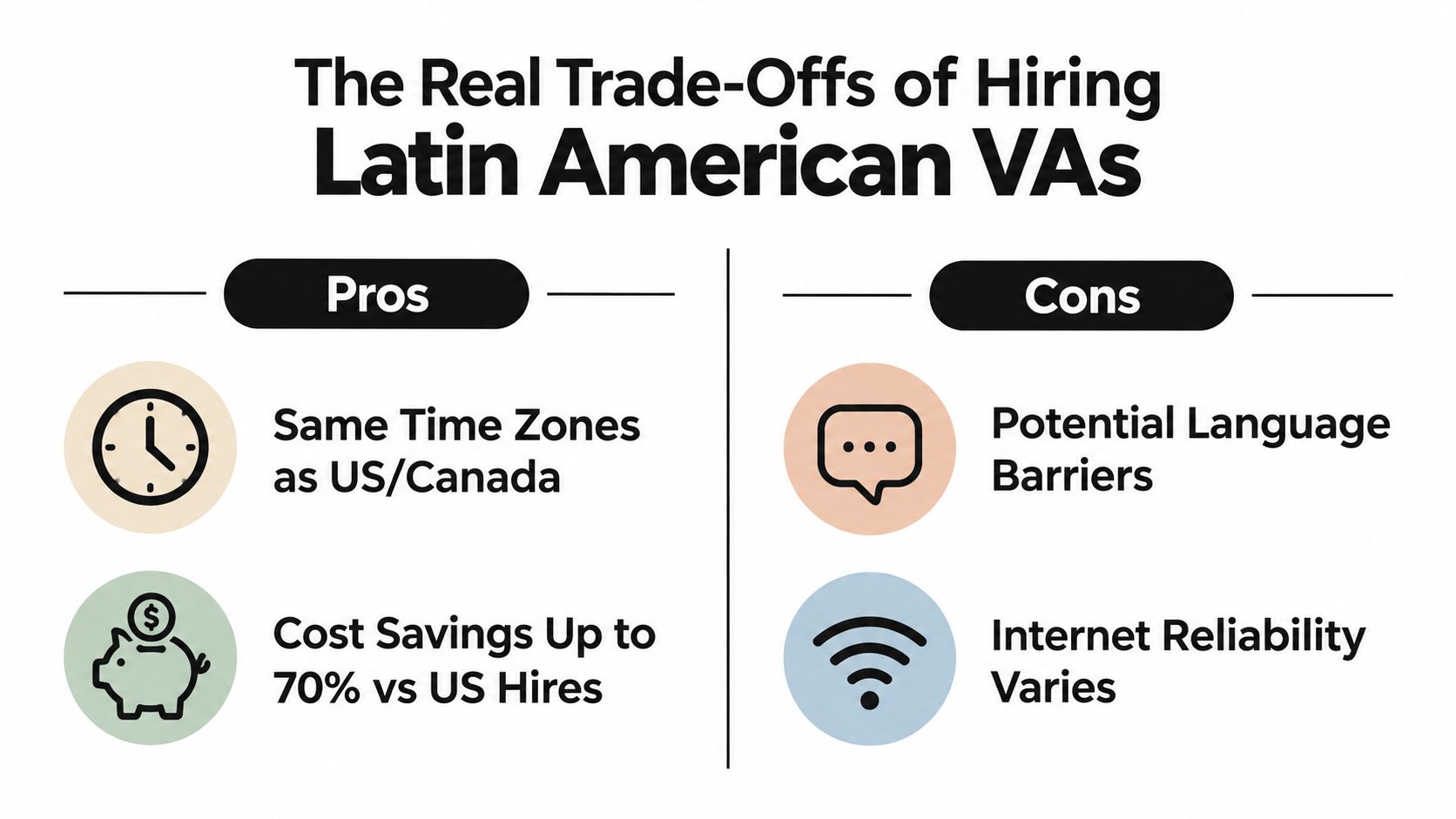
Latin America often wins because it fits operations, not because it is always the cheapest place to hire. If your team sits in New York, Toronto, or Texas, the practical upside is easy to see. A VA can answer, escalate, and resolve issues during your workday instead of pushing everything to the next morning.
Where LATAM is strong
The strongest fit is work that needs same-day collaboration and enough cultural alignment that instructions do not need constant translation. Sales teams, customer success groups, and founders with messy back-office processes usually feel that benefit quickly. Messaging-based work also fits well because many teams already run on WhatsApp and similar tools.
A 2023 IDC and Yalo study of Mexico, Colombia, and Brazil found that 66% of surveyed companies had already adopted digital technologies to communicate with suppliers or business partners, that investment in B2B chatbots was expected to grow 31% by 2025, that 82% of companies in Mexico in the study preferred WhatsApp for customer relationships, and that only 40% of companies had connected with customers through conversational commerce. The useful point is not the headline percentage. It is the operating pattern. These teams are already used to digital handoffs, WhatsApp-based service, and partial automation. A VA who works alongside those systems usually fits better than one who expects everything to happen by email.
Where the hidden costs show up
The downside is coordination, not effort. Cross-border hiring adds payroll, classification, onboarding, and contract work that can get messy fast if nobody owns the process. A strong VA can still become a poor operational choice if you do not have a clear system for approvals, access control, and escalation.
The comparison set matters too. A U.S.-based remote hire is often easier to manage legally, though usually more expensive. Asian outsourcing can be cheaper for some task types, but time-zone overlap is often worse. AI-only workflows can look efficient on paper, but they break down when the task needs judgment, escalation, or relationship handling. In practice, the best setup is often a hybrid one. AI drafts the routine response, and the VA handles exceptions, tone, and follow-up.
That leaves a straightforward rule. Latin America is a strong fit when responsiveness, overlap, and human judgment matter more than chasing the lowest hourly rate. It is a weaker fit when you need a fully standardized back office and do not want cross-border management at all.
Contracts, Payroll, and Legal Basics Across LATAM
Hiring a great assistant and paying them badly is a bad way to start. So is getting the legal structure wrong and hoping nobody notices. The details vary by country, but the fundamentals are the same: classify the relationship correctly, define the work clearly, and protect your data and intellectual property from day one.
The documents that should not be optional
A solid engagement usually includes a contractor agreement, IP assignment language, confidentiality terms, data-handling obligations, invoicing rules, and an escalation path for off-hours issues. If the assistant will touch customer data, financial records, or contracts, spell out access controls and retention expectations in plain language. Don't bury that inside vague “professional services” wording and call it done.
Non-negotiable: if the VA can access business systems, the contract should define what happens when the engagement ends.
Payments also need to be boring and predictable. International wires, Payoneer, Wise, Deel, and local payroll providers are all used in cross-border hiring, but the best choice depends on whether you're paying a contractor, running payroll, or managing multiple workers through one system. The payment tool matters less than whether the invoicing, currency handling, and approval flow are consistent.
A simple compliance checklist
- Role scope. Define exactly what the VA owns and what stays with you.
- Classification. Treat contractor and employee setup differently from the start.
- IP rights. Make sure work product belongs to your company.
- Confidentiality. Cover customer data, internal docs, and account credentials.
- Data handling. Limit access and document what tools the VA can use.
- Invoice process. Decide who bills, when, and in what format.
- Offboarding. Remove access and confirm file handoff when the work ends.
The point isn't to turn yourself into a labor lawyer. The point is to avoid the common mistake of paying for labor while silently inheriting legal and data risk. If the role is core to your business, a U.S. hire can still be the cleaner call. If the role is modular, remote, and process-driven, a properly papered LATAM engagement is usually the better operating choice.
How LatHire Can Help
Sourcing is where a lot of companies lose time. They post a role, sift through mismatched applicants, and end up hiring whoever replied fastest. A better sourcing channel compresses the search, improves fit, and gives you some confidence that the candidate can do the work.
LatHire is one of the clearer examples of a platform built for this exact problem. It connects U.S. and Canadian companies with pre-vetted Latin American professionals across technology, marketing, sales, and operations, and it adds screening, background checks, and hiring support around the talent pool. If you want a faster path to qualified candidates, you can hire Latin American virtual assistants through a platform that also handles payroll, benefits, and compliance support.
Where it fits and where it doesn't
This kind of platform makes the most sense when the role is important enough that random marketplace screening isn't good enough. That includes operations support, bilingual customer service, marketing coordination, and more specialized roles that need a wider filter than a job board can provide. It's also a good fit when you want one place to manage candidate matching, onboarding, and cross-border admin.
Direct hiring still has a place, especially if you're building a small core team and want more control over culture and compensation. Freelance marketplaces can work for narrower projects. Agencies can help when the role is high-stakes and speed matters. The right channel depends on the work, not the logo.
Where to Source Latin American Virtual Assistants
The best sourcing strategy depends on how messy the role is. If you need someone to own a defined function, don't waste time on generic marketplaces alone. If you need a project-based assistant for document cleanup or lead enrichment, a broader pool can be enough.
The four sourcing paths
Specialized staffing agencies usually charge a markup, but they reduce the screening burden and are useful for executive support or specialized operations roles. General freelance platforms like Upwork give you volume and flexibility, though you'll need a tighter vetting process. Curated marketplaces can be a middle ground when you want pre-screened talent without fully outsourcing hiring. Direct sourcing through LinkedIn, local boards, and referrals works best when the role is long-term and part of your operating core.
Rule of thumb: the more customer-facing or process-sensitive the role, the more you should pay for screening.
Matching channel to role
- Agencies. Best for executive assistants, technical VAs, or roles that need fast shortlisting.
- Marketplaces. Best for admin support, task-based help, and lower-risk project work.
- Direct sourcing. Best for long-term team members where retention and culture matter.
- Referrals. Best when you already trust the person making the introduction.
If you're hiring for a role that touches inboxes, calendars, and customer communication, quality screening matters more than channel purity. If you're hiring for a well-bounded project, speed can matter more than perfect pedigree. And if the assistant will stay embedded in your team for a year or longer, invest in a sourcing path that gives you cleaner ownership from the start.
Screening and Interviewing Latin American VAs
The most expensive mistake is treating VA hiring like low-stakes admin work and skipping the work sample. A polished resume can hide weak execution, and a low rate can hide slow communication or chaotic follow-through. Structured screening catches both.
A process that actually exposes quality
Start with a written application that asks candidates to respond to role-specific scenarios. Then do a 30-minute video screen to check communication, pace, and English comfort. After that, use a paid 60-minute work sample that reflects actual job duties. Finish with a culture-fit conversation only after the candidate has already shown how they work.
That sequence filters for the things that matter: clarity, tool fluency, and the ability to document decisions. It also gives you a realistic read on whether the person can work asynchronously without being chased for every update.
A few interview prompts are especially useful:
- Process recall. Ask them to walk through a task they handled from start to finish.
- AI fluency. Ask how they verify outputs before sending anything to a client.
- Tool stack. Ask which tools they use for notes, task tracking, and file sharing.
- Async habits. Ask how they flag blockers when you're offline.
- Reliability. Ask how they handle power or connectivity issues without missing deadlines.
The biggest red flag is vagueness. If someone can't explain how they work, what they double-check, or how they prioritize, the relationship will cost you more than the salary line suggests.
If you're also refining the job post itself, this AI cover letters guide can help you think more carefully about what candidate-generated text is telling you. In VA hiring, the work sample is still far more valuable than any polished intro.
Onboarding, Management, and Retention Workflows
A good hire can still fail if the first month is sloppy. The work needs a home, the owner needs clear priorities, and the handoff has to be documented in a way that survives vacation, turnover, and timezone gaps. That's why onboarding is an operating system, not an orientation call.
A workable 30-60-90 rhythm
Days 1 to 30 should focus on tools, SOPs, and small wins. The VA should know where files live, how requests come in, what “urgent” means, and who approves what. By day 60, the person should own a real slice of work with limited supervision. By day 90, the assistant should be handling routine decisions, flagging exceptions, and improving the process instead of just following it.
Notion, Loom, and simple SOP docs are enough for the majority of teams. The goal is to remove ambiguity, not build a corporate intranet. If you have more than one assistant, standardize naming, task routing, and escalation so handoffs don't disappear into Slack noise.
Practical insight: micromanagement across time zones usually means the workflow wasn't documented well enough.
Retention is cheaper than replacement
Pay reviews, growth paths, and better responsibilities matter because strong assistants eventually learn your business better than you expect. When that happens, they're no longer just an assistant. They're an operator. Losing that person forces you to re-teach everything, which is expensive even before you count the time lost.
If you want a simple benchmark for daily tool choices and workflow cleanup, this productivity tools guide is useful as a reference point for what can be automated, templated, or delegated. The best teams don't manage VAs with memory. They manage them with documented systems and a clean cadence.
Sample Job Descriptions and Your 30-60-90 Day Action Plan
The fastest way to move from reading to hiring is to turn the role into something concrete. The job description should make it obvious what success looks like, what tools the assistant will use, and where the line sits between routine work and escalation.
Three sample roles
General admin and operations VA. This person handles inbox triage, scheduling, file organization, follow-ups, and basic reporting. They should be comfortable with Google Workspace, project tracking, and process notes. Success looks like fewer dropped tasks and less founder interruption.
Bilingual customer support VA. This role handles ticket triage, WhatsApp or email communication, FAQ responses, and escalation. The assistant needs strong written communication, calm judgment, and comfort with scripts and knowledge bases. Success looks like faster response handling and cleaner handoffs to specialists.
Marketing coordinator VA. This person manages content calendars, asset collection, coordination with designers, and campaign checklists. They should be able to work in shared docs, track deadlines, and follow brand instructions without constant correction. Success looks like fewer missed launches and cleaner execution across channels.
A simple 30-60-90-day plan
- Days 1 to 30. Finalize scope, legal setup, tools, and the hiring channel.
- Days 31 to 60. Run structured screening, make the hire, and complete onboarding.
- Days 61 to 90. Review performance, tighten SOPs, and decide whether to expand responsibilities.
If you're hiring now, start with one role, one scorecard, and one source channel. Don't overbuild the process before you've learned what the assistant needs to own. If you want support beyond the first hire, Writingmate can help your team research, draft, compare, and organize the hiring materials that make the process faster and cleaner.
Frequently Asked Questions
Sources

Written by
Artem Vysotsky
Ex-Staff Engineer at Meta. Building the technical foundation to make AI accessible to everyone.

Reviewed by
Sergey Vysotsky
Ex-Chief Editor / PM at Mosaic. Passionate about making AI accessible and affordable for everyone.