Your team probably has an automation pilot that looks impressive in a demo and frustrating in daily work. An agent reads a request, finds information, drafts a response, and appears to complete the workflow. Then a permission changes, an API returns an unfamiliar status, or a customer supplies incomplete information. The agent stops, retries the wrong action, or creates a result someone must inspect line by line.
That gap between pilot enthusiasm and durable production automation is the core problem. AI agents can plan, use tools, and adapt across multiple steps, but capability alone doesn't make a workflow dependable. The useful question isn't whether an agent can perform a task once. It's whether your team can control its authority, detect exceptions, explain its decisions, and recover without creating more work than it removes.
Table of Contents
- Why AI Agents Are the Next Automation Wave
- How AI Agents Actually Work
- Performance Reality Check for Agent Automation
- Real-World Use Cases That Deliver Value
- Building Custom Agents or Using Platforms
- Moving from Pilot to Production Automation
- Start Small with AI Agents for Automation
- Frequently Asked Questions About AI Agents
Why AI Agents Are the Next Automation Wave
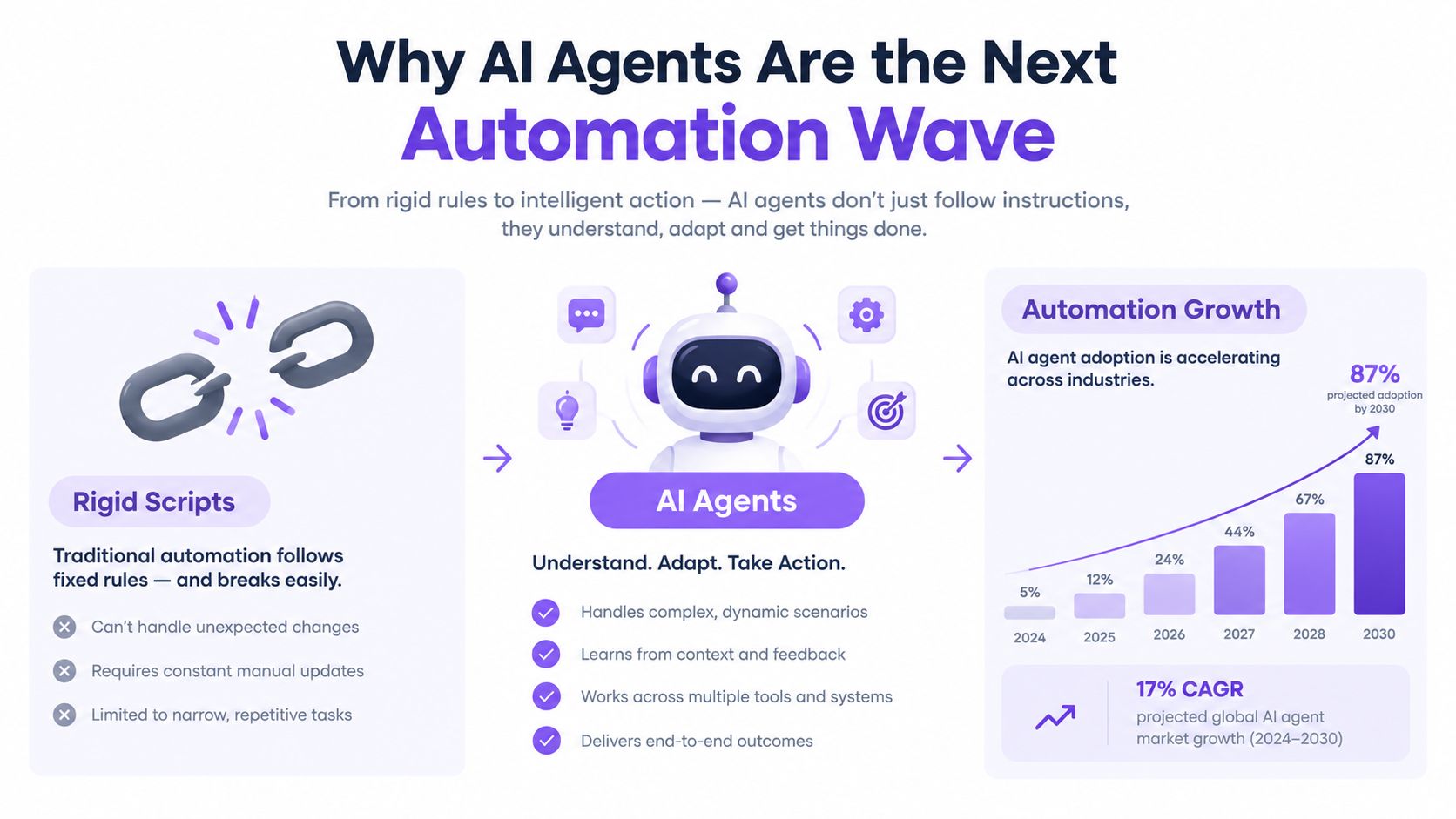
A traditional script expects the world to behave exactly as designed. A purchase-order bot opens the right system, selects the right fields, submits the form, and exits. If a supplier changes the document layout or a required field is empty, the script usually fails because its instructions describe a fixed path rather than the underlying objective.
AI agents for automation approach the same problem differently. Given a goal, an agent can interpret the request, decide which system to query, select tools, evaluate the result, and continue through several steps. It can route an unusual invoice for review instead of treating every deviation as a fatal error. That flexibility makes agents useful for workflows where the destination stays stable but the route varies.
From scripted actions to operational judgment
The important shift isn't that agents can generate fluent text. It's that large language models make it practical for software to plan, decide, and act across multiple steps, rather than only follow rigid scripts. A support agent might classify a request, retrieve account context, check an entitlement, prepare a response, and escalate a sensitive case. Each action can depend on the previous result.
Adoption signals show that this has moved beyond isolated experimentation. A 2025 industry report found that 57% of companies were already running AI agents in production, while a separate 2026 enterprise guide reported that 80% of organizations said those agents were delivering measurable ROI (G2's enterprise AI agents report). Those findings shouldn't be read as proof that every deployment works. They do show why agentic automation now belongs in operational planning, not only innovation labs.
A 2026 business survey found that organizations using agents had an average of 28 AI agents deployed, suggesting that companies are building portfolios of specialized workers rather than relying on one universal assistant (Jitterbit's state of agentic AI automation report). The opportunity is substantial, but so is the architectural responsibility. More agents mean more identities, tools, failure paths, and audit requirements.
How AI Agents Actually Work
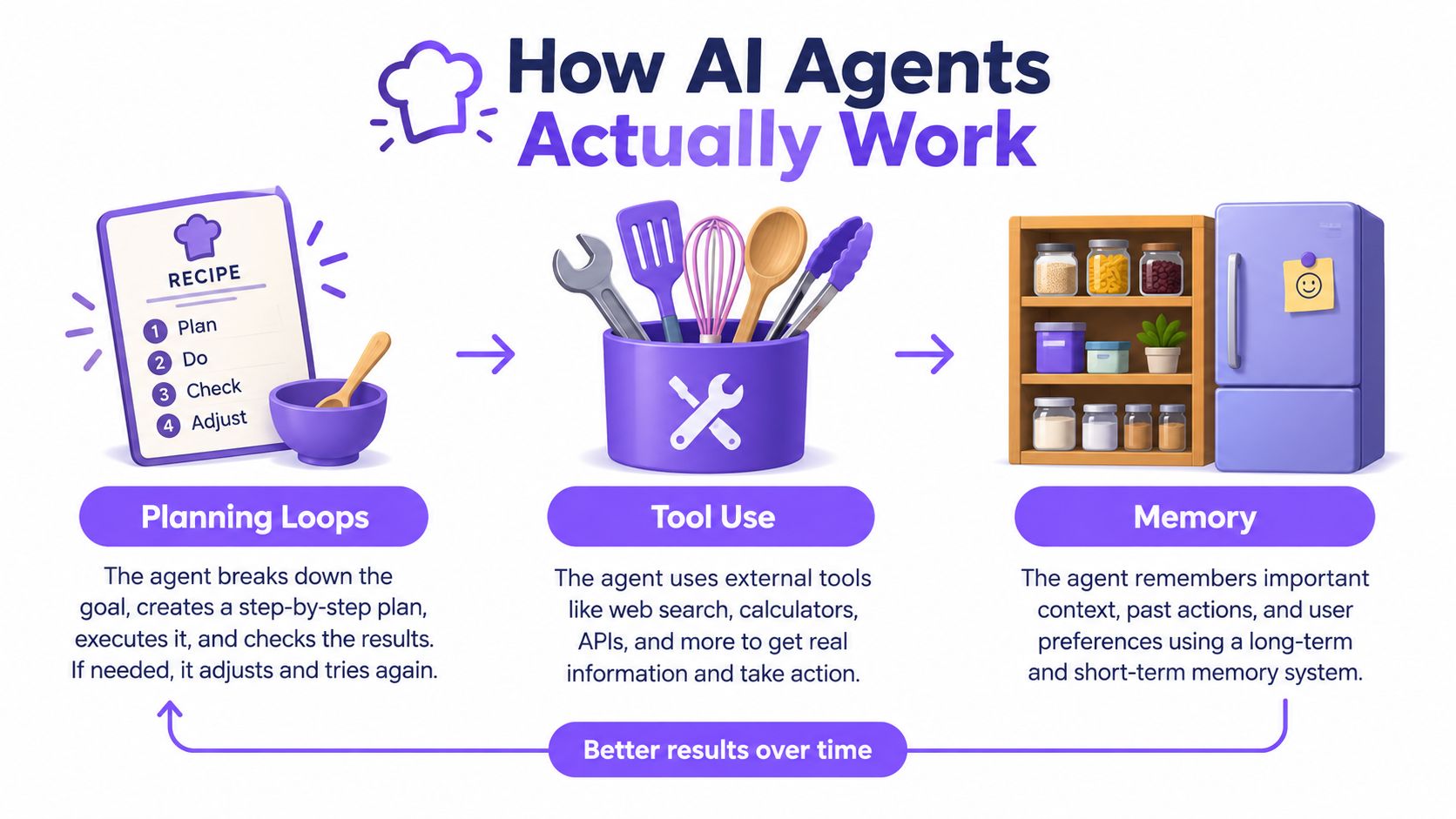
An agent is easier to understand as a kitchen team than as a magical chatbot. You provide a desired meal, not a command for every hand movement. The system turns that goal into a plan, gathers ingredients, uses utensils, checks the result, and adjusts when something is missing.
The planning loop
The first component is a planning loop. The agent interprets the goal, breaks it into actions, and decides what should happen next. After each tool call, it receives an observation and updates the plan. This loop matters because real workflows rarely provide every fact upfront.
A useful loop has explicit stopping conditions. Without them, an agent can repeat a failed call, wander through irrelevant systems, or continue acting after the business objective has already been met. Define what counts as completion, which errors require a retry, and which conditions require a person.
Tools turn reasoning into action
The second component is tool use. Tools are controlled interfaces to systems such as Salesforce, Jira, Slack, a database, a document repository, or an internal API. The agent shouldn't receive unrestricted access to everything a user can access. Give each tool a narrow purpose, typed inputs, validation, and a clear response format.
For example, a refund tool should validate the order, check the permitted amount, record the reason, and return a transaction identifier. The agent can decide when to request a refund, but the tool should enforce the financial rules. This separation keeps the model adaptable while placing critical controls in deterministic software.
Memory is useful only when governed
The third component is memory. Short-term memory holds the current task context. Long-term memory may store approved preferences, customer facts, process documentation, or prior decisions. Treat memory as a data product, not as an unlimited notebook. Define what can be stored, how it is updated, who can retrieve it, and when it expires.
A multi-agent design divides responsibilities among specialized workers, such as a researcher, verifier, and executor. That can improve separation of duties, but it also creates coordination overhead. Start with one agent and clear tools unless specialization solves a demonstrated problem.
The following overview provides a visual introduction to agent behavior and orchestration:
Performance Reality Check for Agent Automation
Agents aren't automatically better than robotic process automation. In a comparative benchmark of LLM agents and RPA on standardized workflow tasks, RPA succeeded in 100% of runs, while the agentic system achieved 90% success on one process and 60% on another. The same benchmark found statistically significant speed disadvantages for the agentic approach, including P2: t = −3.384, p = 0.0096 and P3: t = −17.30, p < 0.001 (the comparative RPA and LLM-agent study).
Those results point to a practical division of labor:
| Workflow condition | Better default | Agent's useful role |
|---|---|---|
| Stable inputs and fixed rules | RPA or conventional code | Trigger, monitor, or report |
| Variable language and documents | Agent with validation | Interpret and classify |
| Multiple systems with uncertain paths | Agentic orchestration | Plan and coordinate |
| High-impact irreversible actions | Deterministic controls plus approval | Prepare, explain, and escalate |
Where agents earn their place
Agents add value when the workflow requires interpretation, exception handling, or coordination across tools. They can examine an unfamiliar customer message, identify missing information, select a relevant policy, and prepare the next action. They can also act as an orchestration layer around reliable services, choosing which deterministic process should run.
That doesn't make the agent the owner of every decision. A good architecture lets the model handle ambiguity while code handles constraints. For stable, repetitive work, an agent may add latency, cost, and another failure surface without improving the outcome.
A 2026 benchmark designed around 47 real tools across Sales, Marketing, Operations, Support, Finance, and HR reinforces this end-to-end view. Its evaluation model drew on patterns from 2B+ monthly tasks across 3.7M companies and focused on multi-tool orchestration, guardrail adherence, and task completion rather than isolated prompt quality (Zapier's AI agent benchmarks). Test the entire workflow, not just the model's answer to a sample prompt.
Real-World Use Cases That Deliver Value
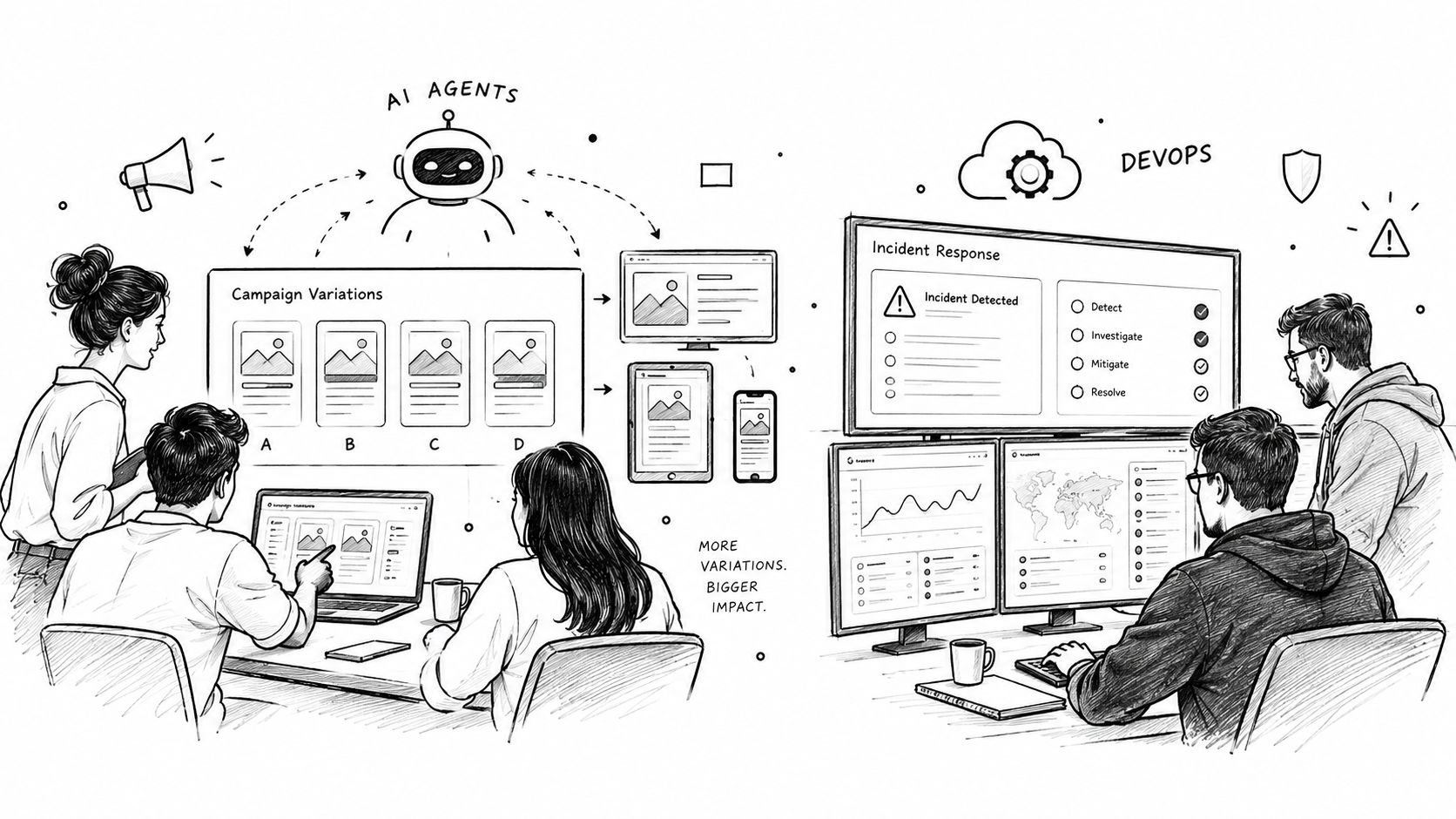
A marketing team rarely needs an agent to invent an entire campaign without supervision. It needs help coordinating the unglamorous sequence around the campaign: inspect a brief, identify audience variants, check approved claims, prepare channel-specific drafts, create review tasks, and flag missing approvals.
An agent can work well here because the process combines structured data with language-heavy decisions. The campaign platform remains the system of record, while the agent handles interpretation and routing. A human still approves messaging, targeting, and publication when the consequences justify review.
Incident response
A DevOps agent can monitor an alert, gather recent deployment context, inspect logs, compare the symptom with known runbooks, and draft a remediation plan. The safe pattern is read broadly, write narrowly. Let the agent collect evidence across observability tools, but restrict production changes to approved actions with explicit conditions.
The agent might restart a service only when a deterministic health check passes and the action is reversible. For an unfamiliar failure, it should create an incident summary and page the right engineer rather than improvise.
Research and content operations
Content teams can use agents to assemble source material, identify gaps in a brief, propose an outline, and draft variations in an approved voice. A reviewer should still verify claims, citations, brand requirements, and search intent. The agent accelerates preparation, but editorial accountability remains human.
Teams evaluating regulated or public-sector workflows may also benefit from specialized context, such as this resource on AI for Government Contracting, which can help frame procurement-related research and compliance questions. For additional examples of task-oriented patterns, see AI agent examples for business workflows.
Across these functions, the strongest candidates share three traits:
- Repeated demand: The team encounters the workflow often enough to justify integration and maintenance.
- Observable outputs: You can verify whether the result is correct without relying on the agent's confidence.
- Bounded authority: The agent can make progress without receiving unrestricted access to sensitive systems.
Building Custom Agents or Using Platforms
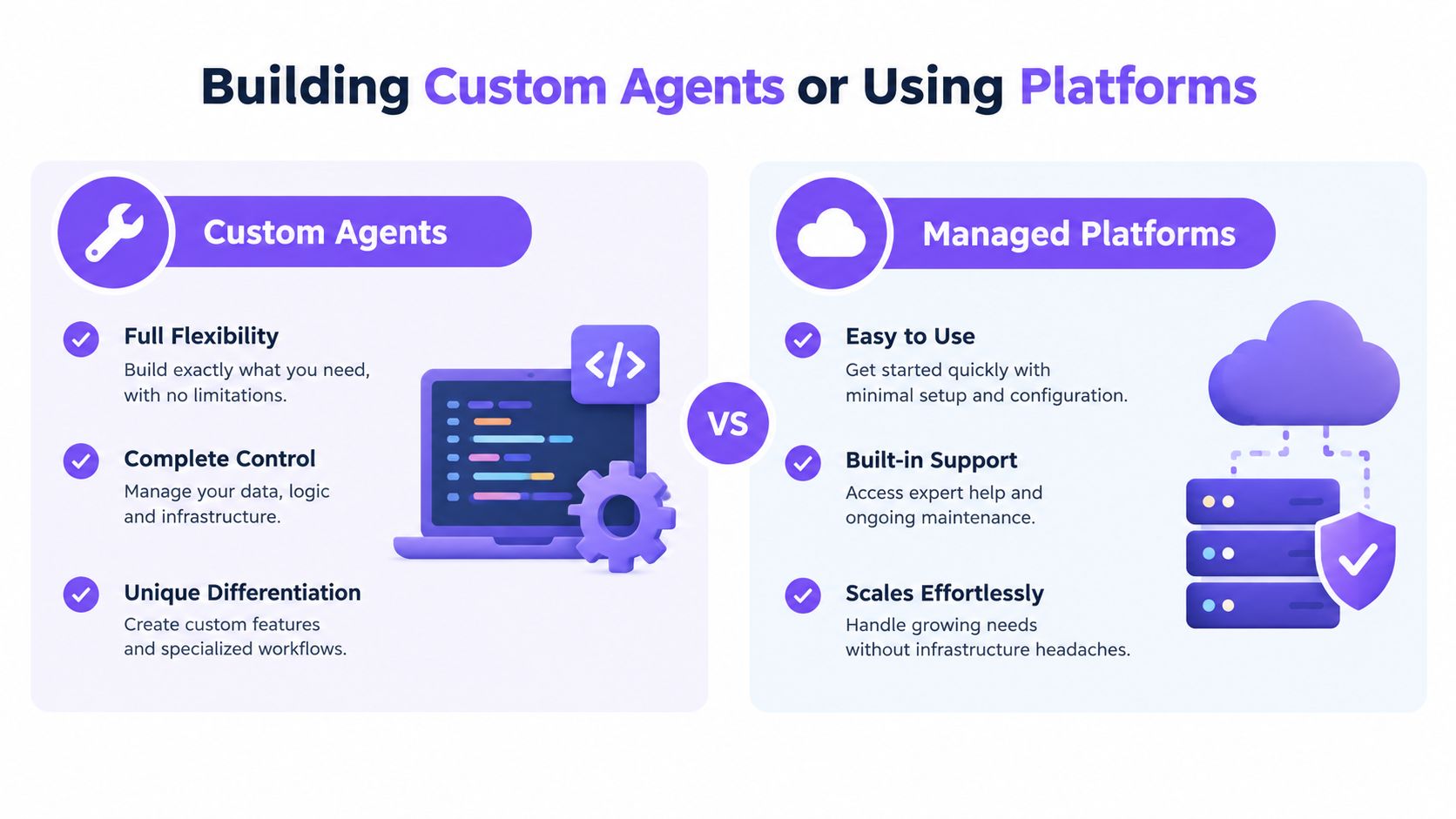
The build-versus-platform decision is less about technical fashion than about where your organization wants to carry operational responsibility. A custom agent gives your engineers direct control over orchestration, prompts, model routing, data handling, tool permissions, and evaluation. It also makes your team responsible for every connector, retry policy, upgrade, trace, and incident.
A managed platform usually offers faster integration, reusable components, model access, observability, and administrative controls. Those advantages can shorten the path to a useful pilot, but you still need to inspect data handling, deployment boundaries, export options, identity integration, and support for human approvals.
Choose custom development when control is the product
Custom development makes sense when the workflow is a core differentiator, requires unusual internal systems, or demands precise control over execution. It can also be appropriate when your team already operates reliable API infrastructure and has the skills to evaluate model behavior.
The hidden cost is maintenance. Models change, tool schemas evolve, permissions drift, and edge cases accumulate. A custom system needs regression tests built from real workflow traces, not only synthetic examples. It also needs a fallback plan for model outages and a way to disable actions without disabling evidence collection.
Choose a platform when integration speed matters
A platform is often the better starting point when the task is common, the systems have supported connectors, and the team needs to validate the workflow before investing in an internal runtime. It can centralize prompts, files, model selection, tools, and reusable agents. Writingmate, for example, provides reusable AI agents with instructions, knowledge files, tools, integrations, and conversation starters, along with connections to external tools through MCP.
That convenience doesn't remove due diligence. Compare AI agent platforms and SDK build approaches before committing. The decision should account for portability, approval workflows, audit logs, tenant isolation, data retention, and whether the platform supports the exact systems your process depends on.
Architecture rule: Build the control plane yourself only when the workflow's value justifies owning its operational complexity.
Moving from Pilot to Production Automation
A pilot can classify requests accurately in a controlled queue, then fail once it encounters missing fields, stale permissions, or an unfamiliar system response. The gap between enthusiasm and durable automation is usually control, exception handling, and governance, not model access.
McKinsey reported that scaling AI agents reached 40% among large enterprises while remaining flat at 22% for smaller organizations (McKinsey's State of AI research). The difference points to the operational support behind deployment, including data teams, integration capacity, governance functions, and ongoing budgets.
Adoption figures show the same pressure. 72% of enterprises were using or testing agents, yet only 31% reported at least one agent in production, according to the 2026 enterprise guide cited in Anthropic's state of AI agents resource. Treat those figures as signals of an adoption gap, not as a universal benchmark.
Production readiness checklist
Before granting an agent durable authority, require clear answers to these questions:
- Identity: Does every action run under a distinct, attributable identity rather than a shared service credential?
- Scope: Can the agent access only the records, tools, and operations required for its assigned workflow?
- Approval: Which actions require a person, and does the system pause before performing them?
- Exceptions: What happens when data is missing, a tool times out, a policy conflicts, or the agent reaches an unfamiliar state?
- Evidence: Can an operator reconstruct the request, retrieved context, tool calls, outputs, approvals, and final result?
- Recovery: Can the team stop the agent, reverse its actions, and replay the workflow safely?
- Evaluation: Are tests based on representative cases, including ambiguous and adversarial inputs?
Measure ROI after accounting for governance, integration, human review, failure recovery, and maintenance. One 2026 enterprise guide reported measurable ROI for 80% of organizations, while MIT Project NANDA research cited in 2025 found that roughly 95% of organizations deploying generative AI saw zero measurable return. The contrast makes the measurement method part of the business case, not an afterthought.
Use this AI agent accountability and audit trail guide to define the operating record. Production starts when the organization can explain what the agent did, why it was permitted, and how a human can intervene.
Start Small with AI Agents for Automation
Don't begin with “automate the department.” Choose one workflow where the pain is visible, the inputs are available, and a person can verify the result. Examples include classifying inbound requests, preparing incident summaries, reconciling document fields, or routing content reviews.
Map the current process before selecting a model. Record the systems involved, handoffs, approval points, common exceptions, and the work people perform after an automated result arrives. If the agent only creates another draft that someone must reread and rebuild, the workflow may become more complicated rather than more efficient.
A disciplined first deployment should have:
- One accountable owner: Someone can change the process, approve access, and review failures.
- One measurable outcome: Track completion quality, handling time, escalation quality, or another business-relevant measure.
- One bounded authority model: Start with read access or draft creation before enabling irreversible actions.
- One failure review loop: Inspect real traces, classify errors, and improve tools or process rules instead of endlessly rewriting prompts.
The first workflow is a learning system. It teaches your team where the model helps, where deterministic automation belongs, and which controls production requires. Expand only after the workflow performs reliably under ordinary variation and known exceptions.
AI agents for automation are valuable when they reduce coordination work without hiding risk. Pick a narrow process, give the agent useful tools, constrain its authority, and measure the complete journey from request to verified outcome.
Frequently Asked Questions About AI Agents
How are AI agents different from chatbots?
A chatbot mainly responds to a conversation. An agent can pursue a goal by planning steps, calling tools, inspecting results, and taking permitted actions. The distinction is operational authority, not conversational style.
Are AI agents secure by default?
No. Security depends on identity, permissions, data boundaries, tool validation, logging, and human approvals. Start with the least authority needed, and keep sensitive or irreversible actions behind explicit controls.
Which model should a team choose?
Choose the least complex model that meets the workflow's requirements. Test reasoning, tool use, latency, cost, structured output, and failure behavior on representative cases. A larger model won't compensate for poor process design or unrestricted tools.
Should agents replace RPA?
Usually not across the board. RPA remains a strong fit for stable, deterministic workflows. An agent is often more useful beside RPA, interpreting inputs, handling exceptions, and selecting the right deterministic process.
How should ROI be measured?
Measure the complete workflow, including review time, corrections, integration work, governance, failures, and maintenance. Compare the result with the existing process, not with a polished demonstration.
Writingmate brings chat, web research with citations, file analysis, reusable agents, model comparison, and integrations into one workspace, which can help teams prototype controlled automation workflows before committing to a larger build. Visit Writingmate to test a repeatable agent workflow with the tools and context your team already uses.
Frequently Asked Questions
Sources
- G2's enterprise AI agents report
- Jitterbit's state of agentic AI automation report
- the comparative RPA and LLM-agent study
- Zapier's AI agent benchmarks
- AI for Government Contracting
- AI agent examples for business workflows
- AI agent platforms and SDK build approaches
- Anthropic's state of AI agents resource
- AI agent accountability and audit trail guide
- Writingmate
Written by
Artem Vysotsky
Ex-Staff Engineer at Meta. Building the technical foundation to make AI accessible to everyone.

Reviewed by
Sergey Vysotsky
Ex-Chief Editor / PM at Mosaic. Passionate about making AI accessible and affordable for everyone.