You've got a long report open, a meeting in an hour, and one question in your head: can an AI text summary shrink this document without changing what it says?
That's the appeal of summarization tools. They promise relief from overload. Instead of reading every page, you ask a model to do the first pass and hand you the main points.
But a useful summary has to do two jobs at once. It has to make the document shorter, and it has to stay true to the source. If it only does the first job, you get polished nonsense. If it only does the second, you may get a pile of copied sentences that saves almost no time.
Table of Contents
- What an AI Text Summary Actually Does
- The Three Main Approaches to Summarization
- Choosing the Right Method for Your Workflow
- How Different Models Perform Across Document Types
- How to Measure If a Summary Is Any Good
- Why Long AI Summaries Quietly Get Worse
- A Quick Checklist for Trusting an AI Summary
What an AI Text Summary Actually Does
Think about a colleague stepping into an elevator with a busy executive. The executive asks, “What's in that report?” Your colleague has maybe thirty seconds. They need to compress a lot of material into a few sentences without distorting the conclusion, skipping the caveats, or mixing up who said what.
That's the core of an AI text summary too. It's a shorter piece of text generated by a machine learning system that tries to preserve the most important information from one or more documents while leaving out the rest.
The two jobs that matter
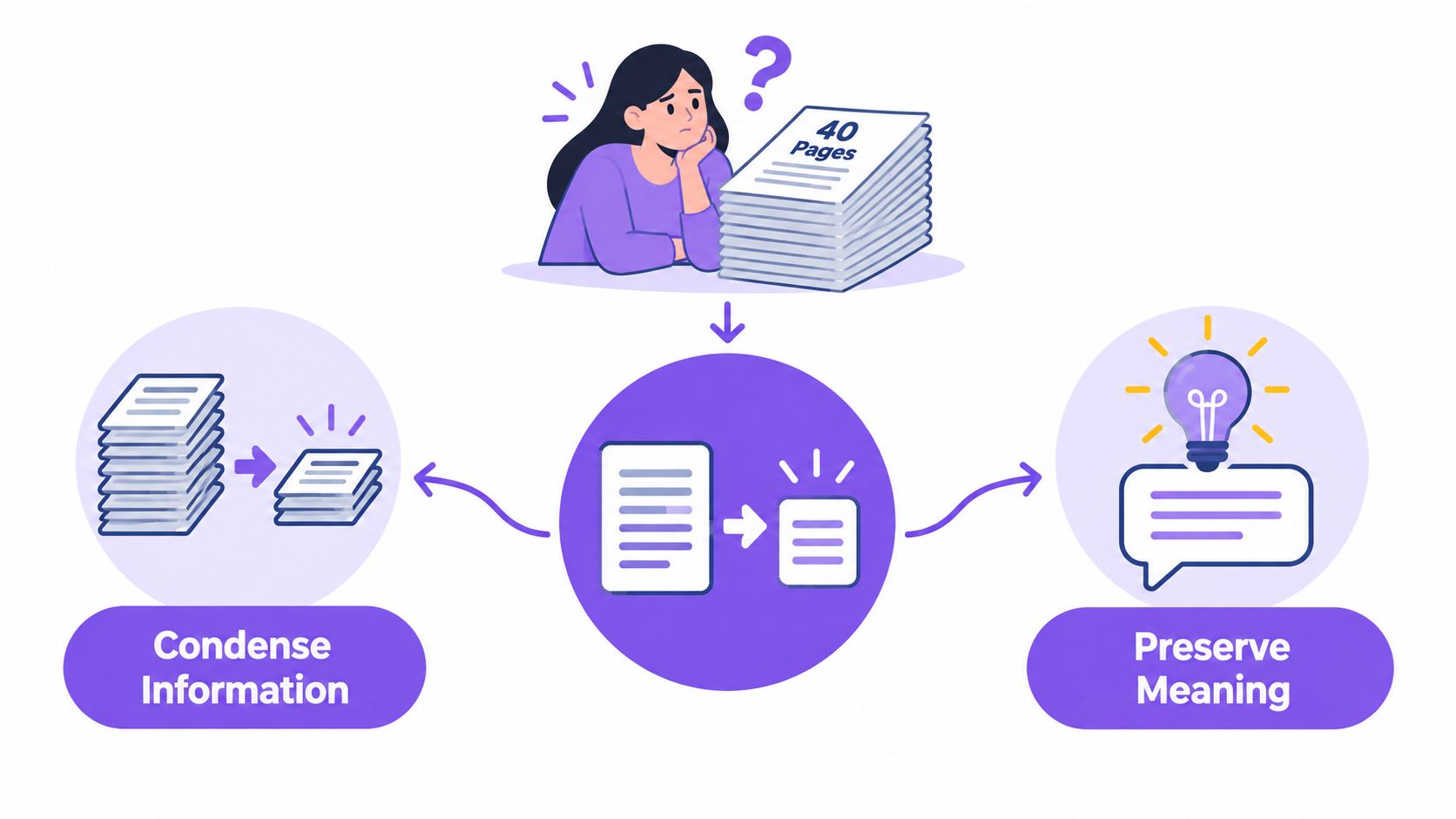
The first job is compression. A model has to decide what belongs in the short version and what can be dropped. That sounds simple until you try it on real material. In a product brief, the launch date may matter most. In a legal memo, one qualifying sentence may matter more than the whole introduction.
The second job is fidelity. The summary can't invent support, certainty, or claims that never appeared in the original. Readers often miss this because fluent writing feels trustworthy. It isn't.
Practical rule: A summary that reads smoothly can still be wrong in ways that are hard to spot at a glance.
Why people get confused
Many readers assume summarization is just “make this shorter.” In practice, it's closer to controlled compression with evidence constraints. The model must decide what's central, what's background, and what wording changes are safe.
That's why summarization gets especially tricky in documents where wording carries legal, financial, or scientific weight. If a paper says a result is preliminary, and the summary says the result is proven, the summary has failed even if every sentence sounds professional. Teams working with evidence-heavy material often care about traceability for the same reason people care about auditable evidence in crypto. The point isn't only speed. It's being able to check what claim came from where.
A short history that still matters
Automatic text summarization goes back to the 1950s, and Hans Peter Luhn's 1958 work is widely treated as the first major milestone in the field. His method ranked sentences using word frequency and heuristic scoring, which made it one of the earliest extractive systems. Over time, the field moved from statistical approaches, to graph-based and feature-based methods, and then to deep learning approaches that emerged in 2015, including encoder-decoder and sequence models that improved context handling and coherence, as described in this history of machine summarisation.
That history explains a distinction you still need today: some systems select text from the source, while others generate new wording.
The Three Main Approaches to Summarization
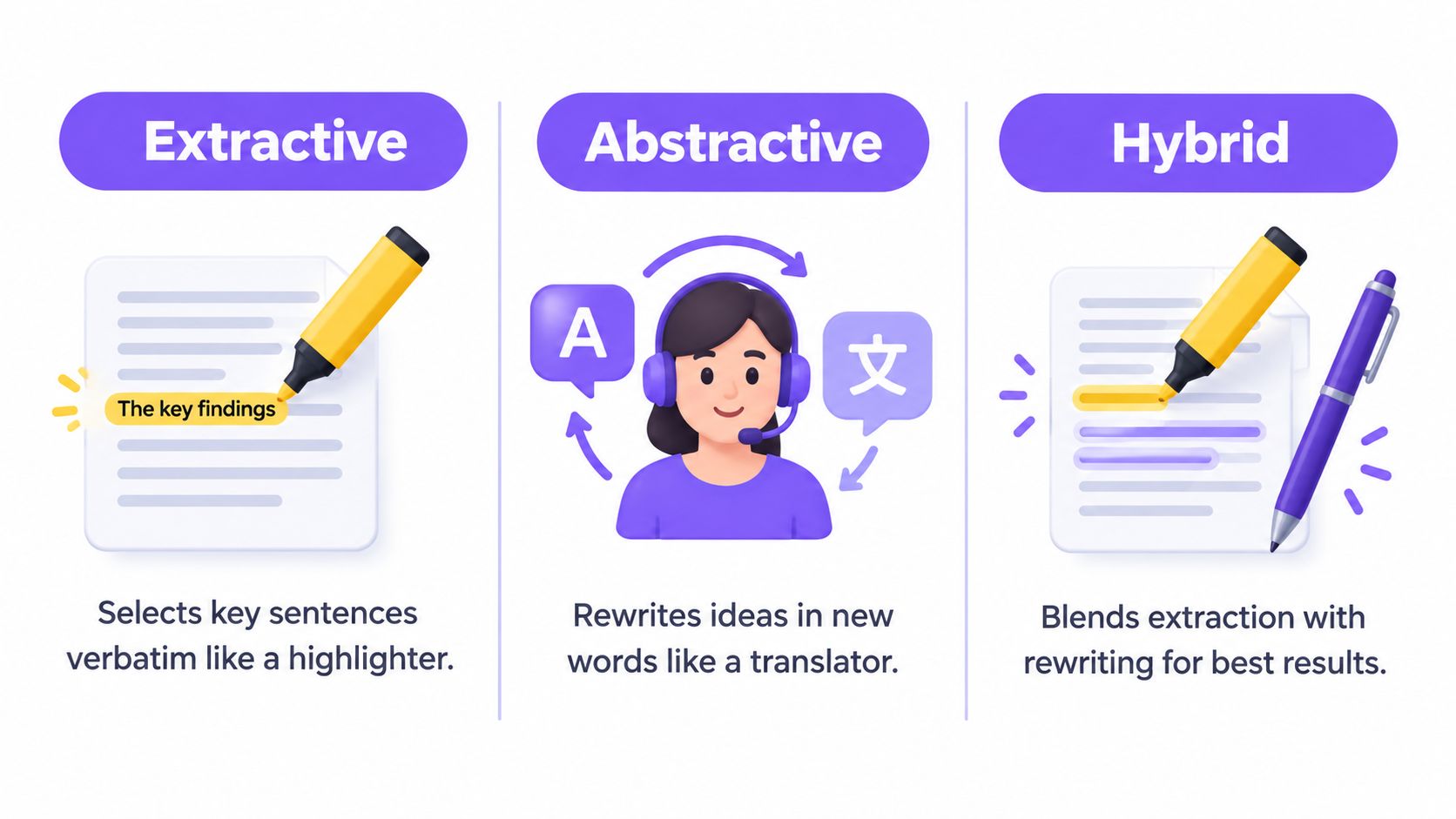
If you want to understand almost any AI text summary tool, it helps to carry three mental models in your head: extractive, abstractive, and hybrid.
Extractive works like a highlighter
An extractive system scores sentences or passages, then pulls the top candidates into the final summary. Nothing is paraphrased. The words come directly from the source.
That makes extractive summarization appealing when precision matters. If the original sentence names a regulation, a date, or a contract term, the summary keeps that wording intact. The downside is readability. A set of high-scoring sentences can feel choppy because those sentences were written for the original context, not for a shorter standalone brief.
A quick example:
- Original report contains ten paragraphs.
- The model picks three sentences spread across the document.
- The result is faithful to the source wording, but it may jump abruptly between ideas.
Abstractive works like a translator
An abstractive system reads the source and then writes a fresh summary in new words. It doesn't just select. It rephrases, compresses, and restructures.
That usually sounds better to a human reader. Repetition disappears. Tangents get folded together. A messy meeting transcript can become a crisp paragraph.
But this freedom creates risk. When a model rewrites, it can also smooth over uncertainty, merge separate ideas into one, or fill in gaps with plausible sounding detail. That's why abstractive summaries often feel more useful right away and more dangerous later if nobody verifies them.
A good abstractive summary sounds like someone understood the document. A bad one sounds like someone understood the genre.
Hybrid tries to get both benefits
Hybrid pipelines combine the two approaches. A common pattern is simple:
- Extract the most relevant passages.
- Feed those passages into a generator.
- Rewrite them into a cleaner summary.
- Check the output against the selected evidence.
This is a practical compromise. The extractor narrows the evidence set, which can reduce fabrication. The generator makes the final text easier to read.
Why these labels matter
People often ask which method is best. That's usually the wrong question. Each method carries a different trade-off:
- Extractive is safer but rougher.
- Abstractive is smoother but riskier.
- Hybrid is more balanced but more complex to design well.
If you only remember one thing, remember this: every AI text summary tool is making a bet about faithfulness versus fluency. You want to know which side of that trade it leans toward before you trust the output.
Choosing the Right Method for Your Workflow
The right summarization method depends less on hype and more on what kind of document you're holding. A board deck, a legal clause set, a customer call transcript, and a research paper all punish different mistakes.
Match the method to the risk
If you're summarizing dense legal, policy, or regulatory text, paraphrasing can create trouble. One softened qualifier or one altered number can change meaning. In that setting, extractive summaries usually make more sense, or an extract-then-verify workflow where the rewritten version is checked line by line against the source.
If you're summarizing meetings, support tickets, interviews, or review data, the opposite is often true. These documents contain filler, repetition, false starts, and informal phrasing. Rewriting is the whole value. An abstractive model can remove the noise and keep the actual decisions, complaints, and next steps.
When long documents force a hybrid setup
Once documents get large enough, especially when they exceed what a model can reliably handle in one pass, hybrid methods become practical rather than optional. You split the source into chunks, summarize each chunk, and then summarize those summaries into a final brief.
That's also why many teams compare tools before settling on one workflow. A roundup like tested AI summarizers for different use cases) can help you narrow options, but the decision still comes down to your document type and your tolerance for mistakes.
Method Selection by Document Type
| Document type | Best method | Why |
|---|---|---|
| Legal contracts and regulations | Extractive or extract-then-verify | Original wording matters, and paraphrasing can distort obligations or conditions |
| Research papers and technical memos | Hybrid | You need readability, but you also need evidence grounding and caveat retention |
| Meeting transcripts | Abstractive | Repetition and filler are common, so rewriting creates most of the value |
| Customer reviews and support logs | Abstractive or hybrid | Themes matter more than exact sentence wording |
| Long reports and manuals | Hybrid with chunking | The content is too large for a single pass, so staged summarization is more reliable |
Why production systems often blend methods
Most real systems combine extraction and generation because users want two things that conflict. They want the summary to be easy to read, and they want it not to make things up.
Extractors help preserve the evidence. Generators help produce prose that people can use. The best workflow isn't usually the newest model. It's the one whose failure mode matches the document in front of you.
How Different Models Perform Across Document Types
Model choice matters, but not in the simplistic “which model wins” way people often expect. The more useful question is: which model fails in the least harmful way on this material?
Recent benchmarking points in that direction. Performance shifts a lot by dataset and domain, and a 2026 systematic evaluation reported that general-purpose LLMs outperform reasoning-oriented and domain-specific models across lexical, semantic, and factuality metrics in the tested settings, according to this systematic evaluation of summarization models. That doesn't mean general models always feel best to use. It means “best” depends on the text and the trade-off you care about.
Model performance across document types
| Document Type | General LLM Strengths | General LLM Weaknesses | Domain-Tuned Strengths | Domain-Tuned Weaknesses |
|---|---|---|---|---|
| Conversational transcripts | Usually handles informal language, interruptions, and speaker flow well | May invent speaker intent, over-clean disagreement, or turn uncertainty into decisions | Better if tuned for call center, clinical, or legal conversation patterns | Can sound rigid and miss social nuance or implied context |
| Dense technical documentation | Often produces clear plain-English overviews | Can flatten cause-effect chains, blur terminology, or drop key entities | Better with specialized vocabulary and field-specific structure | May read stiffly and preserve jargon without helping comprehension |
| Long-form narrative reports | Good at turning sprawling prose into concise takeaways | Can oversmooth distinctions across sections or lose the thread late in the document | Can preserve domain framing better if trained on similar reports | May struggle to produce a concise and readable executive-style brief |
The practical differences readers notice
For conversational content, general models often feel strong because the material resembles the broad language they were trained on. They can turn a rambling meeting into action items quickly. The failure signal is subtle. They may imply that a speaker endorsed a conclusion when the person only suggested it.
For technical documents, domain-tuned models usually respect terminology better. If you work with biomedical, legal, or scientific text, that matters. But technical accuracy alone doesn't guarantee a good summary. Some domain-tuned systems preserve vocabulary while producing prose that is hard for non-specialists to use.
A tool like an AI PDF summarizer for document workflows is useful here because file-based workflows let you compare outputs on the same source document instead of judging models in the abstract.
Pick the model whose mistakes you can catch quickly. That matters more than chasing the most impressive demo.
What to watch for
When you test models, don't just ask which one sounds smartest. Look for failure patterns:
- In transcripts it may hallucinate motivation or agreement.
- In technical docs it may simplify away the mechanism.
- In long reports it may merge separate findings into one neat but false conclusion.
That's why a single leaderboard rarely answers the buying question. You're not selecting a universal winner. You're selecting an error profile.
How to Measure If a Summary Is Any Good
Evaluation is where many people get misled. They see a high benchmark score and assume the summary is trustworthy. In summarization, that leap is dangerous.
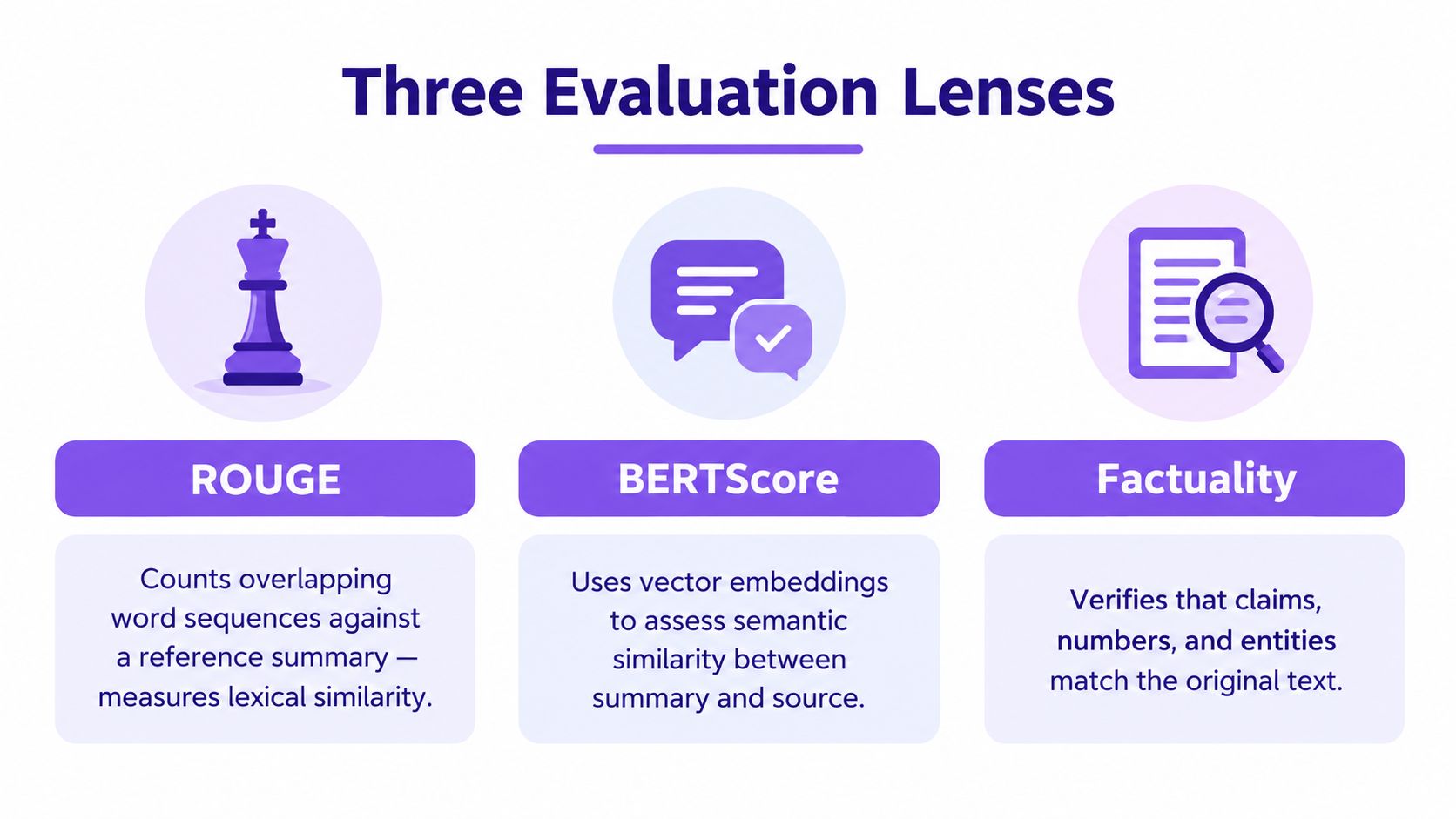
ROUGE checks overlap
ROUGE became the dominant automatic evaluation standard for summarization over the last decade and a half, and benchmark suites routinely use ROUGE-1, ROUGE-2, and ROUGE-L alongside human judgments. In SummEval, one reported set of correlations between ROUGE and human ratings included 0.2500 for ROUGE-1 coherence, 0.5882 for ROUGE-2 consistency, and 0.5535 for ROUGE-4 fluency, as reported in the SummEval paper.
In plain English, ROUGE mostly checks how much wording overlaps with a reference summary. It's useful, but narrow. If the model copies key phrases, ROUGE often likes that. If the model paraphrases well, ROUGE may undervalue it.
A simple analogy helps. ROUGE is like a spelling checker for summary content. It notices whether the same words and short phrases appear. It does not tell you whether the summary preserved the source's actual intent.
Semantic metrics look for meaning similarity
Metrics such as BERTScore try to measure semantic similarity rather than exact phrase overlap. That helps when one summary says “profits fell” and another says “earnings declined.” The wording differs, but the meaning is close.
This is a step forward, not a final answer. Semantic similarity can still miss factual drift. A sentence can sound semantically aligned while changing scope, certainty, or who did what.
Factuality checks ask a different question
Recent surveys point out that ROUGE remains the default metric, but it mainly measures lexical overlap rather than factual correctness. Those surveys recommend pairing ROUGE with semantic and faithfulness checks such as BERTScore, SummaC, FactCC, or LLM-based factuality judges in production pipelines, as described in this survey on summarization evaluation.
That gives you three different lenses:
- ROUGE asks whether the words overlap.
- BERTScore asks whether the meaning seems similar.
- Factuality checks ask whether the claims are supported.
Working heuristic: Use one metric for wording, one for meaning, and one for grounding. None is enough alone.
Why high scores can still fool you
A summary can score well and still add an unsupported causal claim, omit a key caveat, or overstate confidence. Human spot-checks remain necessary because metrics don't read with the same suspicion a careful domain expert brings.
If the summary will inform a decision, not just a casual skim, scoring should be treated as a filter, not a verdict.
Why Long AI Summaries Quietly Get Worse
People often assume a longer summary is a better one because it feels more complete. In practice, long AI summaries can become less trustworthy as they continue.
Research on long-context summarization reports a practical failure mode: quality degrades as outputs get longer because hallucinations concentrate disproportionately toward the end of long generated responses. That makes 800-word-plus summaries risky in a specific way. The opening can stay accurate while later sections drift, according to this long-context summarization analysis.
What goes wrong late in the response
The model starts with strong grounding because the beginning of the task is fresh. As it keeps generating, that grounding weakens. Attention gets diluted across a long context, and each new token is more likely to be driven by pattern completion than by close rereading of the source.
You'll see this in familiar forms:
- The last section introduces a detail that never appeared earlier.
- Citations or entity references get vaguer near the end.
- The summary ends with broad conclusions that sound reasonable but aren't actually supported.
A concrete fix that works better than one giant prompt
Instead of asking for one long summary in a single pass, use a staged process:
- Split the document into overlapping chunks.
- Summarize each chunk separately.
- Merge those chunk summaries into a shorter draft.
- Verify the final draft against the original source, especially the ending.
This sounds less elegant than “summarize the whole PDF,” but it usually produces a more dependable result.
Treat length as a warning sign
A longer output is not automatically more complete. Sometimes it's just more room for drift. If you need a long summary, ask for sectioned output and validate the last sections as carefully as the first ones.
That's especially important in workflows where readers only skim the top and trust the rest by default.
A Quick Checklist for Trusting an AI Summary
If you only have a minute, you can still catch many summary failures before they cause trouble. The trick is to verify the parts models most often get wrong.
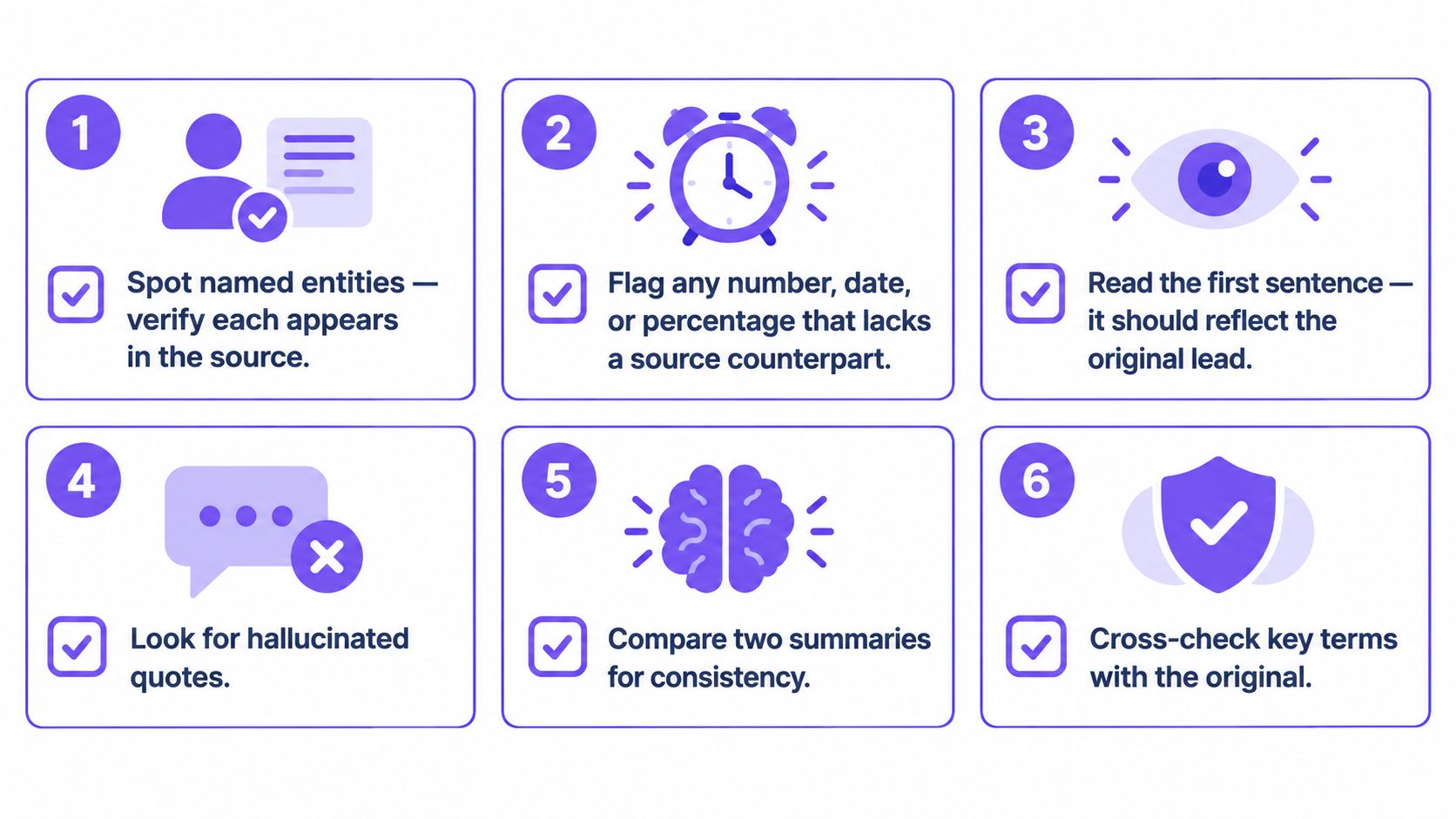
The one-minute trust check
- Check named entities: Verify that every person, company, product, or institution in the summary appears in the source.
- Trace every number: If the summary includes a number, date, or rate, find the matching line in the original document.
- Compare the tone: A cautious source shouldn't become a confident summary.
- Watch for new hedging or new certainty: Models sometimes add “likely,” “clearly,” or “proves” even when the source didn't.
- Confirm the task fit: Make sure the summary answers your actual prompt, not a nearby easier question.
- Ask for evidence mapping: Prompt the model to list the source sentence behind each major claim.
If you regularly work with papers, a file-based tool such as an AI research paper summarizer can help structure that review, but the checking habit still matters more than the interface.
Failure modes worth learning by name
Readers catch errors faster when they can label them.
- Entity swapping means the summary assigns an action or statement to the wrong person or organization.
- Numeric drift means a value changes, gets rounded loosely, or appears without support.
- Unsupported causal claims happen when the source shows correlation, sequence, or speculation, and the summary upgrades it to cause.
- Silent omission of opposing evidence happens when the summary includes the favorable result and drops the limitation, caveat, or contradictory point.
A recent review highlights why this matters. Coverage often focuses on overlap and similarity while giving weaker answers on faithfulness, even though faithfulness remains a major unresolved problem. The same review notes that a 2025 survey spans 40+ studies, and a 2025 study reported that AI summaries of scientific papers more often overgeneralize findings and omit caveats than human or expert summaries, as discussed in this review of faithfulness in summarization.
If a single checklist item fails, treat the summary as a draft, not a deliverable.
The habit that saves the most trouble
Keep the source open beside the summary. Don't evaluate the output in isolation. Most bad summaries aren't obviously absurd. They're plausible enough to pass unless you compare claim by claim.
That small habit does more for summary quality than any prompt trick.
If you want one workspace for testing summaries across different models, uploading documents, and comparing how tools handle the same source text, Writingmate brings those pieces together in one interface. That's useful when you're not just asking for a fast AI text summary, but also checking which model stays closest to the document you care about. You can explore it at Writingmate.
Frequently Asked Questions
Sources
- auditable evidence in crypto
- this history of machine summarisation
- this systematic evaluation of summarization models
- an AI PDF summarizer for document workflows
- the SummEval paper
- this survey on summarization evaluation
- this long-context summarization analysis
- an AI research paper summarizer
- this review of faithfulness in summarization
- Writingmate

Written by
Artem Vysotsky
Ex-Staff Engineer at Meta. Building the technical foundation to make AI accessible to everyone.

Reviewed by
Sergey Vysotsky
Ex-Chief Editor / PM at Mosaic. Passionate about making AI accessible and affordable for everyone.