The popular advice is simple: search the quote, copy the version that appears most often, and add the speaker's name. That method fails precisely when accuracy matters. A memorable line can be shortened, translated, modernized, paraphrased, or assigned to the wrong person while being repeated across thousands of pages.
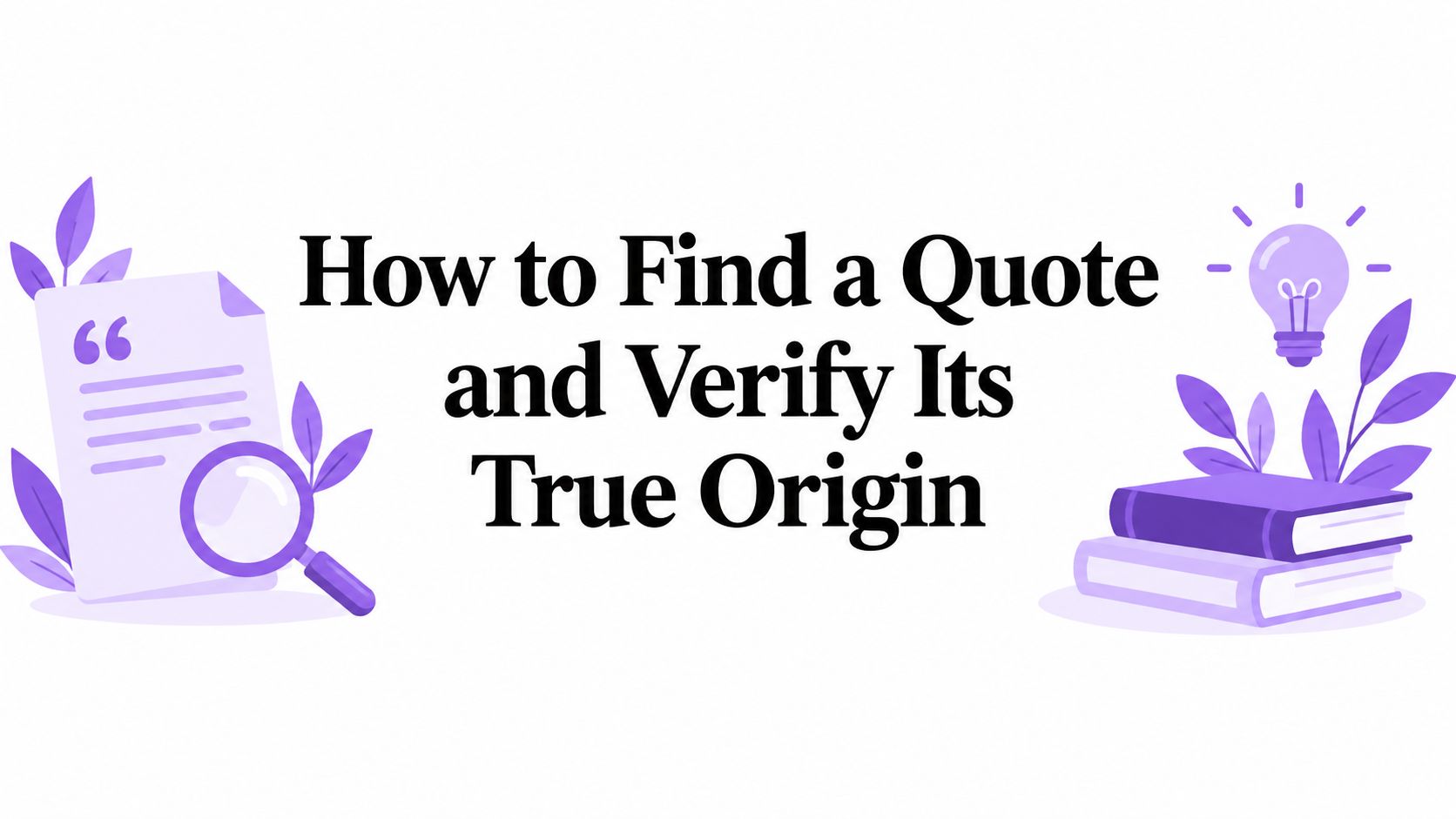
To find a quote responsibly, treat the task as lightweight fact-checking. You need to establish the exact wording, identify the speaker or author, locate the earliest credible source, inspect the surrounding context, and decide whether the passage is legally and ethically usable. Modern AI tools can accelerate that work, but they can also produce polished, nonexistent citations, so speed must never replace provenance.
Table of Contents
- Why Most Quote Websites Fail the Accuracy Test
- Advanced Web Search Tactics for Primary Sources
- Extracting Textual Quotations from Uploaded Documents
- Cross-Referencing Attributions with Multi-Model AI
- Navigating Copyright and Ethical Usage Rules
- Building a Repeatable Quote Audit Workflow
Why Most Quote Websites Fail the Accuracy Test
A quote aggregator is useful for generating leads. It isn't reliable evidence. Many pages copy one another without linking to a speech, book, transcript, letter, recording, or archival document. Once an edited version appears often enough, search engines can make repetition look like confirmation.
The risk is more than a missing citation. A secondary citation can change the claim itself through attribution drift, paraphrase presented as verbatim text, omitted qualifiers, translation, or a later popular wording mistaken for the original. In a study of quotations from systematic-review protocols, researchers manually checked citing articles against the original protocols and found 38 erroneous quotations among 124 reviewed quotations, or 31.4%, while 18 quotations, or 14.8%, couldn't be verified. The study's categories classified 109 quotations, or 90%, as correct. Those figures come from a specific scholarly citation context, not from all web quotations, but they show why confidence based on repetition is misplaced. The quotation-verification study provides the underlying methodology and findings.
Practical rule: A quote website is a lead. The primary record is evidence.
AI makes the shortcut more dangerous. A language model can produce a plausible sentence, attach it to a famous person, and invent a source that sounds authoritative. The Electronic Frontier Foundation documented a 2025 case involving a fake link and bogus quotation circulated as authentic, and warned that AI systems may generate nonexistent sources or misattribute statements. The EFF account is a useful reminder that fluent wording isn't proof.
Historical practice also argues for caution. The Oxford English Dictionary's work began in 1857, and its first fascicle appeared on 1 February 1884. Its second edition contained approximately 2,412,400 usage quotations, collected to document how words appeared and changed over time, not merely to preserve attractive sayings. The OED overview shows the scale of evidence behind reliable historical quotation work.
A quote deserves publication only when its wording, attribution, source, date, and context can be checked. If one of those elements remains uncertain, label it accordingly or paraphrase it instead.
Advanced Web Search Tactics for Primary Sources
Start with the text you received, but don't assume it's exact. Preserve the original version in your notes, including spelling, punctuation, capitalization, and any claimed speaker. Then isolate a distinctive phrase, usually a short sequence unlikely to occur by accident.
Search in shrinking fragments
Put the phrase in quotation marks for an exact-match search. If the wording may be inaccurate, search a shorter fragment, then repeat with likely variants. Try older spelling, punctuation-free versions, translated wording, and a synonym only when you suspect the quotation has been paraphrased.
Add identifying terms after the fragment:
- Speaker: Include the alleged author, politician, scientist, or writer.
- Work: Add the book title, speech, interview, poem, or event.
- Date: Search within a plausible period rather than accepting the first result.
- Topic: Use a subject term to separate unrelated matches.
The Library of Congress recommends breaking long quotations into smaller phrases, using wildcards for uncertain words, excluding irrelevant terms, and narrowing results to authoritative categories. Its full-text searching guidance for quotations also warns that open-web quotation pages often contain incorrect attributions or no citations. Duke's advice, included in the same research tradition, is similarly practical: search a phrase with the author's name instead of relying on an entire quotation that may have been remembered imperfectly.
Move from discovery to documentation
Once you find a promising match, stop treating the search-results page as the destination. Look for a scanned book, official transcript, digitized correspondence collection, newspaper archive, institutional repository, legislative record, or recording with a dependable transcript. Compare the wording directly with the original document.
Use domain restrictions when they help. A query limited to a university, library, government archive, publisher, or museum can reduce the noise from reposts. Date filters are useful for locating an early occurrence, but the oldest search result isn't automatically the original. It may be an OCR error, an undated repost, or a citation that copied an earlier source.
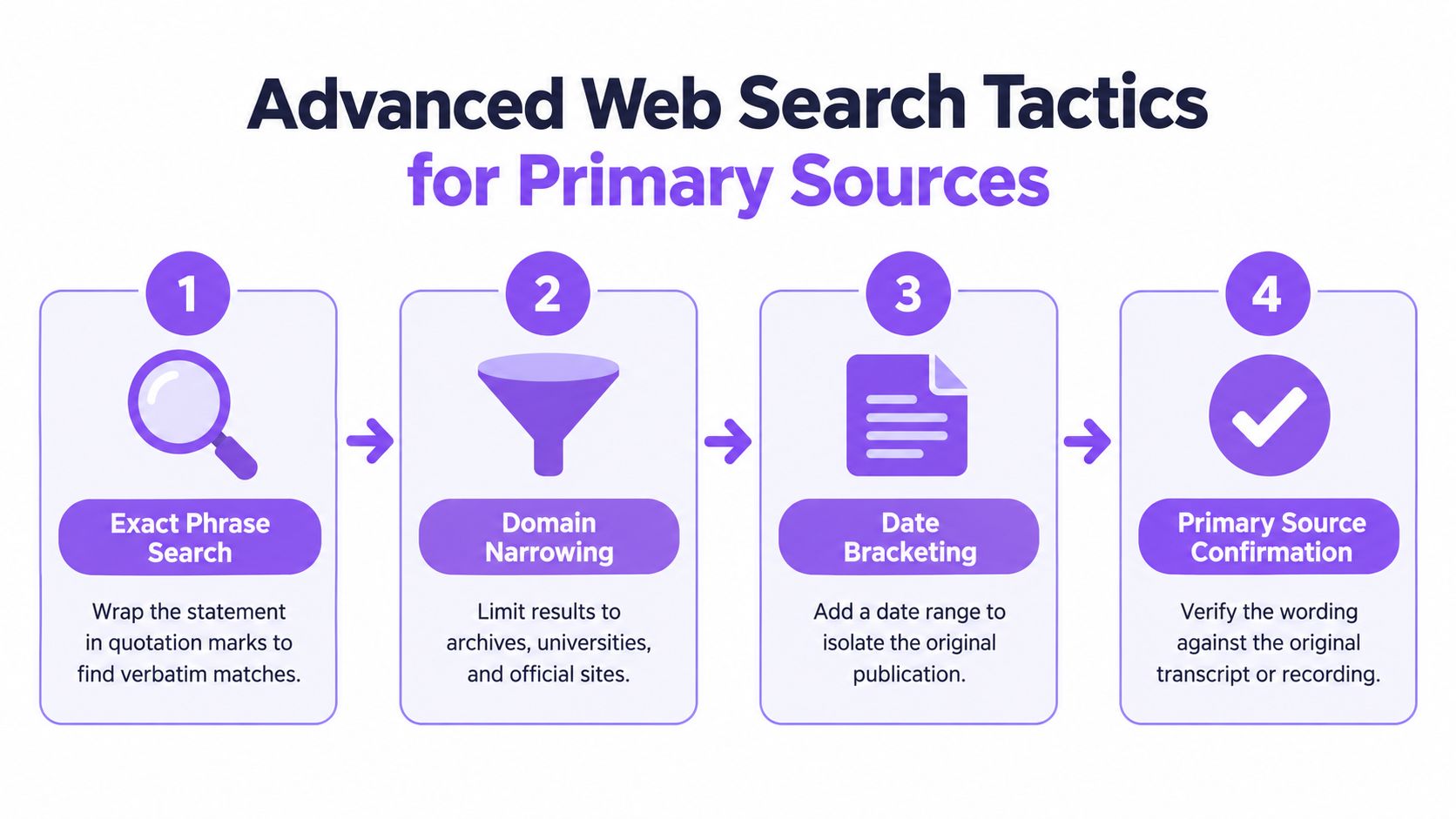
AI research tools can help gather candidate sources and compare search paths, especially when one system misses an archive or misreads a phrase. A comparison of AI search engines can help you evaluate how different tools handle citations, live retrieval, and source presentation. Still, ask every tool for the exact page, timestamp, edition, or document location, then open the source yourself.
Record the candidate wording, alleged speaker, earliest located occurrence, original document, date, page or timestamp, and surrounding passage. That provenance chain turns a vague search into an auditable research record.
Extracting Textual Quotations from Uploaded Documents
Sometimes the strongest source is already in your possession. It may be a dense PDF, a research paper, a conference transcript, a deposition, a book chapter, or an interview file. Searching that material manually can make you notice the most repeated phrase while missing the qualification that gives it meaning.
Document chat tools are useful here, provided you treat their output as an index and reading aid rather than an unquestionable transcript. Upload the source, ask for passages related to a defined topic, and request the answer with page numbers or section labels. Then compare the returned wording against the rendered document.
Ask for evidence, not just an answer
A weak prompt asks, “What did the author say about risk?” A stronger prompt asks for every relevant passage, exact wording, page location, nearby qualifications, and a distinction between direct quotation and summary. You can also ask the tool to return several surrounding sentences before and after each candidate passage.
Useful questions include:
- Locate: “Find passages that discuss the relationship between X and Y.”
- Extract: “Copy the exact sentence without correcting grammar or punctuation.”
- Contextualize: “Explain the argument immediately before and after this sentence.”
- Separate: “Mark whether this is the author's wording, a cited quotation, or a paraphrase.”
- Audit: “List any uncertainty caused by OCR, illegible text, or incomplete pages.”
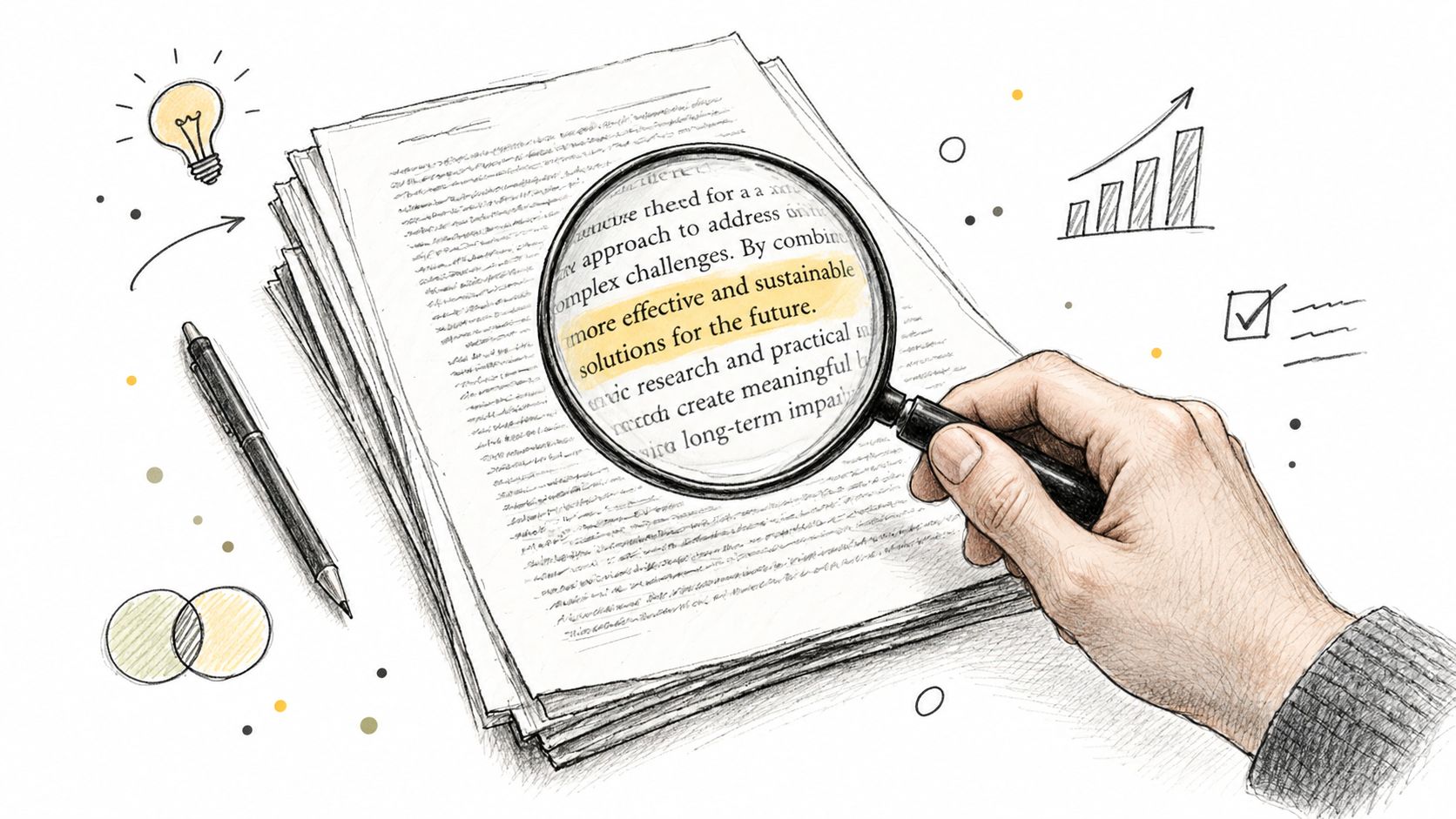
OCR deserves special attention. A scanned page may turn a name into a different word, omit quotation marks, or confuse footnote text with the main argument. If the document is image-based, an AI OCR software guide can help you choose an extraction workflow, but no OCR result should be published without checking it against the page image.
Preserve the document's structure
Keep page numbers, headings, footnotes, speaker labels, and editorial notes attached to the extracted text. A sentence in a report may belong to a source cited by the report, not to the report's author. An interview transcript may distinguish the interviewer's prompt from the subject's answer. A legal or academic document may also use brackets to signal editorial changes.
The safest workflow is simple. Let AI surface candidates, read the original page, copy the final wording yourself, and store a screenshot or stable file reference with the citation. If the system can't identify where its answer came from, treat the output as unverified.
Cross-Referencing Attributions with Multi-Model AI
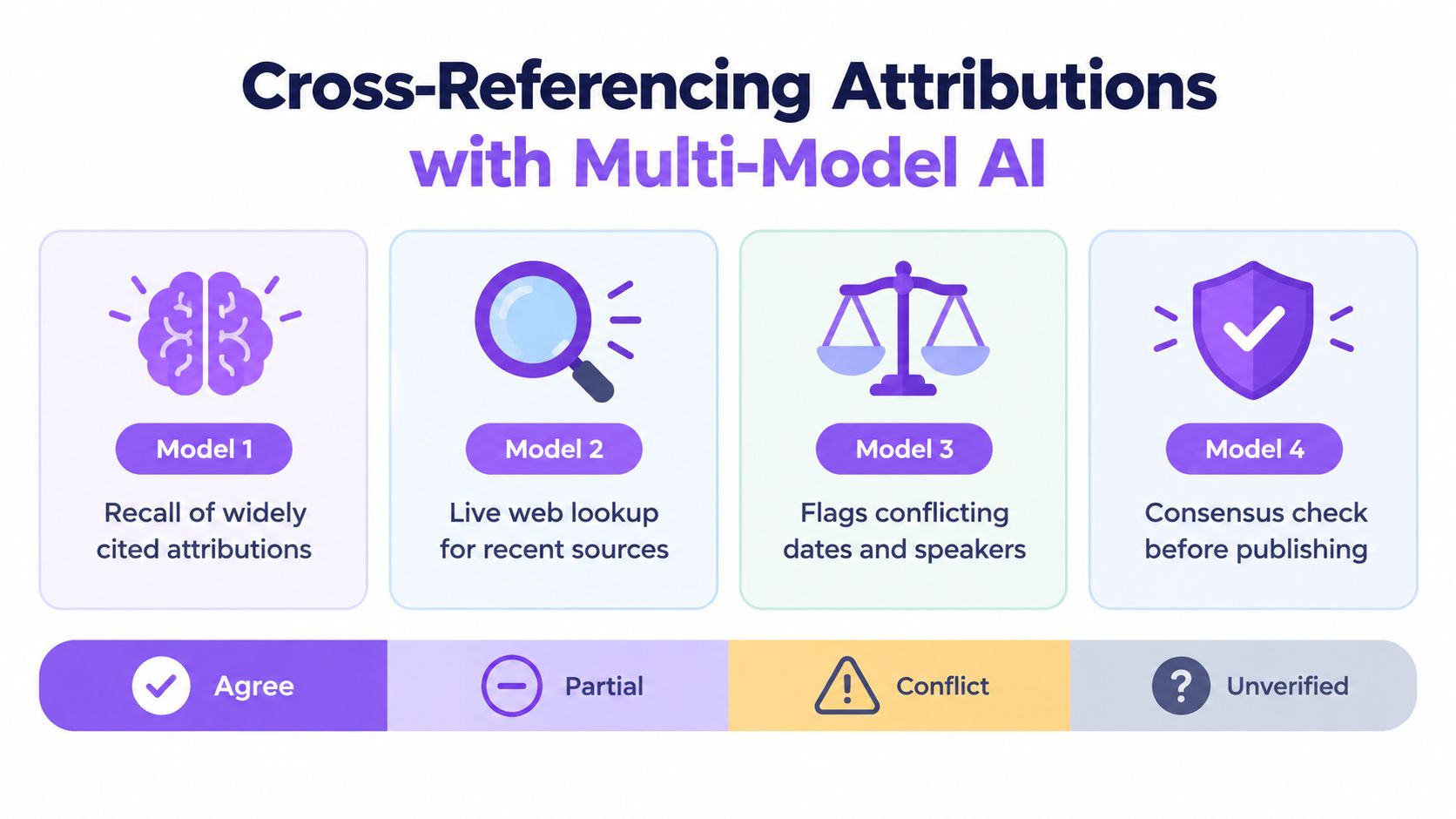
Conflicting attributions are common around famous sayings. One model may recognize a familiar version, another may locate a different date, and a third may notice that the wording is a translation or later paraphrase. The value of multi-model comparison isn't that agreement proves truth. It's that disagreement exposes where human review is needed.
Give each model the same evidence and the same constrained task. Ask for the exact source, not a confidence-filled narrative. Require the model to distinguish among verified, probable, and unverified, and instruct it to say “not found” when it can't support the attribution.
Compare outputs by evidence quality
A useful comparison has separate roles:
- Recall: Identify widely circulated versions and possible speakers.
- Retrieval: Locate books, transcripts, archives, or recent source records.
- Conflict checking: Compare dates, editions, languages, and wording.
- Decision support: Summarize what remains supported after the sources are opened.
Don't ask, “Which model is right?” Ask, “Which model supplied a source that independently supports the wording and attribution?” A confident answer with no page or timestamp is weaker than a cautious answer that identifies a primary document.
Historical texts add another complication. Quotation marks developed gradually. The fifteenth-century Gutenberg Bible used neither quotation marks nor indentation to distinguish quoted material, while printers experimented with comma-shaped marks by the early sixteenth century. Modern quotation functions became more established during the eighteenth century. The history of quotation marks explains why an older text may contain borrowed speech without modern punctuation.
That matters when a model searches digitized historical material. The absence of quotation marks doesn't prove that a passage was original prose, and a modern editor may add punctuation that wasn't present in the source. Check the page image, editorial apparatus, translation notes, and publication history before assigning authorship.
For teams handling sensitive records, a practical example is the use of a focused legal AI resource such as Ares for personal injury firms, where source handling and review discipline matter as much as model fluency. A guide to comparing AI models can also help teams design side-by-side tests, but comparison remains a triage method, not a substitute for primary-source confirmation.
Navigating Copyright and Ethical Usage Rules
Finding an authentic quote doesn't automatically give you permission to publish it. Authenticity and usability are separate decisions. A passage may be accurately attributed yet still require permission, careful licensing analysis, or a shorter excerpt.
Public-domain material is generally easier to reuse, but the status of the underlying words can differ from the status of a particular translation, edited edition, annotation, or recording. A modern translation may carry its own rights even when the original work is old. A public post may be easy to copy and still create ethical problems if the speaker never intended the statement for commercial reuse or if the account itself is impersonated.
Match the use to the source
Consider the purpose before selecting the wording:
- Academic work: Preserve the exact text, provide a complete citation, and include the edition or translation used.
- Journalism: Verify the speaker, event, date, and surrounding context, especially when the statement is controversial.
- Marketing: Prefer a short, clearly attributed excerpt, confirm permission where appropriate, and avoid implying endorsement.
- Social publishing: Don't treat a viral screenshot as a primary source. Locate the original post or recording and document retrieval details.
Paraphrasing can reduce the risk of presenting an uncertain sentence as verbatim, but it doesn't solve attribution problems. You still need to represent the speaker's meaning fairly and make clear that you're paraphrasing. If a translation is involved, credit the translator and identify the language and edition rather than presenting the English wording as the speaker's original words.
Think about consent and identity
AI-generated quotations create an additional ethical concern. A fabricated sentence can place a false position in a real person's mouth, while synthetic audio or edited video can make the attribution appear more convincing. A practical guide to consent for personal AI offers useful context for thinking about likeness, identity, and permission when technology reproduces a person's voice or image.
Copyright exceptions vary by jurisdiction and use. Don't promise that a quote is safe merely because it's short, famous, or widely reposted. If the excerpt is central to a paid campaign, book, product, or branded asset, ask a qualified rights professional when the source, translation, recording, or intended use is uncertain.
The ethical baseline is straightforward: credit the original speaker, credit the translator or editor when relevant, preserve meaning, and disclose uncertainty. If you can't verify the text, don't decorate it with a famous name just because the attribution improves the message.
Building a Repeatable Quote Audit Workflow
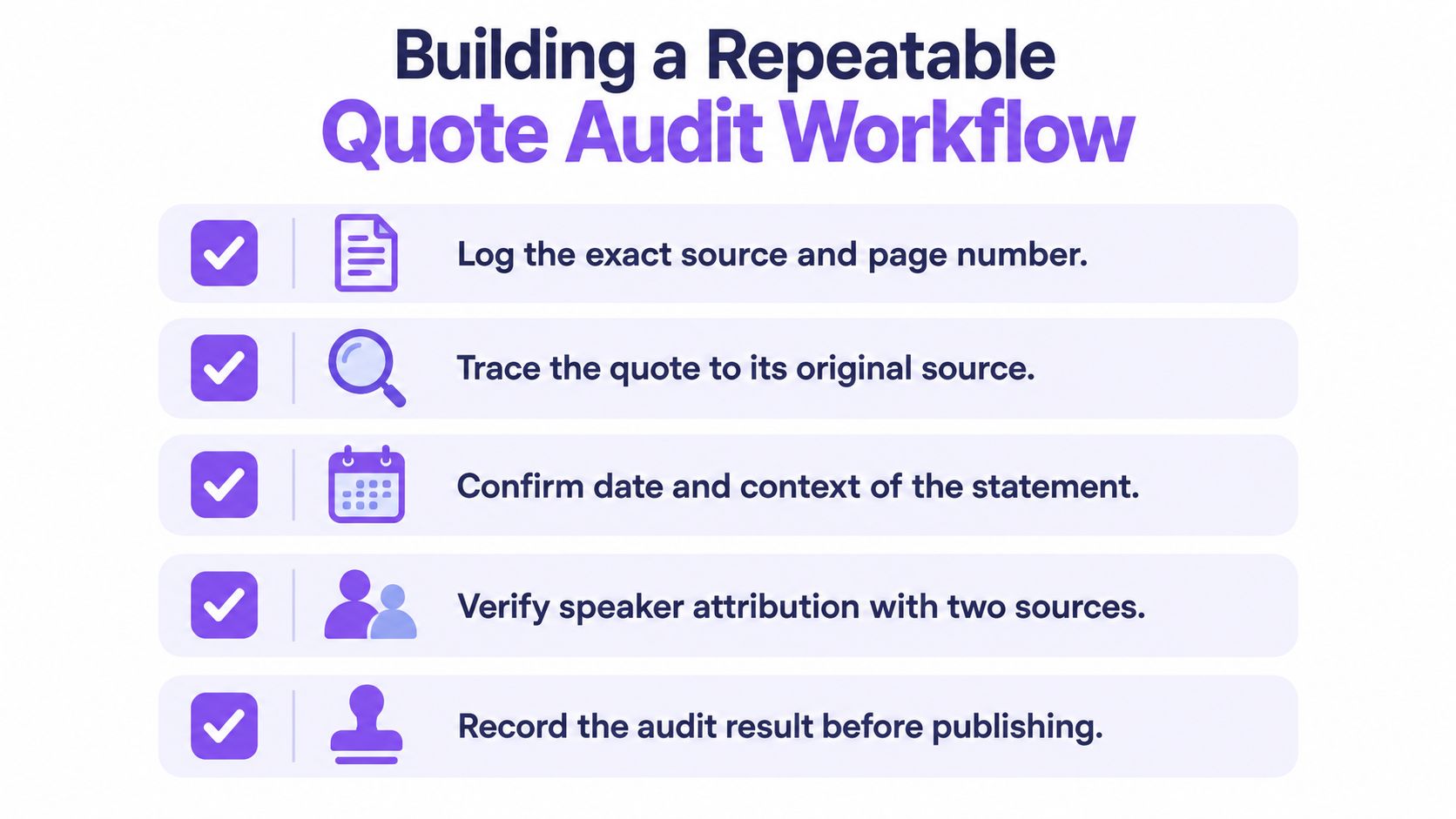
A reliable quote audit should be easy enough to repeat and strict enough to stop attractive mistakes. Start before searching by saving the received wording exactly as it arrived. That gives you a reference point when later sources normalize spelling, remove qualifiers, or merge several versions.
Use an evidence record
Create one record per quotation with these fields:
- Candidate text: Store the wording, punctuation, capitalization, and source where you found it.
- Search trail: Log distinctive fragments, spelling variants, speaker names, and date ranges.
- Primary evidence: Save the original book, transcript, recording, archival scan, or scholarly facsimile.
- Attribution check: Confirm the speaker or author in the primary record, not just in a citation.
- Context note: Record the surrounding passage, event, language, translation, and any irony or qualification.
The OED's historical quotation practice illustrates why provenance matters. Its archive organized examples chronologically across literature, journalism, pamphlets, and other records, allowing researchers to document usage rather than rely on memorable repetition. The same principle works for modern content teams, even when the record is a transcript, a PDF, or a timestamped video.
Apply the acceptance test
Before publication, ask five questions:
- Does the primary or scholarly source support the exact wording?
- Does the original record support the speaker or author?
- Have you checked the surrounding context for irony, quotation within quotation, or changed meaning?
- Have you confirmed the date, edition, language, and location?
- Have you classified the result as verified, probable, or unverified?
If no primary source is available, preserve the uncertainty. “Often attributed to” is not a substitute for evidence, and omitting an attribution is often better than assigning a false one. The Library of Congress identifies ideal verification as including the quotee, exact date, context, and earliest documented source, which gives teams a practical standard for final review.
Run AI tools as assistants in this process. Let them generate search variants, compare candidate sources, extract text from files, and flag conflicts. Make a person responsible for opening the cited record and approving the final wording. That division keeps the useful speed of automation while reserving authorship and accountability for human review.
Writingmate brings web research with citations, document analysis, and side-by-side multi-model comparison into one workspace, so you can search for candidate sources, interrogate uploaded files, and test conflicting attributions without switching between tools. Use Writingmate to build a faster quote-audit routine, then open and verify the primary evidence before you publish.
Frequently Asked Questions
Sources
Written by
Artem Vysotsky
Ex-Staff Engineer at Meta. Building the technical foundation to make AI accessible to everyone.
Reviewed by
Sergey Vysotsky
Ex-Chief Editor / PM at Mosaic. Passionate about making AI accessible and affordable for everyone.