Maybe you have recently switched places, or just are living somewhere where digital services get blocked. There are, indeed, places where Claude AI in its native chatbot and through direct API, does not work even in 2026. In my article there are several ways to overcome this and to use Claude AI in any place of the world.
There have also been changes and updates that I will break down here, and you can also read this new Claude update on restrictions of sales to unsupported regions. Also remember that in September 2025, Claude Code gets native VS Code extension and autonomy features.
Claude 4 is the newest-gen set of AI models and most recent as of 2026. It is a lot more capable, stable, and human-like than any previous version. There are two main models to it:
- Claude 4 Sonnet, a balanced model that combines strong reasoning with quick responses. It’s ideal for writing, research, in my experience, everyday business use, offering high accuracy, better context understanding.
- Claude 4.1 Opus, the most advanced and powerful model in the Claude 4 family. Serves well for complex analysis, long-form content creation, coding, deep reasoning.
So, those two models differ from each other, and here I came up with a table of ways to use those for your tsks, even it your region is not supported.
| Feature / Topic | Claude 4 in WritingMate AI | Claude 4 in Native Chatbot (Claude.ai or API) | Notes |
|---|---|---|---|
| Access Regions (Oct 2025) | Accessible worldwide except where Anthropic blocks (China users may access via WritingMate’s integrated cloud if their workspace is hosted in a supported region). | Officially supported only in Anthropic’s listed countries — China not supported. | WritingMate uses Anthropic’s backend, some users in China still face restrictions especially if their organization is China-controlled. |
| Login & Account Setup | Single WritingMate account; no Anthropic account there needed. | Requires Anthropic account (Claude.ai) or API key. | WritingMate simplifies onboarding for unsupported or enterprise setups. |
| Claude Code Access | Available inside WritingMate workspace; can use Claude Code tools for writing and coding assistance via integrated interface. | Claude Code (VS Code extension / API) works only in supported regions; “Claude Code might not be available in your country” appears in China. | WritingMate has some fallback suggestions but can’t override region locks and it's not a separate Claude Code platform. |
| Features & Model Access | All Claude 4 models (Opus, Sonnet, Haiku) depending on plan; unified chat + docs + browser. | Full feature set in supported regions only. | WritingMate has lots of Anthropic’s features within its UI and 100+ of AI models. |
| Compliance & Legal Safety (China) | WritingMate operates via compliant cloud infrastructure; does not endorse VPN circumvention. | Direct access may breach local rules if accessed via VPNs. | Safer to use WritingMate in compliance mode or from supported regional workspaces. |
| Team & Collaboration Tools | Shared docs, prompts, chat history, team seats. | Limited; team work via API integrations. | Added collaboration layer and access within several devices. |
| Best For | Users needing an all-in-one AI workspace or operating near unsupported regions. | Developers and researchers in supported countries with direct API needs. | Choose WritingMate for simplicity, native Claude for full dev/API control. |
How I Verified Claude Availability and Access Methods
I rebuilt this guide around official availability, not hearsay. The primary sources I checked were Anthropic’s own supported countries and regions page, its restrictions update, and the official getting started documentation. I treated those as the source of truth for whether Claude.ai and Anthropic API access are officially allowed.
That official position differs from the practical routes people use: direct Claude.ai signup, Anthropic Console / Workbench, and access through writingmate.ai. Methods that depend on masking location, violating a provider policy, or relying on an unstable loophole are not counted as official support, even if they sometimes work.
One thing I checked carefully is the difference between model access and product access. In practice, “Claude is available” can mean very different things: chat on Claude.ai, API calls in Console, Claude Code in an IDE, or Claude surfaced inside a third-party workspace. During that review, this was the biggest source of confusion I saw, so the sections below separate those paths instead of treating all Claude access as one thing.
Claude 3 Supported and Unsupported Countries
Anthropic’s official list is the first place to check, because Claude is not available everywhere. The company maintains a live supported countries list and uses it to define where Claude.ai accounts and commercial API access are allowed. Anthropic first expanded Claude to 95 countries in October 2023, then broadened coverage further over time according to this timeline summary.
Here is the practical picture based on Anthropic’s published availability:
- Clearly supported major markets: United States, Canada, United Kingdom, France, Germany, Japan, Australia, India, Singapore, South Korea, and the United Arab Emirates, along with many other countries across Europe, Asia-Pacific, Latin America, and Africa on Anthropic’s official page.
- Official source to verify your exact country: use Anthropic’s supported countries and regions page before creating an account or rolling out access to a team. For people looking up the anthropic supported countries claude official reference or the broader anthropic claude supported countries regions official list, this same page is the source to trust.
- Notable unsupported case: mainland China is not on Anthropic’s supported list, and public summaries also commonly note Hong Kong and Macau as outside direct support boundaries in practice, as reflected in this availability overview. That means the usual searches for anthropic claude supported countries china official or anthropic claude supported countries china availability official point to a negative answer: China is not part of the official direct-support footprint.
The important distinction is that official support is product-specific. Claude.ai is the consumer and team chat product. Anthropic API is the developer/commercial route used through Console and Workbench. Claude Code is another layer again: even if a model exists, the coding product or extension may still show a region-related restriction. I have seen readers assume that API access automatically means every Anthropic product will work in the same place; that is not a safe assumption.
There are also organization-level edge cases. A person may be physically in a supported country and still hit restrictions if billing, company control, or workspace configuration ties the account to an unsupported region. Anthropic’s restrictions update is especially relevant for businesses because it covers sales and support boundaries, not just whether a chat page loads.
For unsupported regions, the next question is not “is Claude secretly available?” but “which access path is official, which is indirect, and which carries policy risk?” That is why I split the next section into three separate routes.
Plain-English takeaway: Claude is available in many countries, but not worldwide. If your country is absent from Anthropic’s official list, direct Claude.ai and direct Anthropic API access should be treated as unsupported unless you are using a separate third-party product that lawfully provides access on its own infrastructure. If you want an anthropic claude supported countries list, always verify it on Anthropic’s live page rather than on copied screenshots or old forum posts.
Use Claude 3 From Supported Countries
- Just go to Claude login page: claude.ai/login
- Sign up with your email.
- This is it – you can start chatting with Claude 3 Sonnet model.
Note that to use super-advanced Claude 4.1 Opus, you have to subscribe pro Pro or use an all-in-one AI platform that has both Opus 4.1, Sonnet 4 and 100+ other models, from GPT to Mistral and Gemini, Llama and more: writingmate.ai

Access to Claude 3 in Unsupported Countries
If your country is unsupported, there are really only three paths worth considering: use a third-party platform that offers Claude inside its own product, use Anthropic directly only when your account and location are officially eligible, or try VPN/proxy access and accept the risk that it can fail or violate policy. In my review, the main mistake people make is mixing these paths together and assuming they are equally reliable. They are not.

Path 1: Use Claude through WritingMate
This is the simplest route for many users who care more about getting Claude responses than about maintaining a direct Anthropic account.
Best for: people in unsupported regions, teams that want one workspace for several models, and users who do not need native Anthropic billing or direct Claude.ai identity.
How to do it:
- Open WritingMate and create an account.
- Enter the workspace and pick a Claude model from the model selector.
- Start using Claude for chat, writing, research, or coding tasks inside the same interface.
- If you need alternatives, switch to other models in the same workspace instead of rebuilding your setup from scratch.
Prerequisites: a WritingMate account, working payment method if you need paid tiers, and a region/workspace setup that does not conflict with underlying provider restrictions.
Likely failure points: some enterprise or China-controlled environments can still run into policy or infrastructure limits, especially if the organization expects native Anthropic products such as Claude Code to behave exactly the same way inside a third-party workspace.
What I like about this path: it removes the direct Claude.ai signup hurdle. When I compare access methods, this is usually the least fragile for regular users because it avoids the “service not available in your region” wall at Anthropic account creation. It also gives you other models if Claude access changes later.
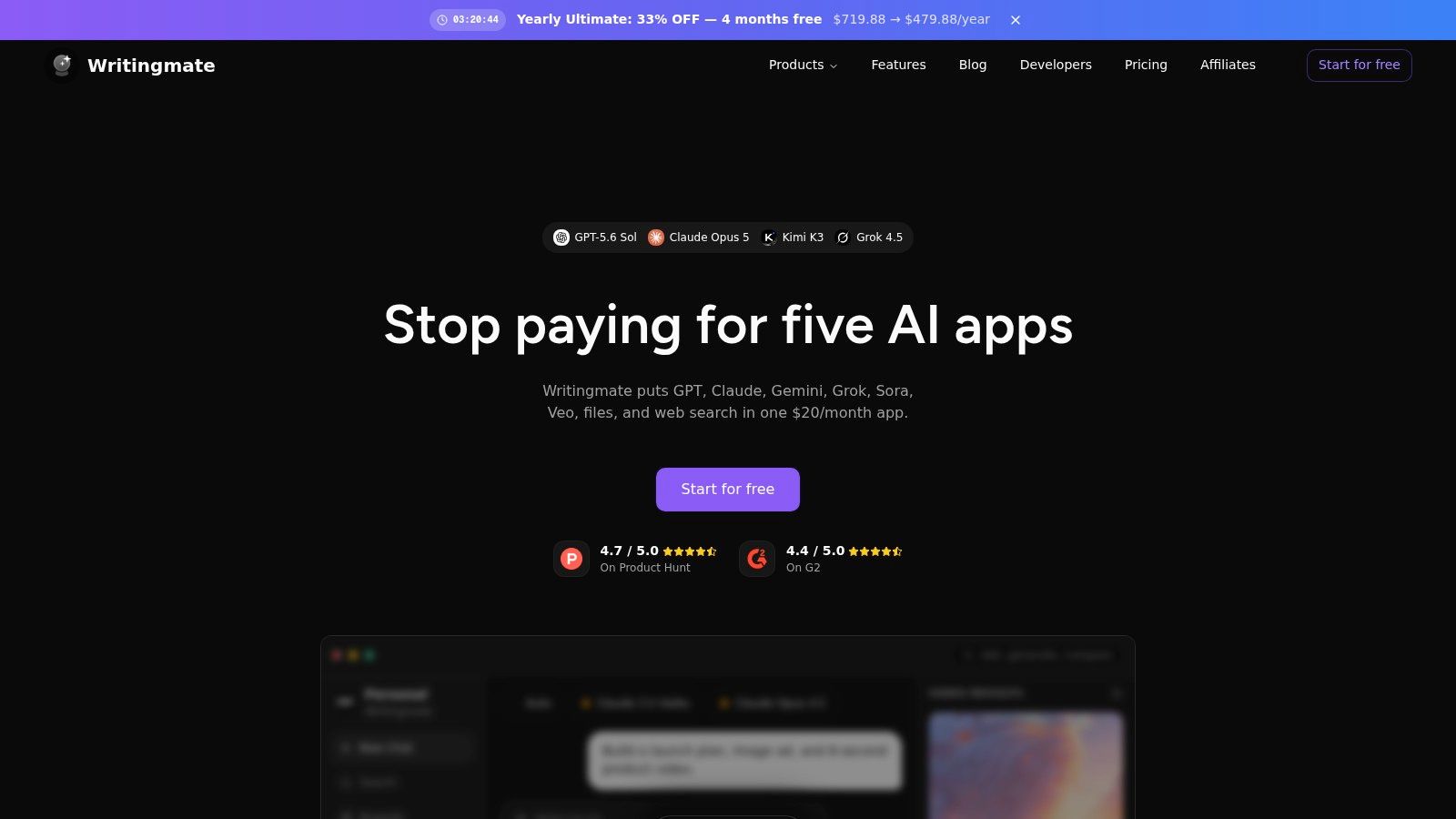
By joining WritingMate, use not only to Claude 4 models, try switching to gemini 2.5 Pro, GPT-5, or Meta Llama 4. This is also a way to use web browsing with Claude, image generation and prompt templates, and tools to build your own custom AI assistants (ai agents).
Path 2: Use Anthropic products where your country is officially supported
This is the cleanest route when your country is on Anthropic’s supported list and you need direct access to Claude.ai, billing under Anthropic, or developer tooling tied to their platform.
Best for: developers, researchers, and teams that need official API access, native Claude.ai, or direct vendor support.
How to do it:
- Verify your country on Anthropic’s supported countries page.
- Create a Claude.ai account or open the Anthropic developer environment.
- If you need API usage, go to Console, create an API key, and use Workbench or your own app.
- Confirm product-by-product access if you also need Claude Code, because product availability can lag behind model availability.
Prerequisites: being in a supported country, valid signup details, and a billing/profile setup that is not linked back to an unsupported jurisdiction.
Likely failure points: people assume that because the model exists, every entry point will work. In practice, Claude.ai access, API access, and Claude Code availability can diverge. I have also found that organization-controlled environments are where edge cases show up fastest.
Claude 4 Console or Anthropic Workbench with API Key
If your country is supported and you want the direct developer route, Anthropic Console is the right place to start via Anthropic Console.
To use this feature, you first need an API key. After getting the key, sign up and begin using Claude in Workbench. The older example model name in many tutorials is outdated; choose the current Claude model family offered in your account instead of relying on legacy names. If your goal is development cost control before you integrate at scale, this SpendLens AI guide to Anthropic API cost is a useful companion.
This path is not a workaround for unsupported countries. If Anthropic does not support your region, Console and Workbench are still part of Anthropic’s official ecosystem and remain subject to the same compliance boundaries. That is the key operational difference from using WritingMate.

Tutorial on how to use Anthropic Workbench.
Path 3: Use VPN or proxy access, knowing the risks
A VPN or proxy can sometimes make a blocked service appear reachable, but this is the least reliable path and the one with the most policy risk.
Best for: technically confident users who understand the compliance and account-ban risk and are making their own decision.
How people usually attempt it:
- Connect through a VPN or proxy in a supported country.
- Try to sign up for Claude.ai or log into an existing account.
- Attempt billing or API setup from that new network location.
Likely failure points: signup checks, payment verification, prior account history, changing IP patterns, or later enforcement. Even when access works at first, it may stop later.
My view: I would not build business workflows on this. The biggest problem is not just privacy or network quality; it is that success today does not mean stability tomorrow. Anthropic can enforce its rules after signup, after payment, or when product-specific tools like Claude Code perform extra checks. If you want examples of how people try this, the existing thread on Reddit shows the pattern, but it should not be mistaken for official guidance.
China: what works, what does not
Officially, direct Anthropic support for mainland China is not available. That means you should not expect normal access to Claude.ai signups, direct Anthropic API onboarding, or smooth activation of Claude Code from a China-based setup.
In practice, here is the clearest breakdown:
- Claude.ai: generally treated as unsupported for mainland China.
- Anthropic API / Console / Workbench: also tied to official country support, so not a dependable direct route from China.
- Claude Code: may display explicit country-related unavailability messages even when people can reach other Anthropic pages.
- Third-party platforms: can be the most practical route if they legally provide Claude access through their own product architecture, but that still does not make Anthropic itself officially available in China.
Many reports can be misleading. A workaround that surfaces Claude output inside another tool is not the same thing as saying Anthropic officially supports China. If you are an enterprise user, or your company is China-controlled, treat policy review as mandatory before rollout.
Conclusion
Claude 4 is still not accessible in some countries, with China being an example of that. But actually using Claude even in those regions is possible, either through VPN trickery or just by using tools like writingmate.ai.
There are certainly ways to bypass geographical restrictions and use even the previous Haiku, Sonnet, and newest Opus 4.1 . It's a shame not to use such advanced AI technologies in 2026, as Claude 4 Sonnet is still one of the top performing AI models together with other models by Anthropic.
Especially if you are Enterprise and business user, be sure to comply with local laws or regulations on business internet use, technology access and similar paragraphs. If everything is in check, try to maximize your engagement with Claude 4 and other AI models.
Frequently Asked Questions
Where is Claude avaliable in 2025? What is the situation like with Claude Code?
Claude is officially available only in the countries and regions listed by Anthropic on its supported countries page. That list includes a large set of markets across North America, Europe, Asia-Pacific, the Middle East, Latin America, and Africa, but it is not global coverage. Claude Code is a separate product layer, so even if Claude models are available through one channel, Claude Code can still show country-specific restrictions.
Is Claude available in China in 2025? Why does Anthropic block access in China (and to China-controlled firms)?
No—mainland China is not part of Anthropic’s official supported-country footprint. Anthropic’s own restrictions update makes clear that unsupported-region controls are compliance-driven, so this is not just a temporary website issue. For China-based or China-controlled organizations, the important point is that direct Anthropic access should be treated as unsupported unless Anthropic itself says otherwise.
I suddenly see “Claude Code might not be available in your country.” Explanation?
That message usually means product-level availability checks are stricter than basic model awareness. In other words, being able to read about Claude or even use Claude indirectly in another platform does not guarantee that Claude Code is enabled for your location or organization. I have seen this confuse users because they assume all Claude-branded products share one availability rule.
But can I still use the Claude Code VS Code extension via AWS / Google Cloud?
Cloud infrastructure does not automatically override Anthropic product restrictions. There is a difference between accessing Anthropic models through another cloud/provider relationship and using Anthropic’s own Claude Code product or extension. If your model access comes through AWS or Google Cloud, that does not necessarily mean the native Claude Code experience is available in the same environment.
Can I use a VPN in China and other non-supported countries to use Claude?
Technically, some users try it. Officially, that is not the same as supported access, and it can fail during signup, billing, or later enforcement. If you only need Claude output and want a steadier route, a third-party workspace such as all-in-one chatbots is usually more practical than building a workflow around location masking.
Did Claude disappear from tools like GitHub Copilot for users in China? Why?
That can happen when the end product, the model supplier, and the user’s region each have separate compliance rules. Model availability inside a partner tool is not identical to direct Anthropic availability, and regional policy changes can affect one layer without changing another. When this happens, check the product’s own regional support notice first, then Anthropic’s official country support and restrictions pages.
Sources
- Anthropic - Supported Countries and Regions
- Anthropic Documentation - Getting Started
- Anthropic - Claude API Access
- restrictions of sales to unsupported regions
- writingmate.ai
- supported countries page with tracking parameter
- claude.ai/login
- Anthropic Console dashboard
- Tutorial on how to use Anthropic Workbench
- thread on Reddit
Written by
Artem Vysotsky — Ex-Staff Engineer at Meta. Building the technical foundation to make AI accessible to everyone.
Reviewed by
Sergey Vysotsky — Ex-Chief Editor / PM at Mosaic. Passionate about making AI accessible and affordable for everyone.
Frequently Asked Questions
Sources
- restrictions of sales to unsupported regions
- writingmate.ai
- Anthropic - Supported Countries and Regions
- Anthropic Documentation - Getting Started
- timeline summary
- availability overview
- claude.ai/login
- Anthropic Console dashboard
- SpendLens AI guide to Anthropic API cost
- Tutorial on how to use Anthropic Workbench
- thread on Reddit
- Anthropic - Claude API Access
- supported countries page with tracking parameter
Written by
Artem Vysotsky
Ex-Staff Engineer at Meta. Building the technical foundation to make AI accessible to everyone.
Reviewed by
Sergey Vysotsky
Ex-Chief Editor / PM at Mosaic. Passionate about making AI accessible and affordable for everyone.