Writingmate now includes Laguna S 2.1 for long-context professional work. The right evaluation is not a novelty prompt; it is the kind of work where a model failure costs editing time: long files, structured decisions, source-heavy summaries, and careful rewrites.
My first question for Laguna S 2.1 is simple: can it keep a large brief, multiple constraints, and a useful output format in its head without turning the answer into polished guesswork? That is where long-context models either become valuable or merely expensive.
Laguna S 2.1 is available in the Writingmate catalog as of July 21, 2026. Confirm the live model page before sending large source packs or sensitive documents through a new workflow.
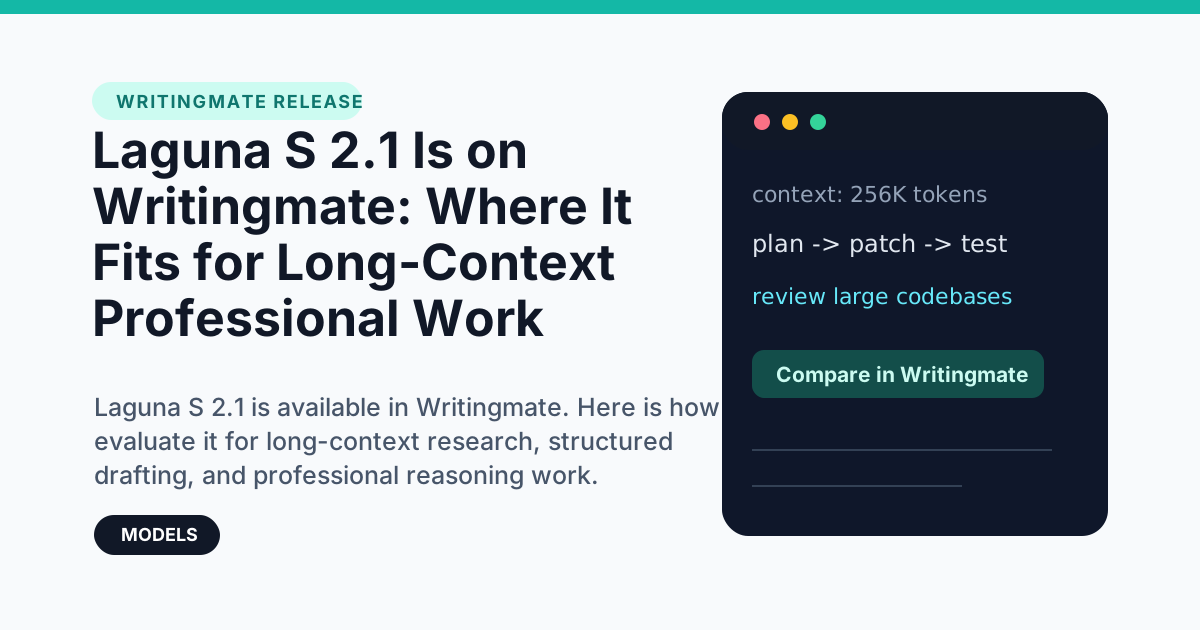
What changes for long-context work
Laguna S 2.1 is positioned as a Poolside model for complex professional workloads. Laguna S 2.1 is the latest coding agent model from Poolside. Laguna S 2.1 is a 118B total parameter model with 8B active parameters, scoring 70.2% on Terminal-Bench 2.1 and In practical terms, that makes it a candidate for tasks where you need more than fluent prose: research synthesis, long document analysis, planning, technical explanation, and careful drafting.
The Writingmate advantage is that you do not have to judge it in isolation. Open the model page, run the same prompt against Laguna S 2.1 and a strong baseline, and compare the amount of editing required before the output is ready to use.
The live model page for Laguna S 2.1 is the right starting point before you upload a source pack or run a document-heavy comparison.
Laguna S 2.1 specs for source-heavy work
Field | The model | Reader takeaway |
|---|---|---|
Provider | Poolside | Useful if you already rely on this provider's models for structured professional work. |
Availability date | July 21, 2026 | Available in the catalog as of July 21, 2026. |
Context window | 1.0M tokens | Best tested on long briefs, source packs, transcripts, and document-heavy prompts. |
Input | text | Best tested with long text, files, transcripts, and structured instructions. |
Output | text | Use it for analysis, plans, drafts, tables, summaries, and rewrites. |
Pricing | $0.10 / M tokens input / $0.20 / M tokens output | Paid models should earn their place on quality, not novelty. |
For a fair long-context comparison, keep the source pack, output format, and decision criteria identical. Then check whether it preserves details from the beginning, middle, and end of the material without adding unsupported certainty.
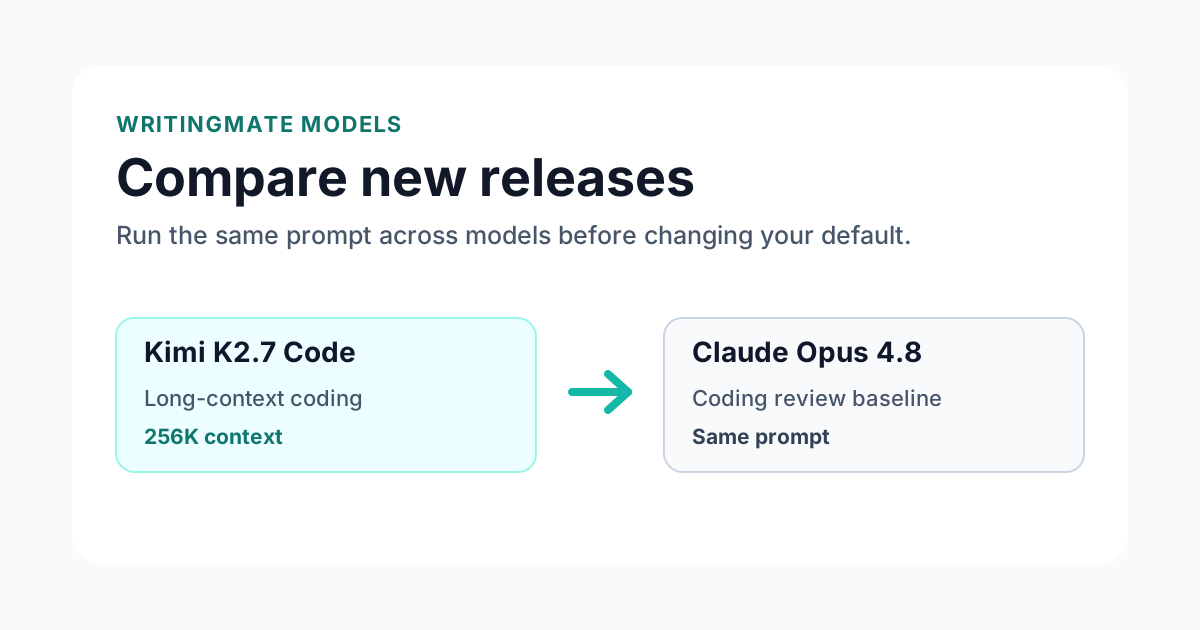
A long-context trial for this release
Give the model a dense task where the answer must preserve details from the beginning, middle, and end of the context. For example: upload a long strategy memo, ask for the strongest argument, the weakest assumption, and a decision table with risks, owners, and next steps.
Then test revision quality. Ask it to shorten the answer by 40 percent without dropping caveats, then ask it to turn the same reasoning into an executive email. A model that handles both steps cleanly is more useful than one that only writes a strong first draft.
- Long-context test: summarize a large source pack with specific uncertainties.
- Decision test: produce a tradeoff table with recommendation, risks, and assumptions.
- Formatting test: return strict JSON or a table without extra prose.
- Revision test: compress and retarget the same answer for a different audience.
For it, I would pay attention to editing cost. If the answer is slightly better but takes the same cleanup time, it has not earned the higher price.
Where this release fits against long-context alternatives
Compare the model against a model you already trust for serious work, such as Claude Opus 4.8. Do not compare it against a weak baseline and declare victory. The useful question is whether it beats your actual default.
If it wins, promote it gradually: research summaries first, then structured drafting, then more sensitive customer-facing or technical work after it proves consistent on your examples.
Open the Writingmate comparison page and use the same source pack for both models. The winner should reduce review time, not only produce a longer answer.
Best source-heavy tasks for it
Start with source-heavy work where a better model should reduce review time:
- Long-context research across large files
- Professional drafting with strict structure
- Source-heavy summaries and decision memos
- Document-heavy synthesis and executive summaries
After that, test long-context failure modes: missed early details, overconfident summaries, dropped caveats, and answers that follow the last instruction while forgetting the original goal. This release should reduce review time on dense material.
How to evaluate the release in Writingmate
The practical way to test this release is to start from the Writingmate models catalog, open the model, and run the same prompt against at least one nearby alternative. Keep the task narrow: a real support reply, a code review, a data summary, or a document rewrite usually reveals more than a generic benchmark prompt. Then compare the answer for structure, factual discipline, latency, and how much editing it still needs before it can ship.
For teams, the comparison page is the safer default because it keeps model choice tied to a specific workflow instead of a headline. Save the winner only after it performs well on the prompts your team repeats every week. That makes the release useful for day-to-day work without turning every new model announcement into a manual migration project.
Bottom line
It belongs in your workflow only if it reduces editing time on hard work. Test it on one long document, one decision memo, and one strict-format task before changing your default model.
Frequently Asked Questions About Laguna S 2.1
Sources
Written by
Artem Vysotsky
Ex-Staff Engineer at Meta. Building the technical foundation to make AI accessible to everyone.

Reviewed by
Sergey Vysotsky
Ex-Chief Editor / PM at Mosaic. Passionate about making AI accessible and affordable for everyone.