Writingmate now includes Pareto for agentic coding and tool work. The useful test is whether it can plan, call tools through an agent client, revise after feedback, and keep the task moving without drifting from the goal.
The model accepts image input, but that should be treated as supporting context. Use screenshots, diagrams, and captures when they help explain the task; do not evaluate Pareto as if it were a dedicated visual-generation model.
Pareto is available in the Writingmate catalog as of September 17, 2026. Confirm the live model page before you wire it into repeated agent or tool-use workflows.
What changes for agentic tool work
Pareto is listed as a Pareto model for agentic work. Pareto is a multimodal composite model built for research, coding, and agentic workflows, while delivering frontier-level performance across a broad range of general-purpose tasks. The important reader takeaway is that the model should be tested on execution quality: plans, tool boundaries, coding changes, research decomposition, and follow-up corrections.
In Writingmate, the model page gives you the live catalog entry, while the comparison page lets you run the same agent-style prompt against a baseline. That matters because agentic models often sound good in the first answer and fail when the task becomes a loop.
Open Pareto in the Writingmate model directory before you run an agent loop. Confirm the current input types, context window, and pricing so the test matches the live catalog entry.
A real agent loop for Pareto
Start with a task that has a real loop: inspect context, propose a plan, wait for approval, then produce a patch or tool-call sequence. A useful agentic model should separate observation from action and avoid pretending that a tool has already run.
Then run a research-to-plan prompt. Give Pareto a messy goal, a few constraints, and an instruction to produce the next three actions with acceptance criteria. The answer should be specific enough that another agent or teammate could execute it.
- Tool-use test: require explicit arguments, expected result, and fallback if the tool fails.
- Coding loop test: ask for a plan first, then a small patch with a verification step.
- Research test: turn a vague request into sources to inspect, questions to answer, and decision criteria.
- Visual-context test: include a screenshot only when it changes the plan or debugging path.
For the model, the pass/fail test is not a clever first answer. It is whether the model keeps the task state clean when planning, tools, code, and revisions are all in play.
it specs that matter for agent loops
Field | This release | Reader takeaway |
|---|---|---|
Provider | The model | Useful if you already evaluate this provider for agentic coding or research workflows. |
Availability date | September 17, 2026 | Available in the catalog as of September 17, 2026. |
Context window | 256K tokens | Best tested on multi-step tasks with source excerpts, constraints, and tool instructions. |
Input | text + image | Use text as the main instruction layer; add screenshots or diagrams only when they clarify the task. |
Output | text | Judge plans, code, tool-call arguments, research outlines, and revision quality. |
Pricing | $2.50 / M tokens input / $7.50 / M tokens output | Use cost to decide whether it belongs in repeated agent loops or only high-value tasks. |
For a fair agentic comparison, keep the task goal, tool contract, files, and acceptance criteria identical. Then judge whether it separates planning from action, writes usable tool arguments, and recovers cleanly when the next step changes.
Where this release fits in an agent stack
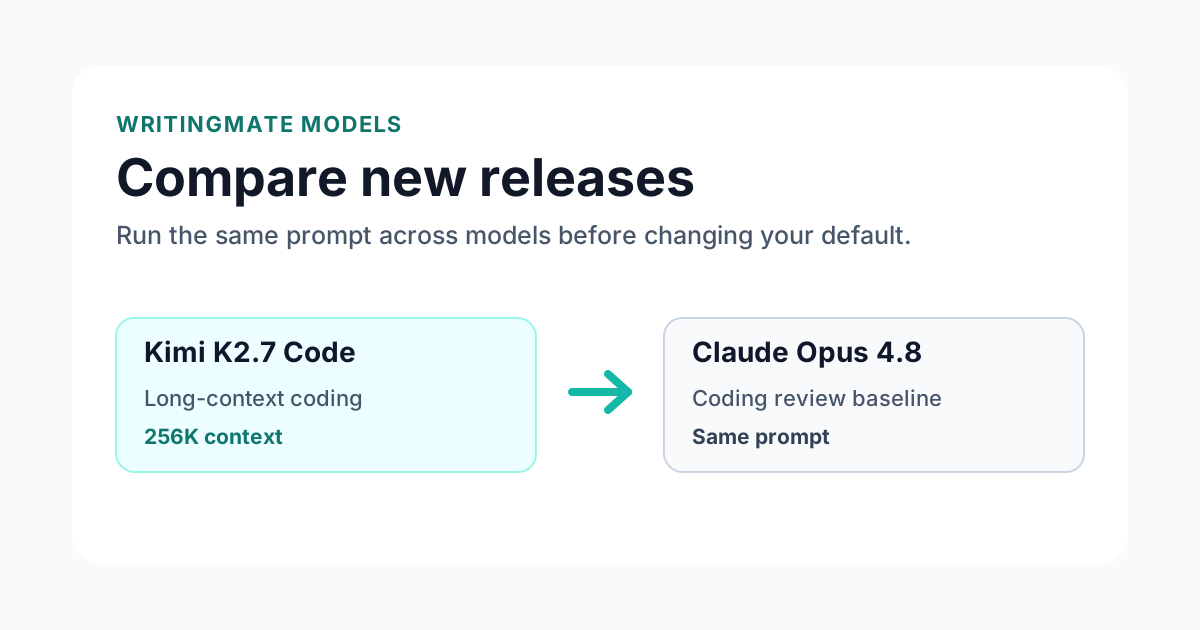
Compare the model against Claude Opus 4.8 or another model you already trust for agent work. Use the same task loop, the same tool contract, and the same acceptance criteria so the comparison measures execution, not phrasing.
If it wins, start with low-risk agent workflows: coding plans, research decomposition, tool-call drafting, and review tasks where a human can verify the next step before it runs.
Open the Writingmate comparison page and run the same agent loop against this release and Claude Opus 4.8. The useful signal is whether the plan, tool arguments, and verification step improve together.
Best first agent tasks for the model
Promote it only after it proves useful in controlled agent loops. Good first candidates are:
- Agentic coding plans
- Tool-use and function-calling workflows
- Deep research task breakdowns
- Image-supported debugging when visual context matters
After that, test agent failure modes: vague plans, invented tool results, missing verification steps, and follow-up answers that forget the original acceptance criteria. This release belongs in an agent workflow only if those failures are rare and easy to catch.
How to evaluate the release in Writingmate
The practical way to test this release is to start from the Writingmate models catalog, open the model, and run the same prompt against at least one nearby alternative. Keep the task narrow: a real support reply, a code review, a data summary, or a document rewrite usually reveals more than a generic benchmark prompt. Then compare the answer for structure, factual discipline, latency, and how much editing it still needs before it can ship.
For teams, the comparison page is the safer default because it keeps model choice tied to a specific workflow instead of a headline. Save the winner only after it performs well on the prompts your team repeats every week. That makes the release useful for day-to-day work without turning every new model announcement into a manual migration project.
Bottom line
It is worth testing if your work depends on agent loops rather than one-shot chat answers. Judge it on tool discipline, constraint tracking, and second-turn correction before moving it into higher-risk automation.
Frequently Asked Questions About Pareto
Written by
Artem Vysotsky
Ex-Staff Engineer at Meta. Building the technical foundation to make AI accessible to everyone.

Reviewed by
Sergey Vysotsky
Ex-Chief Editor / PM at Mosaic. Passionate about making AI accessible and affordable for everyone.