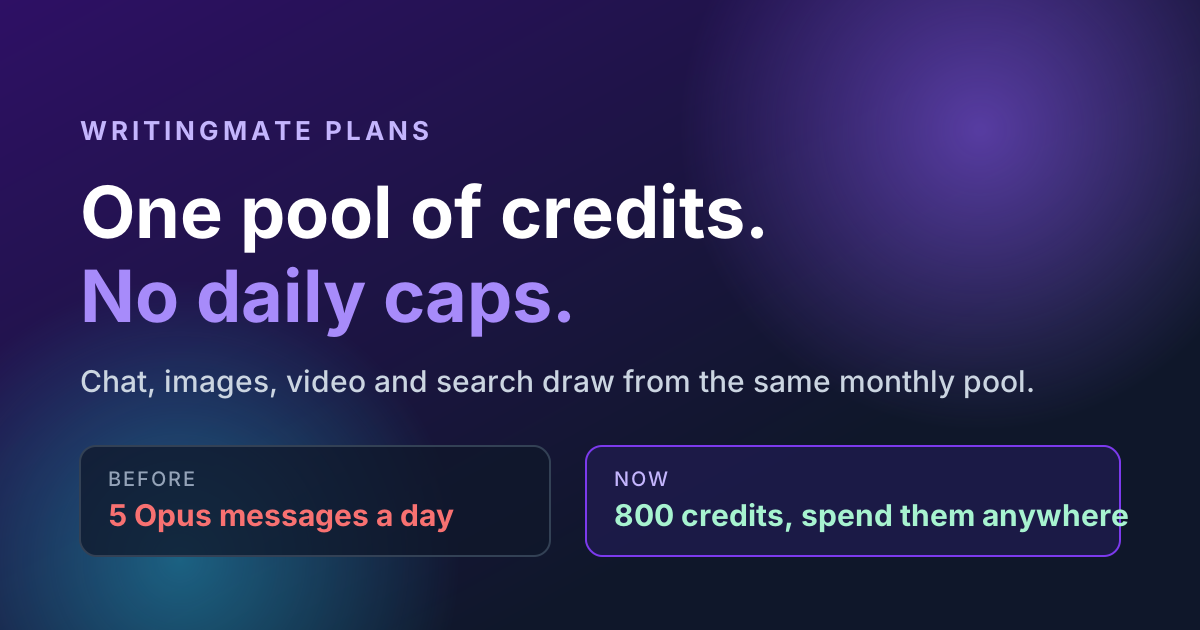
Writingmate plans no longer cap how many messages you can send per day. As of this release, every paid plan gets one monthly pool of credits that covers chat, images, video and web search together — and every model in the catalog is available on every paid plan, including Claude Opus 5 and GPT-5.6 Sol.
The old plans rationed the strongest models to 5 messages a day on Pro, no matter how much you paid. That cap is gone. Pro now includes 800 credits a month and Ultimate includes 2,000, and you decide what to spend them on.
If you are an existing customer: nothing changes for you mid-term. Your current plan keeps working exactly as it does today until it renews. The details are further down.
What is changing in Writingmate plans?
Per-category daily message caps are replaced by a single monthly credit pool. Previously each plan had separate daily allowances for Basic, Pro and Ultimate model categories, and reaching one meant waiting until 00:00 UTC. Now there is one number, and it refills on your billing date.
| Before | Now | |
|---|---|---|
| Top models (Claude Opus, GPT-5.6 Sol) | 5 a day on Pro, 20 on Ultimate | No daily cap |
| Allowances | Separate per model category | One pool for everything |
| Reset | Daily, at 00:00 UTC | Monthly, on your billing date |
| Images and video | Separate counters, plus a monthly video cap | Same pool as chat, no video cap |
Video comes out of the same pool too — there is no separate monthly clip count. At a typical 8-second clip that is roughly 10 clips on Pro and 25 on Ultimate, and a good deal more on the lighter video models. The only remaining video restriction is that 3 clips can be rendering at once, which is a queue limit rather than an allowance.
Why change the model at all?
Because per-category daily caps break in four ways that credits do not, and every one of them was costing somebody — us or you.
1. New models needed new rules. Every time a lab shipped something more expensive, a cap-based system had to decide which bucket it belonged in, and whether that bucket needed its own daily number. With credits there is nothing to decide: a pricier model simply costs more credits per message. We can add it the day it launches instead of renegotiating the plan around it.
2. The caps distributed messages unfairly. A cap counts messages, not cost. Under the old rules a message to a small, cheap model consumed the same allowance as a message to a frontier model that costs 48x more to serve. That meant the allowance on cheap models had to be set low enough to survive people using it on expensive ones — so everybody got fewer messages than they could have had. Pricing by cost instead of by count is what lets Pro include roughly 3,000 everyday messages rather than a few hundred.
3. You could not choose how to spend. Separate buckets meant leftover image allowance could not become chat, and unused chat could not become video. If you want to spend an entire month on frontier models and nothing else, that is now a valid way to use the plan. So is the opposite.
4. The mismatch cut both ways. This is the real reason. Under caps, some people hit a wall while still costing us very little, and others stayed under every cap while costing us far more than they paid. Both are bad: the first is a customer we frustrated for no reason, the second is a plan that loses money quietly. Credits price the actual work, so heavy use draws down faster and light use goes further — and our costs scale with what people genuinely do instead of with how the buckets happened to be drawn.
It is also where the whole category has landed. Poe, OpenRouter, Monica, Higgsfield and Revid all meter with credits or points rather than per-category message counts. The labs have moved the same way inside their own products — Codex and Claude Code both meter token usage rather than counting messages. The common thread is pricing the work actually done instead of counting requests, which is the only approach that stays coherent when one model costs 48x another.
How many messages is 800 credits?
Between roughly 230 and 11,900 messages on Pro, depending entirely on which model you pick. That range is not a hedge — the cheapest models in the catalog genuinely cost about one forty-eighth of the most expensive ones.
| Model | Credits per message | Pro (800) | Ultimate (2,000) |
|---|---|---|---|
| GPT-5.6 Luna | 0.07 | ~11,900 | ~29,800 |
| Qwen3.7 Flash | 0.02 | ~43,000 | ~107,000 |
| Gemini 3.5 Flash Lite | 0.24 | ~3,200 | ~8,200 |
| Claude Sonnet 5 | 1.22 | ~650 | ~1,600 |
| Claude Opus 5 | 3.06 | ~260 | ~650 |
| GPT-5.6 Sol | 3.35 | ~230 | ~590 |
These come from measuring real conversations on the platform, not from a spreadsheet estimate. On the plan cards we quote lower figures — about 3,000 everyday messages or 200 top-model messages on Pro — because those assume the most expensive model in each group.
Images cost 2 to 20 credits depending on model, video costs 4 to 50 credits per second, and a web search costs about 2. Video used to carry a hard monthly clip count on top of credits; that is gone, because the pool already bounds what you can spend.
Why does Claude Opus cost more than Gemini Flash?
Because a message costs far more than the words you type, and the expensive models charge more for reading. The typical message someone sends is about 15 words. The model does not read only those 15 words — it re-reads the whole conversation so it can answer in context, which on a typical turn is around 7,500 tokens going in.
That has two consequences worth knowing before you start:
- The first message in a chat is cheap. The twentieth is not. There is more to re-read each time.
- Attached files are re-read too. A long PDF is part of every message after you attach it, not just the one you attached it to.
We cache that conversation history, so you are not charged the full rate for text the model has already seen. About two-thirds of the input on a typical message is served from cache — which is why a long thread costs noticeably less than its length suggests.
What happens to existing customers?
Nothing changes mid-term. Your current plan keeps its current limits until it renews, and nothing is taken away early. Monthly plans move over at their next monthly renewal; annual plans move at their next annual renewal.
When you do move over, two things change:
- The daily caps disappear. Every model in the catalog becomes available, with no separate allowance per category and no waiting for a 00:00 UTC reset.
- Heavy models draw down faster. Under daily caps, an Opus message and a Flash message counted the same. Under credits they do not — that is the honest trade for removing the cap.
If you spent your days pinned against the 5-per-day Opus limit, you gain a lot. If you ran long Opus sessions with big files attached and never noticed the ceiling, watch your balance for the first month — you will see the cost of that work for the first time.
You can check which system your workspace is on in Profile Settings → Subscription. If it shows a credit balance, you have moved. If it shows a daily message limit, you have not.
What if I am on an AppSumo plan?
AppSumo tiers are unchanged. They keep their own monthly message pools with daily pacing, exactly as sold — the credit system does not apply to them and nothing about those deals changes. The rules are in AppSumo Plan Tiers.
What if I run out of credits?
You have three options, and the first one is free. Credits refill automatically on your billing date, so waiting costs nothing if you are near the end of a cycle.
- Wait. Your pool refills on your billing date.
- Top up. Buy a credit pack on the upgrade page. Purchased credits last 90 days and are only used after your plan credits are gone.
- Move up. Ultimate includes 2.5x the credits of Pro.
The cheapest way to make credits last is model choice, and it is worth more than everything else combined. Switching a routine task — drafting, summarising, reformatting — from Claude Opus 5 to GPT-5.6 Luna costs about one forty-eighth as much. Save the frontier models for the work that actually needs them.
Where to read the details
The full rate card, per-model costs and worked examples are in Understanding Credits. The Fair Use Policy covers both systems, including the daily-limit rules that still apply to plans which have not renewed yet.
Plan prices have not changed. Pro is $19.99 a month billed yearly, Ultimate is $39.99 — see pricing for both billing cycles.
Frequently Asked Questions
Sources
Written by
Artem Vysotsky
Ex-Staff Engineer at Meta. Building the technical foundation to make AI accessible to everyone.

Reviewed by
Sergey Vysotsky
Ex-Chief Editor / PM at Mosaic. Passionate about making AI accessible and affordable for everyone.