The popular advice for building AI agents is backwards. It starts with a model, adds a prompt, connects a few tools, and treats a successful demo as evidence that the system is ready. In production, better models aren't usually the main bottleneck. Quality, evaluation, guardrails, observability, retries, rollback, and clear ownership decide whether an agent can be trusted with real work.
The distinction matters because an agent doesn't just generate text. It interprets instructions, selects tools, changes state, and sometimes acts across systems that contain sensitive or consequential data. This guide focuses on AI agents and how to build them for dependable operation, not just impressive first runs.
Table of Contents
- Why Most AI Agent Projects Never Leave the Demo Stage
- What an AI Agent Actually Is
- Designing the Agent Architecture
- Building Your First Working Agent
- Testing Agents With Evals Before You Trust Them
- Safety Guardrails and Deployment Practices
- From Deployed Agent to Dependable System
Why Most AI Agent Projects Never Leave the Demo Stage
A polished demo proves that a model can complete one path under supervision. It says little about whether the agent can handle ambiguous instructions, stale records, unavailable APIs, adversarial inputs, duplicate events, permissions, or a user waiting for recovery after failure. Production exposes those conditions immediately.
The engineering problem is therefore wider than prompt quality. An agent can produce a plausible answer while selecting the wrong tool, misreading the request, or completing only part of a multi-step task. Prompt refinement may reduce certain errors, but it cannot create transaction boundaries, audit trails, approval rules, rollback, or ownership for external actions.
The operational gap
Industry coverage often focuses on model selection and prompting because those choices are easy to demonstrate. The production blockers sit around the model: evaluation, guardrails, observability, retries, rollback, and governance. Independent agent-engineering coverage also identifies quality as the largest barrier to production and points to evaluation and guardrails as significant gaps.
Adoption remains uneven. In 2026, 40% of large organizations were scaling agents in at least one function, while smaller organizations were flat at 22%, according to the same State of AI research cited above. Experimentation is easier than assigning operational ownership.
Practical rule: Treat the first successful run as a prototype signal, not a reliability result.
A production agent needs a narrow task boundary, explicit tool contracts, and a test set that reflects real requests. It also needs a failure policy, logs that let engineers reconstruct each run, and escalation when the system reaches a decision it should not make alone.
What dependable builds prioritize
Start with one bounded workflow instead of a general-purpose assistant. Define which actions the model may recommend, which it may execute, and which require approval. Represent those decisions with structured outputs and traceable events.
Choose the architecture before choosing a framework. Add autonomy only after the implementation has measurable behavior. Evaluation, red-teaming, rollback, and governance belong in the product from the first deployment, not in a checklist prepared after a failure.
What an AI Agent Actually Is
A useful definition starts with the system's behavior, not its branding. Modern agentic AI is built on foundation models that can plan, reflect, use tools, and interact with an environment to complete tasks. A 2025 survey of agentic AI describes these systems as foundation-model-based systems that follow natural-language instructions, perform complex reasoning, and produce artifacts through tool-heavy or environment-interactive work.
A chatbot primarily responds to a message. An agent orchestrates a sequence of actions. Given the instruction “review these incoming messages, classify them, draft replies, and update the tracker,” an agent might retrieve the messages, apply a policy, create structured classifications, draft text, call a tracker API, and report which actions succeeded.
That doesn't mean the model should control every step. It means the system can coordinate reasoning and external capabilities inside a controlled loop.
The four baseline components
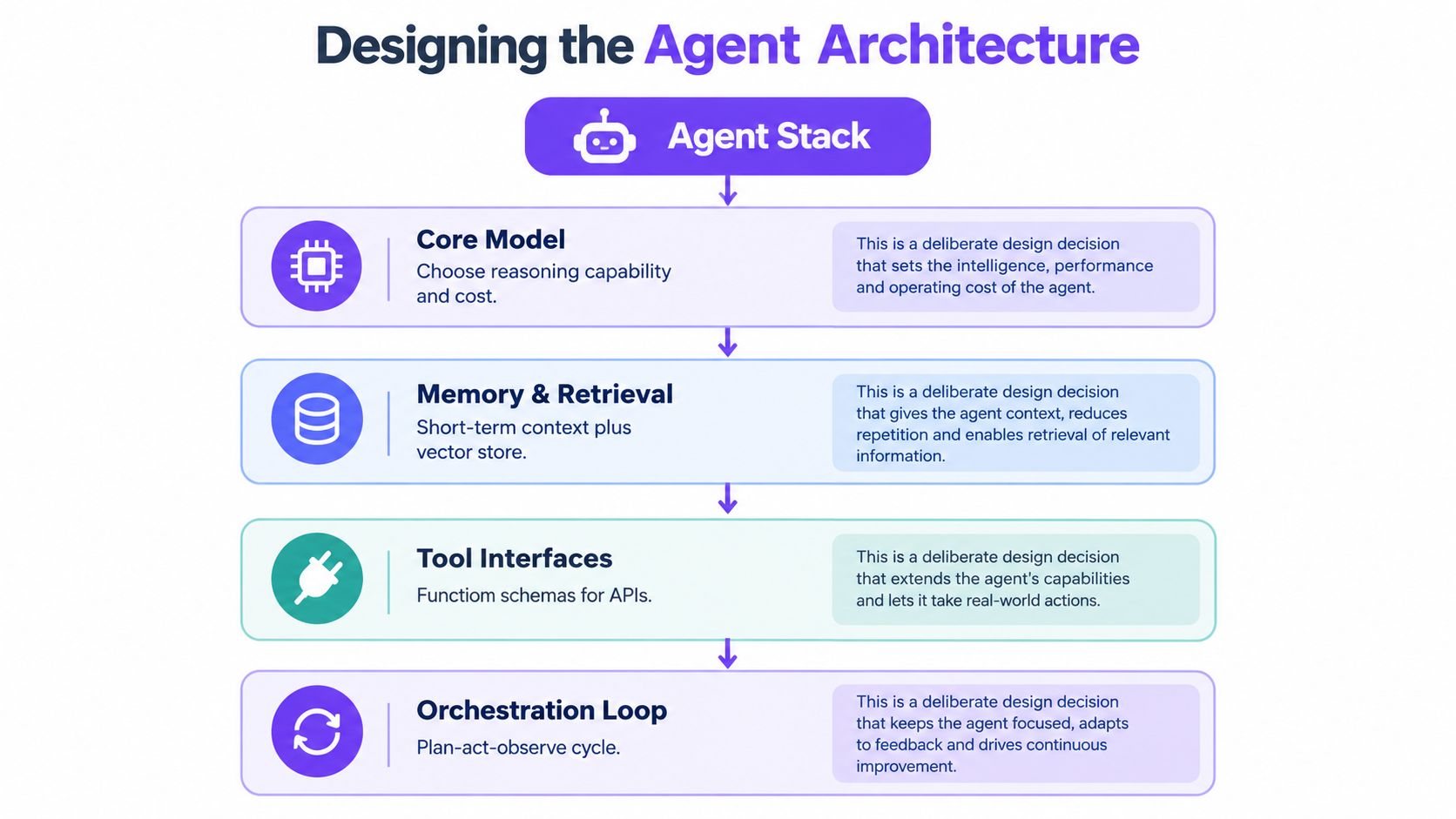
The overview of AI agents is useful vocabulary for separating the moving parts:
- Core model: Interprets instructions, reasons over context, selects actions, and produces text or structured results.
- Memory and retrieval: Supplies relevant short-term context and durable information without placing an entire history in every prompt.
- Tool interfaces: Expose APIs, databases, search systems, or business actions through explicit functions and schemas.
- Orchestration loop: Manages the plan, action, observation, and next decision cycle.
The survey places the current agentic AI era in the 2022-present period and notes that practical systems commonly combine a core model with memory, retrieval, and tool interfaces. That architecture is recent, but these components are now baseline design decisions rather than optional enhancements.
Artifact production changes the design
The output isn't always a paragraph. It might be a ticket, a database update, a report, a code change, or a proposed reply. Each artifact needs a contract that defines acceptable structure, permissions, and review requirements.
This is why “add more prompting” is a weak universal answer. A prompt can describe intent, but a tool schema can restrict arguments, a validator can reject malformed output, and an approval step can stop an unsafe write. Reliable agents combine all three.
Designing the Agent Architecture
The first architectural decision isn't which framework to install. It's whether you need an autonomous agent at all.
A scripted workflow with model calls is often the better choice when the sequence is known. For example, classify a message, retrieve a policy, draft a response, validate the draft, and place it in a review queue. Each stage has a bounded input and output, so the system is easier to test and debug.
Use a more autonomous loop when the path varies, the available tools are numerous, and the agent must inspect intermediate results before deciding what to do next. Autonomy creates flexibility, but it also expands the space of possible failures.
Choose the control surface deliberately
The core model should match the task's reasoning demands and cost constraints. A strong model won't compensate for missing permissions or poor state management. Conversely, a smaller model may work well inside a tightly constrained workflow with clear schemas and limited choices.
Memory and retrieval need boundaries. Store durable facts only when they have a defined source and update policy. Retrieve narrowly, label provenance, and prevent one user's or session's context from leaking into another. Memory that's difficult to invalidate becomes a hidden source of incorrect behavior.
Tools should expose business capabilities, not raw unrestricted access. A function such as create_refund needs typed arguments, authorization checks, idempotency handling, and an audit event. A generic database writer gives the model too much surface area and makes policy enforcement harder.
Plan for interoperability without outsourcing judgment
The ecosystem's interoperability layer is developing quickly. Anthropic launched the Model Context Protocol in November 2024, Google introduced Agent2Agent in April 2025, and Google donated A2A to the Linux Foundation in June 2025 with 50+ launch partners, according to the 2025 AI Agent Index. These protocols can simplify connections between agents and tools, but they don't decide which capabilities your agent should receive.
Protocol support can reduce custom integration work. It can also make a broad tool ecosystem available before your authorization, monitoring, and data boundaries are ready. Adopt protocols at the interface layer, while keeping ownership of permissions, validation, and observability in your application.
The guide to selecting and configuring agents can help with initial setup, but configuration isn't architecture. You still need to decide where the model stops and deterministic code begins.
Building Your First Working Agent
Start with a workflow that has a clear owner and a measurable outcome. An inbox triage assistant is a useful first build because it combines retrieval, classification, drafting, and a possible write action without requiring unrestricted autonomy.
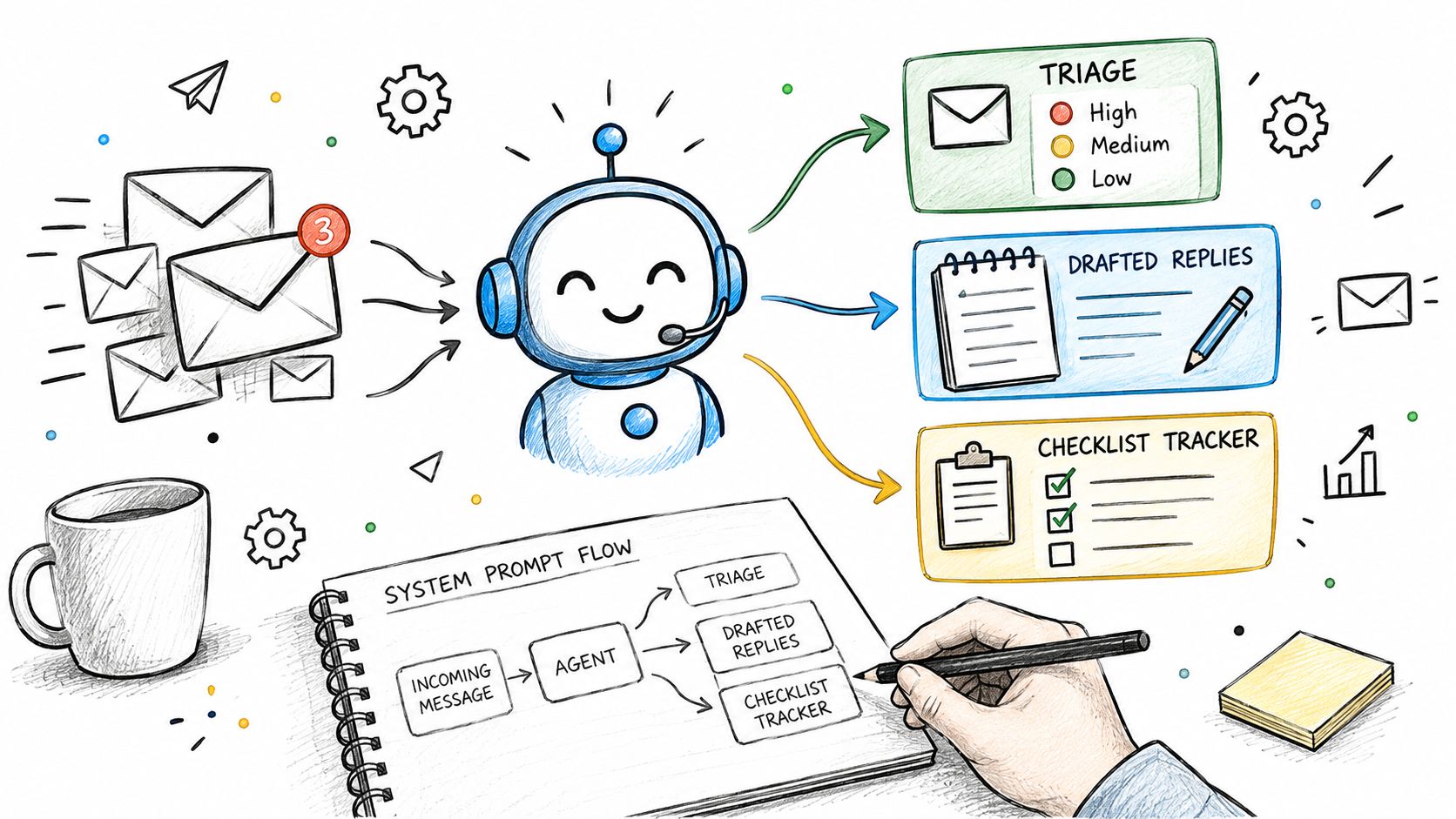
Define the agent's scope in its system instructions. State which messages it may process, which sources it may trust, what output it must produce, and when it must refuse or escalate. Avoid vague directions such as “handle the inbox.” Specify that it should classify each message, identify missing information, draft a response without sending it, and update a tracker only after validation.
Keep the first tool surface small
Begin with read-only tools:
- List messages: Return sender, subject, timestamp, thread identifier, and sanitized body content.
- Retrieve policy: Return the applicable support or routing rule with its source.
- Search tracker: Find existing records without changing them.
- Draft response: Produce a structured draft, not an outbound message.
Each tool should use a strict schema. A classifier might return category, urgency, confidence, reason, and needs_human_review. The application should reject missing fields, unknown categories, unsupported confidence values, and attempts to add arbitrary instructions inside a structured field.
Don't give the model a direct “send email” function at the start. Put that action behind a separate service that checks approval status, recipient scope, content policy, and duplicate-send protection. Read access first, write access later is more than a cautious slogan. It gives you logs and evaluation data before external side effects become possible.
Log every model request, tool call, tool result, validation error, retry, and final disposition. Redact secrets and unnecessary personal data, but preserve enough context to reconstruct the decision. The custom agent creation guidance covers the configuration side, while your application still needs its own runtime controls.
The agent will drift when the request contains several unrelated tasks, when a tool returns ambiguous data, or when retrieved content includes instructions aimed at the model. Use structured outputs, step limits, explicit refusal states, and deterministic routing for known cases. A longer prompt rarely fixes an unconstrained action space.
After the agent drafts a response and prepares a tracker update, show both to a reviewer. Record whether the reviewer approved, edited, rejected, or escalated the result. That feedback becomes part of the evaluation set rather than disappearing into an inbox.
The following video provides a visual introduction to the workflow pattern:
Testing Agents With Evals Before You Trust Them
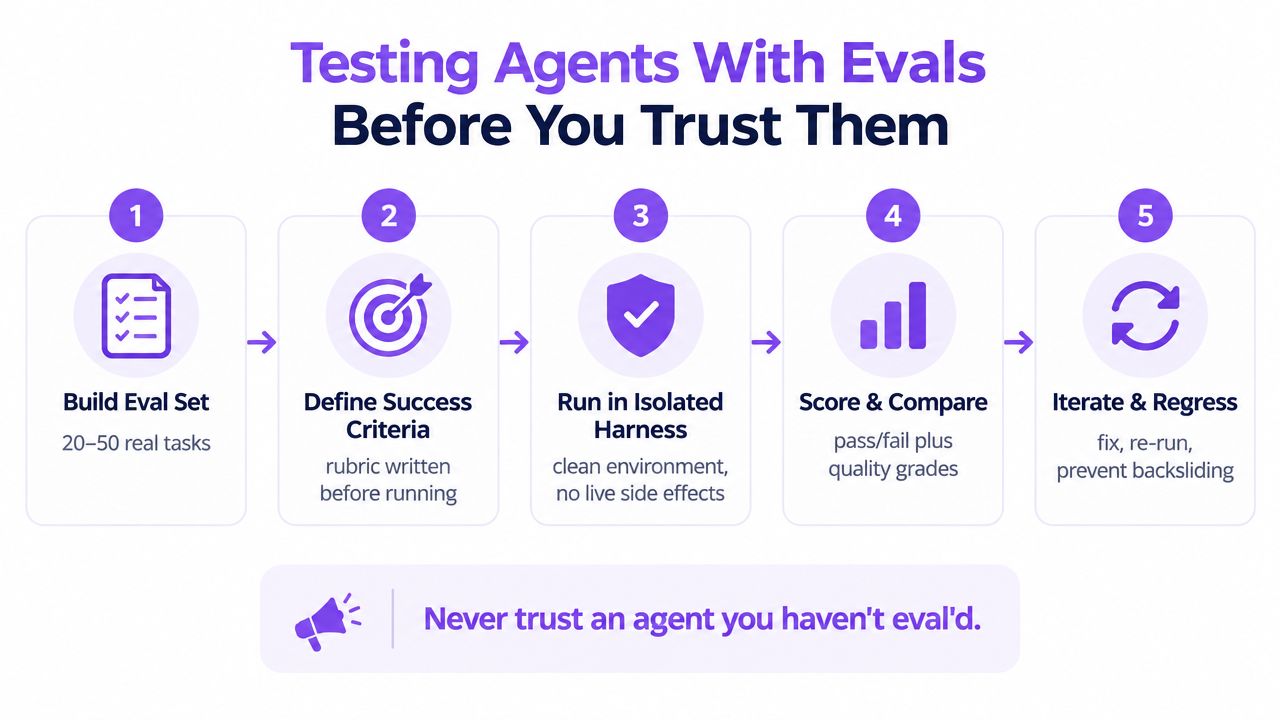
A production eval starts with real work, not synthetic prompts that make the system look competent. Build an eval set of 20-50 real tasks, define success before execution, and run those tasks in an isolated harness, following the practical guide to AI agent evaluation.
Record the full execution path: user input, retrieved context, model response, tool arguments, tool results, validation failures, retries, and final output. Measure correctness with latency and token cost. A correct result that consumes excessive resources may require a different design. A fast result that edits the wrong record is still a failure.
Grade the work and the path
A useful grader examines how the agent reached its answer, not only whether the final text sounds good. For the inbox example, evaluate:
- Classification: Did the agent choose an allowed category?
- Evidence: Did it use the correct message and policy context?
- Completeness: Did the draft address every required point?
- Safety: Did it avoid sending, promising, or changing anything without permission?
- State: Did the proposed tracker update identify the correct record?
- Recovery: Did the agent escalate when information was missing?
Make some checks deterministic. Validate schemas, identifiers, required fields, and permission states in code. Use a human or model-assisted grader for tone, relevance, and nuanced policy adherence. Sample the grader's decisions too, because a flawed evaluator can hide failures while producing reassuring scores.
Aggregate scores hide the failure that matters. Read the transcript that produced the score.
Make regressions visible
Run the eval suite in CI/CD before changing the prompt, model, retrieval settings, tool definitions, or orchestration loop. Store previous results and compare each new run with them. A change that improves one scenario but causes unsafe tool selection elsewhere should fail, even if its average score rises.
The benchmark evidence is sobering. On a realistic end-to-end benchmark covering 53 tasks across four domains, the strongest tested configuration passed only 23.9% of evaluation simulations, according to the end-to-end agent reliability benchmark covering 53 tasks across four domains. The result does not make agents useless. It shows that a polished demo predicts little about dependable behavior across varied tasks.
Inspect failed transcripts by category. Retrieval may be incomplete, a tool result may be misunderstood, or the orchestration loop may continue after a failed write. A retry can also repeat an action. Each cause requires a different fix, so aggregate scores cannot provide the diagnosis.
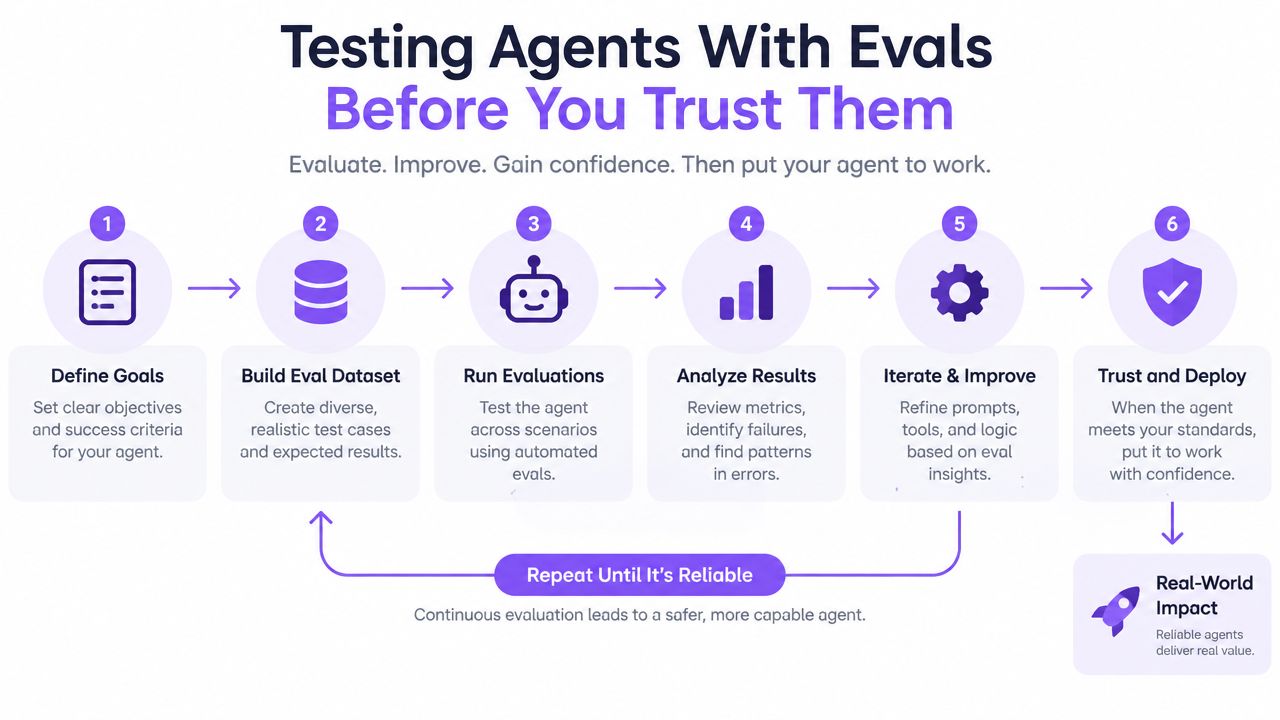
Expand the eval set as production reveals new edge cases. Keep failed examples, label the reason for each failure, and require a passing regression run before restoring changed behavior. That record becomes part of the production stack, alongside rollback controls, observability, and governance, rather than a one-time test report.
Safety Guardrails and Deployment Practices
Production agents fail in recognizable ways. Findings from the same agent-failure research cited in the evals section above describe recurring problems across reasoning, communication, and environment interaction, including prompt injection, goal misgeneralization, memory contamination, tool misuse, and cross-session leakage. Treat those findings as a design checklist, not as a reason to trust a stronger system prompt.
Map every meaningful failure mode to a control:
| Failure mode | What it looks like | Countermeasure |
|---|---|---|
| Prompt injection | Retrieved content tells the agent to ignore its task or reveal information | Treat external content as untrusted data, isolate instructions, and red-team retrieval paths |
| Goal misgeneralization | The agent optimizes an easy proxy instead of the user's actual objective | Define explicit success criteria, add checkpoints, and require confirmation for consequential decisions |
| Memory contamination | A false or outdated fact persists and influences later work | Store provenance, apply update rules, and support deletion and review |
| Tool misuse | The agent sends malformed arguments or invokes an inappropriate function | Use schema-validated calls, authorization checks, allowlists, and typed responses |
| Cross-session leakage | Data from one user or task appears in another context | Isolate session state, enforce tenant boundaries, and test adversarially |
| Partial execution | One step succeeds while a later step fails, leaving inconsistent state | Use idempotency keys, checkpoints, compensating actions, rollback, or escalation |
Design for interruption
Retries need explicit boundaries. Retry transient transport failures, not every tool error. Make writes idempotent so a repeated request does not create duplicate tickets or messages. Persist progress between steps, allowing a restarted process to recover known state instead of guessing what already happened.
Capture what the agent decided, why it selected a tool, what the tool returned, and which guardrail changed the path. Metrics expose latency spikes, validation failures, escalation rates, and repeated retries. Traces explain individual incidents by preserving the sequence of model calls, tool calls, inputs, outputs, and failures.
Use step-level checkpoints to limit damage. Before a write, verify identity, scope, current state, and approval. Afterward, confirm the resulting state through the system of record. A successful API response does not prove that the business operation completed.
Keep humans in the right places
Require human approval for actions that are irreversible, financially consequential, legally sensitive, externally visible, or difficult to audit afterward. Escalation defines a boundary around uncertainty; it is part of the operating design, not evidence that the agent has no value.
Deploy in stages. Start with shadow mode or draft-only behavior, compare decisions with existing workflows, and then permit narrowly scoped actions. Maintain a kill switch that disables tool execution while preserving the evidence needed for diagnosis. Pair it with rollback procedures that identify which writes can be reversed and which require manual remediation.
From Deployed Agent to Dependable System
Deployment creates an ownership problem. Someone must decide whether the agent is performing acceptably, whether it may access another system, who approves changes, and how the team handles a disputed action.
A 2026 SAP LeanIX survey found that 98% of companies had deployed or planned to deploy AI agents, while only 17% had visibility into agent performance or conformance and 48% lacked clearly defined roles or responsibilities for agent management. Those figures point to a governance gap around ownership, monitoring, and accountability.
Assign the operating model
Give the agent a named business owner and a technical owner. The business owner sets acceptable outcomes and approval thresholds. The technical owner maintains prompts, tools, infrastructure, evaluations, incident response, and access controls.
Document these decisions before broadening access:
- Decision rights: Which actions can the agent take, recommend, or never perform?
- Approval rights: Which people or roles can authorize consequential actions?
- Data boundaries: Which sources may be retrieved, stored, or combined?
- Audit requirements: Which inputs, tool calls, outputs, and approvals must be retained?
- Change control: Which modifications require a new evaluation run or security review?
- Exit path: How can a user revoke access, correct memory, reverse an action, or disable the agent?
Treat integration, data access, and security as operating requirements alongside model selection. An agent that cannot reliably reach the correct source or show what it did is not ready for production, even when its prose is excellent.
Use the first ninety days as an evidence cycle
Review incidents and near misses during the initial operating period, not only successful completions. Add real failures to the eval set, classify them, and decide whether each fix belongs in the prompt, schema, workflow, permissions, retrieval layer, or human process. That record becomes more useful than a demo transcript because it shows where the system fails under real conditions.
Measure outcomes that match the task. An inbox assistant might be judged by correct routing, reviewer acceptance, unresolved escalations, duplicate updates, and time spent correcting drafts. Activity counts do not establish return on investment. Connect the agent's work to an outcome an accountable team already recognizes.
The field is changing quickly. The AI Agent Index cited in the architecture section reports that 24 of 30 tracked agents were released or received major agentic updates in 2024-2025. Fast ecosystem growth makes modular interfaces and replaceable models sensible, while increasing the need for regression testing and governance.
The durable advantage will not come from choosing a perfect model once. It comes from building a system that can detect, contain, explain, and improve its failures.
Build the smallest useful agent, keep permissions narrow, evaluate it against real work, and expand only when evidence supports expansion. Teams that invest in evals, guardrails, rollback, observability, and governance can improve a working system instead of repeatedly rebuilding demos around a new model.
Writingmate provides custom AI assistants with saved instructions, a selected model, optional knowledge files, optional tools, and integrations such as MCP. These capabilities can support early agent prototyping and workflow testing before connection to consequential production actions. Visit Writingmate to explore them.
Frequently Asked Questions
Sources
Written by
Artem Vysotsky
Ex-Staff Engineer at Meta. Building the technical foundation to make AI accessible to everyone.

Reviewed by
Sergey Vysotsky
Ex-Chief Editor / PM at Mosaic. Passionate about making AI accessible and affordable for everyone.