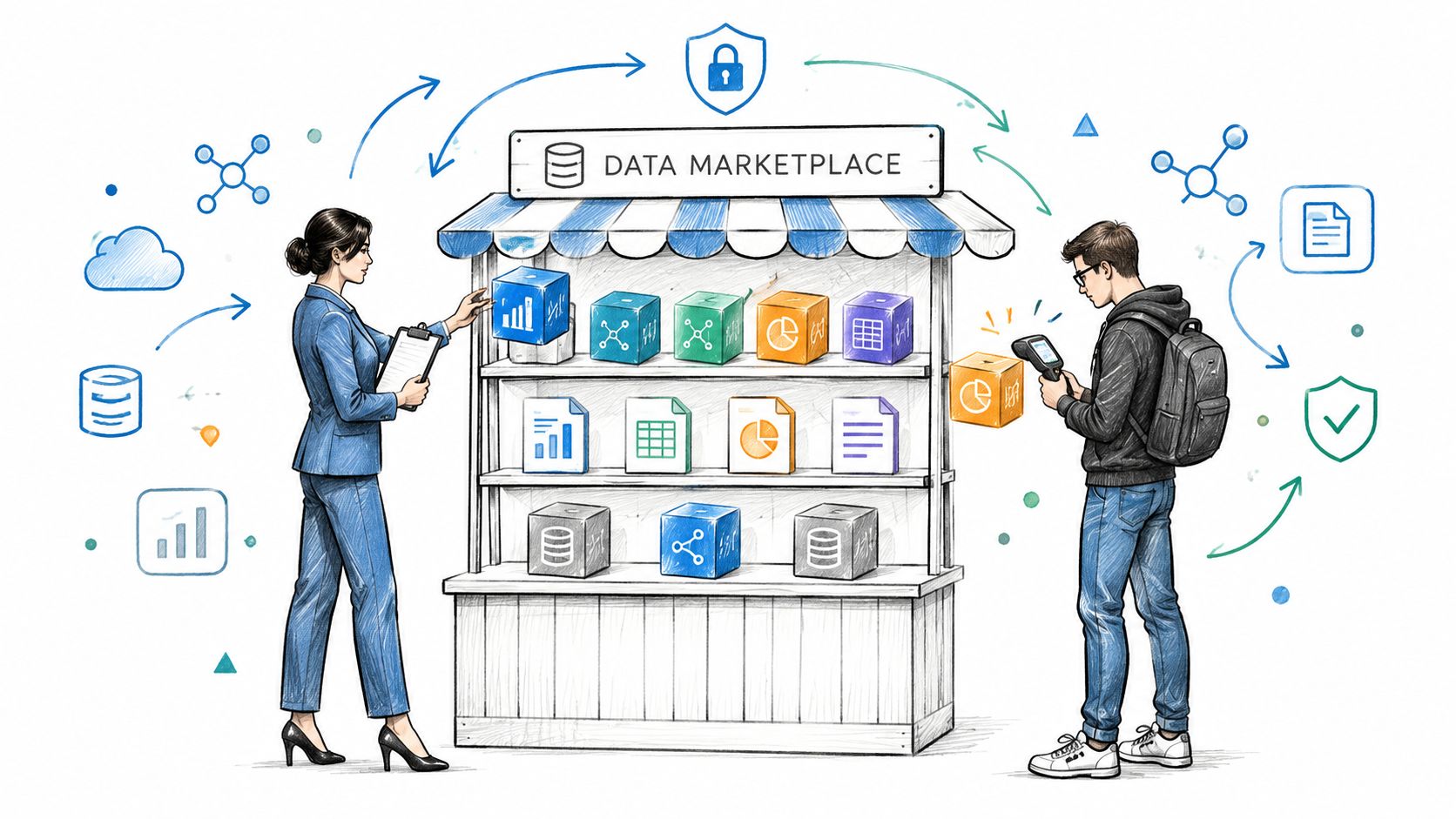
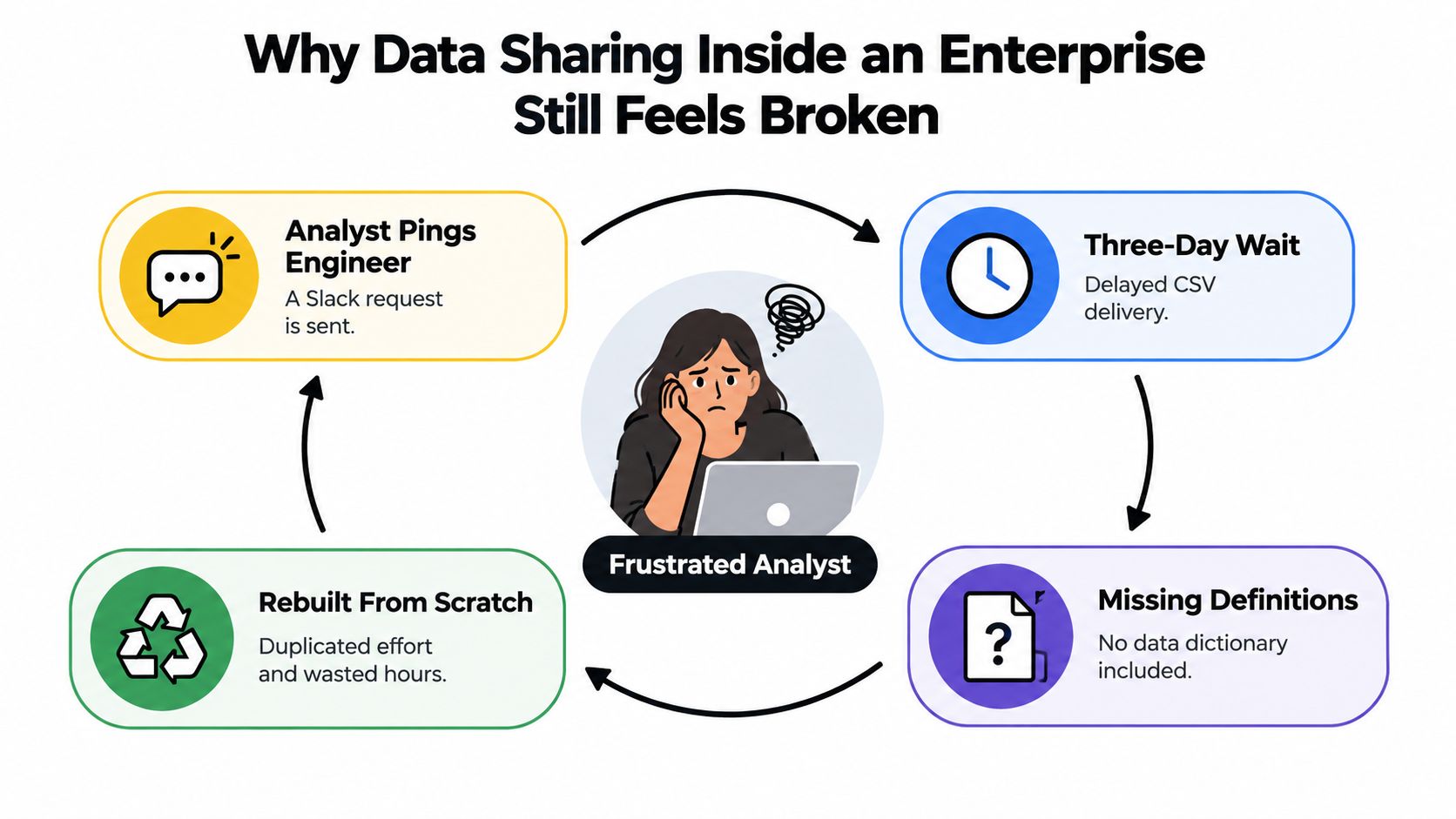
An analyst needs a customer-retention dataset before an executive meeting. She messages a data engineer, waits for a CSV, asks what the columns mean, and discovers that the file contains yesterday's extract with no ownership information. Another team already has a similar dataset, but its definition of “active customer” differs. The analyst eventually rebuilds the data herself, creating another version nobody else can find.
That pattern is more than an inconvenience. It creates duplicated acquisition, uncertain lineage, hidden licensing obligations, inconsistent metrics, and access decisions that live in chat threads. An enterprise data marketplace addresses the problem by making data discoverable, documented, permissioned, reusable, and accountable. It doesn't replace a warehouse or lakehouse. It adds an operating layer that helps people find and use data products safely.
The market reflects growing interest in this model. One estimate valued the global data marketplace platform market at USD 1.5 billion in 2024 and projected it to reach USD 5.7 billion by 2030, implying a 25.2% compound annual growth rate from 2025 through 2030. Large enterprises generated nearly 57% of 2024 revenue, according to Fact.MR's data marketplace platform analysis.
The important questions aren't limited to search and publishing. Who funds a data product? Who owns its service-level commitments? Should internal consumers pay, and if so, how? What happens when a product contains inaccurate information, violates a usage restriction, or causes regulatory exposure? The answers determine whether the marketplace becomes a trusted operating system for data or an expensive catalog that employees bypass.
Table of Contents
- Why Data Sharing Inside an Enterprise Still Feels Broken
- What an Enterprise Data Marketplace Actually Is
- Core Components and Architecture of an Enterprise Data Marketplace
- Governance, Security, and the Economics of Trust
- How SourceX Can Help
- Implementation Path and Best Practices
- Monetization and Business Models
- KPIs, Pitfalls, and How to Keep the Marketplace Alive
- Real-World Use Cases and What They Teach Us
Why Data Sharing Inside an Enterprise Still Feels Broken
The cycle usually begins with a reasonable request. A business user needs sales, support, risk, or product data, but the organization has no reliable route from question to approved dataset. The user asks a colleague, who asks an engineer, who searches an old catalog or a storage location. Someone exports a file, adds a few explanations, and sends it through a private channel.
The recipient now has a file, but not necessarily a product. They may not know which system produced it, whether the values are current, which fields contain sensitive information, or whether the data can be used for a new purpose. If the original engineer changes teams, the informal knowledge disappears with them.
The hidden cost of informal access
Manual sharing makes every request a custom project. Teams repeat the same discovery work, rebuild similar extracts, and negotiate access from scratch. They also lose the context that makes data safe to interpret.
| Failure mode | Symptom | Marketplace response |
|---|---|---|
| Unclear ownership | Nobody knows who can answer questions or approve changes | Named product owner, steward, and escalation contact |
| Missing definitions | Two teams calculate the same metric differently | Shared business definitions and documented schema |
| Untracked access | Permissions live in email or chat | Identity-linked requests, approvals, and audit records |
| Duplicated acquisition | Teams purchase or collect similar external data | Reusable inventory with provenance and usage terms |
| Unreliable freshness | Consumers discover stale extracts after using them | Freshness indicators, quality checks, and service expectations |
A marketplace changes the default path. Instead of asking, “Who has a CSV?”, a consumer asks, “Which approved product satisfies this need, under which conditions?” The platform can show the owner, definition, lineage, quality signals, permitted uses, and access workflow before the consumer downloads or queries anything.
Practical rule: If a consumer still needs a private conversation to understand what a dataset means, the organization has improved discovery but hasn't finished the marketplace.
The sector's early concentration among large organizations makes sense. Mature enterprises tend to have extensive data estates, governance functions, identity systems, procurement processes, and compliance obligations. Those capabilities make it possible to manage data products as reusable assets rather than one-off extracts.
The rest of the operating model follows from that distinction. A catalog helps people locate assets. A marketplace adds product ownership, lifecycle management, access decisions, quality expectations, usage telemetry, and, where appropriate, commercial terms. It connects data management with procurement, analytics, security, and accountability.
What an Enterprise Data Marketplace Actually Is
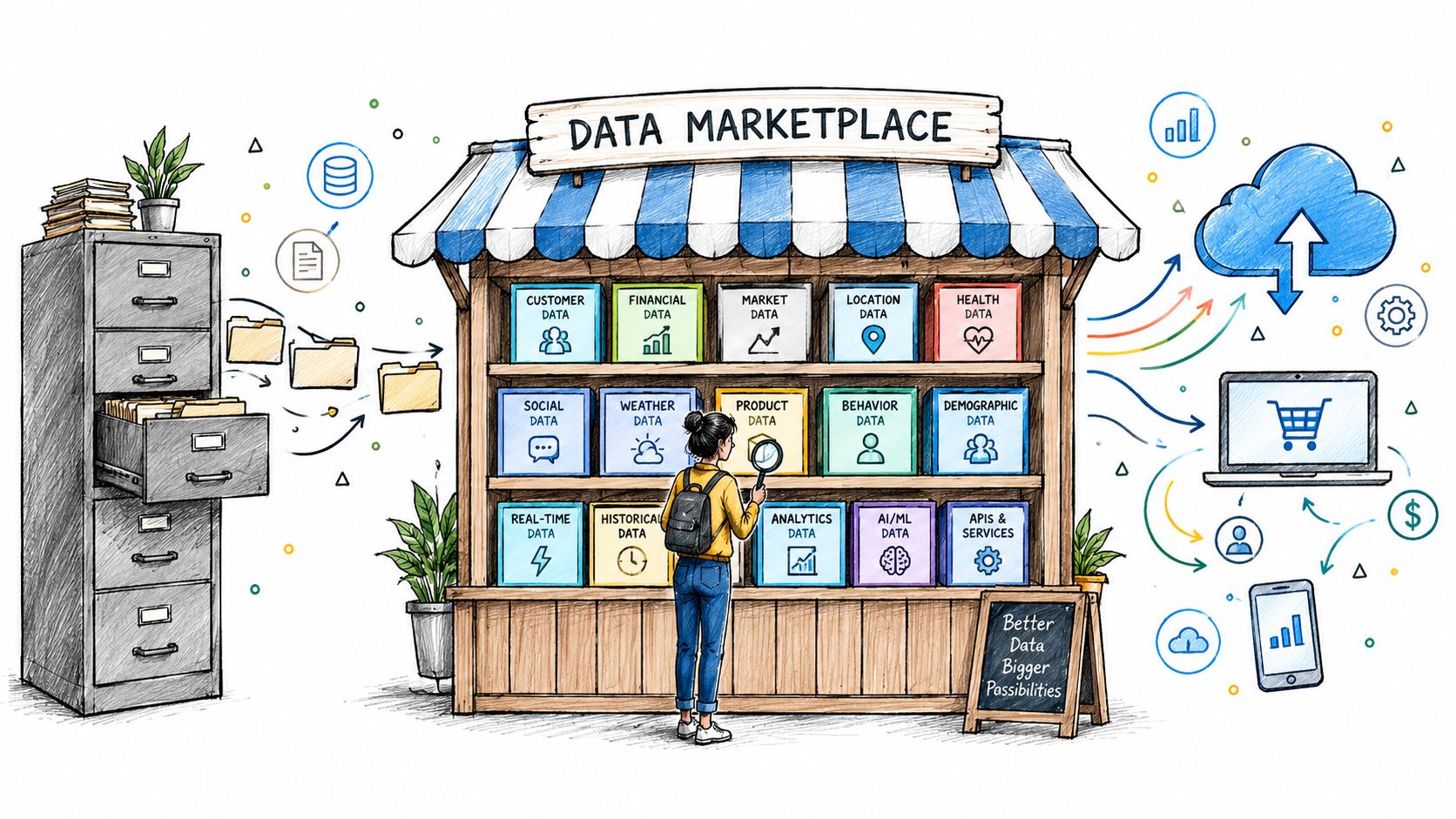
Start with the simplest definition: an enterprise data marketplace is a governed access layer where people and systems discover, understand, request, and use approved data products.
That definition has four parts:
- Discover: Consumers can search and browse products using business language, not only table names.
- Understand: Each product explains its purpose, fields, lineage, quality, freshness, and restrictions.
- Request: The marketplace applies an access process tied to identity, role, purpose, and policy.
- Use: Approved consumers receive access through a controlled table, API, file, stream, model, or other interface.
The word product matters. A raw table is an implementation artifact. A data product has a consumer, an owner, a defined purpose, a quality expectation, and a lifecycle. It might be a curated customer profile, a risk feature set, a claims dataset, an operational API, a document collection, or an analytical model.
Catalog, lakehouse, and marketplace
These terms overlap, but they aren't interchangeable.
A lakehouse or warehouse stores and processes data. It provides compute, storage, transformation, and querying capabilities.
A catalog describes assets and may provide technical metadata, search, ownership, and lineage. It answers, “What exists, and where is it?”
A marketplace adds a consumer-oriented transaction and control experience. It answers, “Can I use this product, for what purpose, under which conditions, and how will the owner support it?”
The marketplace may sit over multiple platforms. A product could combine records from a warehouse, documents in a content system, events from a streaming platform, and external data obtained under a license. Consumers shouldn't need to understand every storage location to use the approved product.
North America accounted for more than 41.6% of global platform revenue in 2024, approximately USD 660.1 million of a USD 1.5869 billion market, while large enterprises represented 74.5% of activity by enterprise size, according to Marketintelo's market assessment. Those figures describe where adoption has been concentrated, not a limit on who can benefit.
A useful mental test is this: a wiki of links points people toward data, while a marketplace takes responsibility for the conditions of use. If the product has no owner, no access policy, no quality expectation, and no retirement process, it may be searchable, but it isn't operating as a dependable marketplace product.
Core Components and Architecture of an Enterprise Data Marketplace
A functioning marketplace has several layers, and each answers a different operational question.
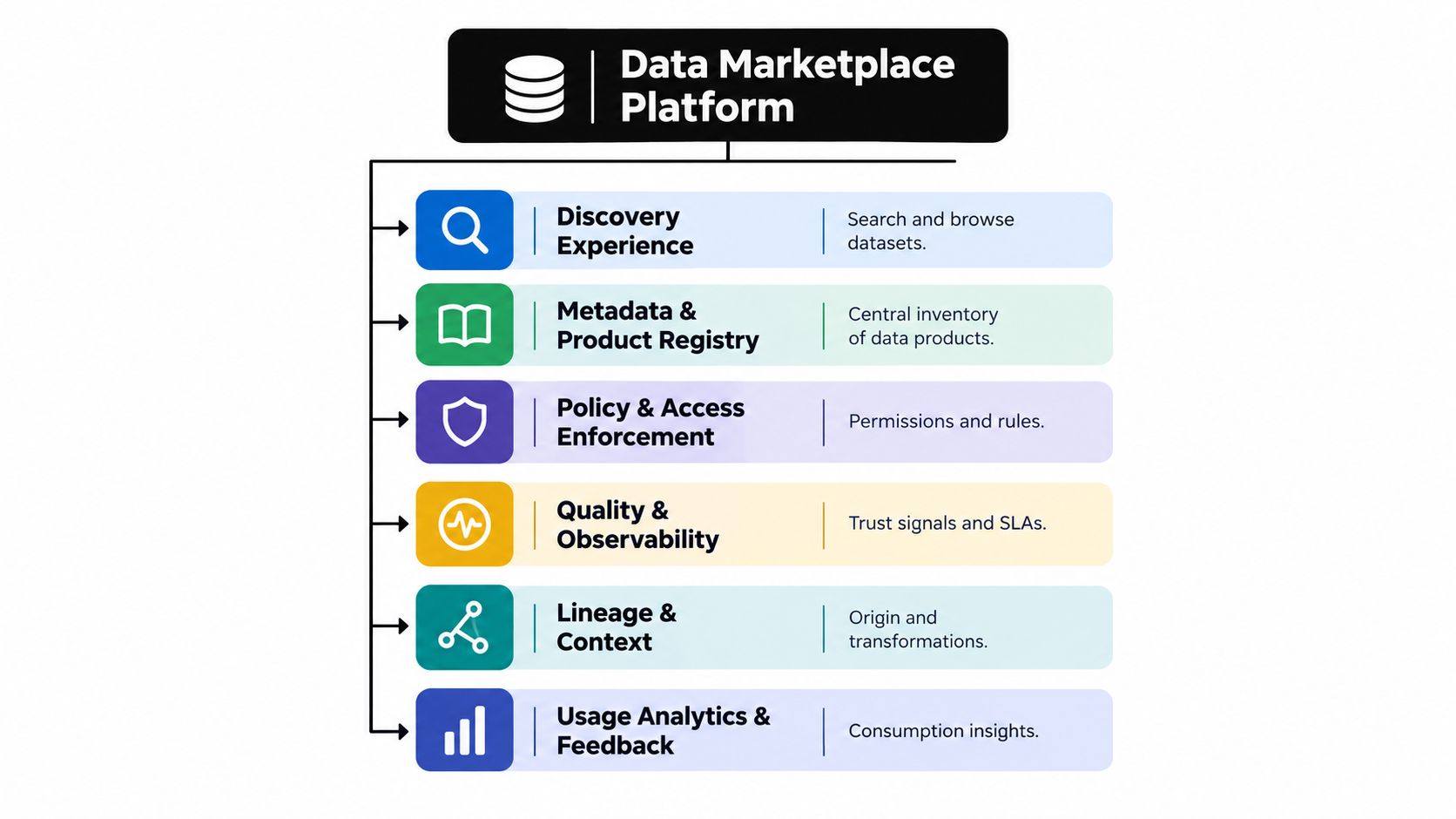
The six layers that make the system useful
Discovery experience is the front door. Search should support business terms, synonyms, domains, owners, certification states, sensitivity, and freshness. A risk analyst shouldn't need to know the physical name of a table to find an approved risk exposure product.
Metadata and product registry stores the product record. It connects descriptions and definitions to technical assets, versions, owners, contracts, and permitted uses.
Policy and access enforcement turns governance into a decision. The layer should integrate with enterprise identity and apply role, attribute, purpose, geography, and sensitivity rules where required.
Quality and observability supplies evidence that a product works as promised. Consumers need visible freshness, validation results, completeness indicators, incident status, and service expectations.
Lineage and context show where the product came from and how it was transformed. Lineage helps a consumer assess meaning and helps an owner identify downstream impact before changing a field.
Usage analytics and feedback reveal whether discovery leads to value. Search terms with no results, repeated denials, abandoned requests, and support questions all indicate where the product experience is failing.
A technically complete record should include business definitions, schema and technical metadata, lineage, freshness, quality metrics, owner and steward contacts, sensitivity classification, permitted uses, service-level expectations, and machine-enforceable access policies, as described in AWS guidance on enterprise data governance catalogs.
| Field | Purpose | Consumer benefit |
|---|---|---|
| Business definition | Explains what the product represents | Prevents incorrect interpretation |
| Schema and technical metadata | Describes fields, formats, and structures | Speeds integration and analysis |
| Lineage | Records source systems and transformations | Supports impact analysis and trust |
| Freshness and quality metrics | Shows whether expectations are being met | Helps consumers judge suitability |
| Owner and steward contacts | Assigns responsibility | Gives users a clear escalation path |
| Sensitivity and permitted uses | States restrictions and lawful purposes | Reduces accidental misuse |
| Service expectations | Defines delivery and support commitments | Makes reliability observable |
| Machine-enforceable policies | Applies rules through systems | Reduces dependence on manual review |
Centralized and federated patterns
A centralized model puts the marketplace platform team in control of the registry, common policies, access workflow, and user experience. This approach is easier to standardize and can work well when domains have uneven maturity.
A federated model lets domain teams own their products while a central function defines interoperability, security, metadata, and policy standards. It fits organizations where business domains understand their data better than a central team does, but it requires stronger contracts and enforcement mechanisms.
Neither pattern solves ownership by itself. A central platform can become a publishing bottleneck, while federation can produce incompatible definitions if the organization doesn't enforce shared standards.
AI agents and retrieval workflows add another consumer type. They shouldn't receive only a data payload. Retrieval should also expose provenance, freshness, authorization context, and permitted-use constraints. Teams building these workflows can also review guidance on the best embedding models, but semantic retrieval quality won't compensate for missing ownership or policy context.
Governance, Security, and the Economics of Trust
A marketplace doesn't create trust by displaying a search box. Trust comes from a chain of controls that connects classification, access, quality, accountability, and evidence.
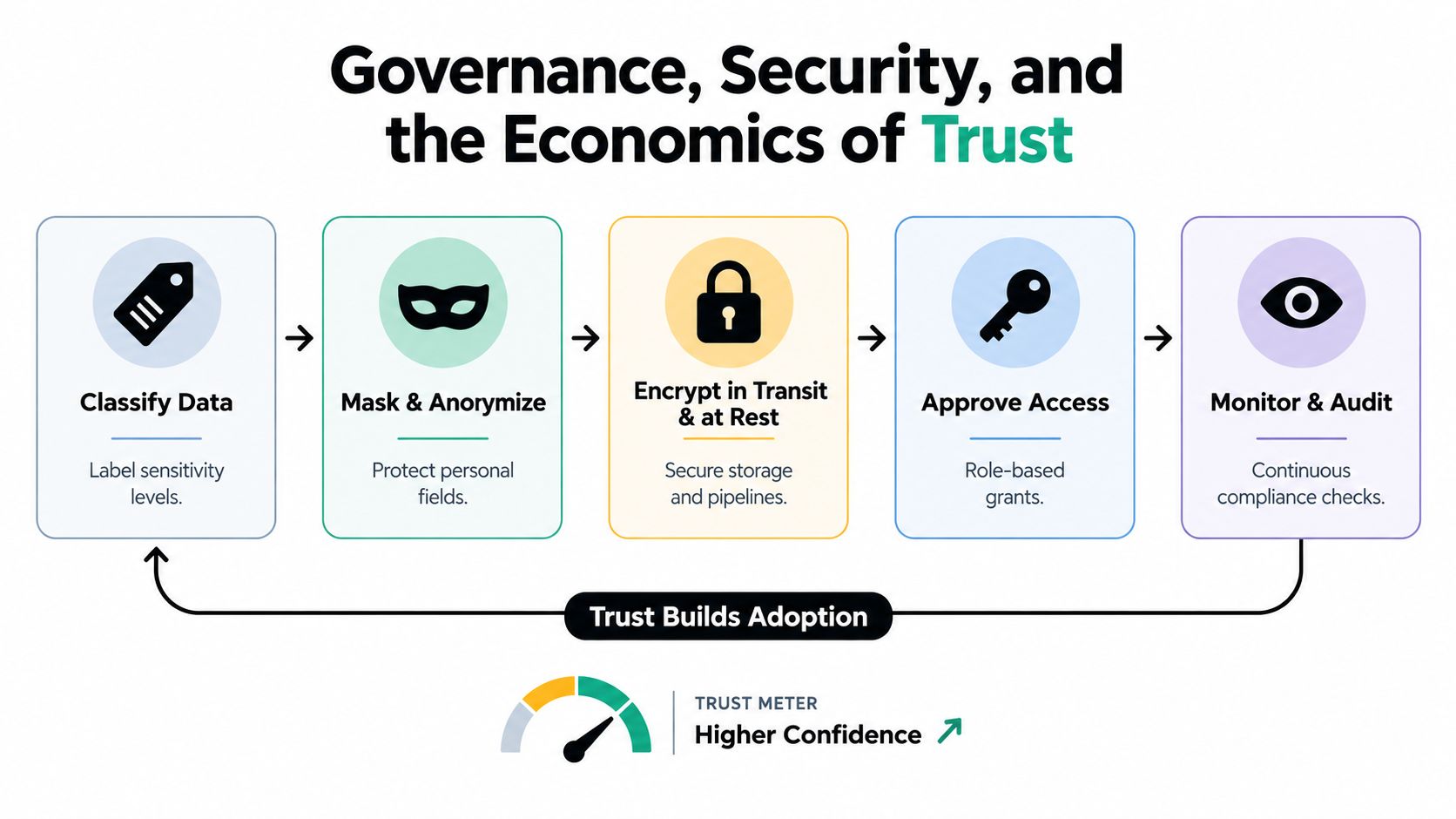
Start with classification. The owner identifies sensitive fields, business restrictions, retention expectations, and permitted purposes. Security controls can then apply masking, encryption, role-based access, and audit logging to the product rather than relying on every consumer to understand the underlying infrastructure.
Data contracts make those expectations explicit. A contract can define schema, quality checks, freshness, security requirements, ownership, change procedures, and acceptable use. Policy-as-code can enforce parts of that contract automatically, reducing the number of requests that sit in review queues.
The trust deficit is substantial. ISG reports that only 16% of organizations in its data-governance benchmark consider their data well trusted, while roughly half identify agreement on data definitions as a primary management concern. A marketplace that improves search without improving definitions may increase the number of people who find inconsistent data.
The economics most catalogs avoid
Every product has a cost, even when nobody sends an invoice. Someone pays for pipelines, storage, quality monitoring, security review, documentation, support, and change management. If the marketplace doesn't make those costs visible, the platform team absorbs them until funding becomes a political problem.
Assign four forms of accountability:
- Product funding: Decide whether the producing domain receives a central budget, a consumer contribution, or a commercial return.
- Service ownership: Name the person or team responsible for freshness, quality, incidents, and communication.
- Consumption rules: Define whether internal use is free, metered, charged by allocation, or charged only for exceptional compute.
- Liability handling: State who investigates an inaccurate product, who pauses access, and who manages regulatory or contractual consequences.
A product owner shouldn't be accountable for risks they can't control. If a central security team approves access but the domain controls the data transformation, the operating agreement must separate those responsibilities clearly.
Useful measures include cost per active consumer, fulfillment latency, freshness compliance, incident rate, and the share of products with named owners and documented contracts. They reveal whether demand is growing faster than the organization can support.
For AI systems, provenance and authorization must travel with retrieval results. A model that receives a paragraph without its source, freshness state, or usage restriction can produce an answer that sounds plausible but cannot be defended. Teams handling connected AI workflows should also account for the governance risks described in this guide to shadow AI governance.
A marketplace can increase demand faster than an enterprise can validate, secure, and support its products. Capacity planning is a governance control.
How SourceX Can Help
Some enterprises need an internal marketplace for analysts and applications. Others need a controlled way to license operational data to AI labs and external buyers. SourceX addresses the second problem by acting as a transaction layer for sourcing, rights validation, deidentification, contracting, delivery, and payment.
The service begins with a fit assessment that estimates licensing potential without requiring an immediate upload. It can then map data across systems and years of history, create a private inventory, and summarize sources, fields, depth, and availability. The inventory is designed to work with exports from systems such as Zendesk, Salesforce, GitHub, Jira, SharePoint, and Google Workspace.
Where the workflow reduces risk
SourceX reviews provenance and supplier permissions before presenting a dataset to buyers. It prepares data through dataset-specific deidentification, records the preparation steps, and asks suppliers to confirm lawful collection and relevant licensing history. That evidence packet can document the system of origin, rights, intended purpose, and usage constraints before release.
Commercial terms are also standardized. Suppliers can define fixed-fee arrangements, selection periods, exclusivity windows, invoicing timelines, and permitted uses. SourceX supports buyer outreach, evaluation, negotiation, agreement execution, packaging, and delivery coordination.
The model keeps the supplier in control. Nothing is shared until explicit authorization, and the signed agreement carries the approved scope and permitted uses. Suppliers retain ownership of their original data, while the treatment of deidentified datasets and underlying intellectual property is defined through the relevant terms.
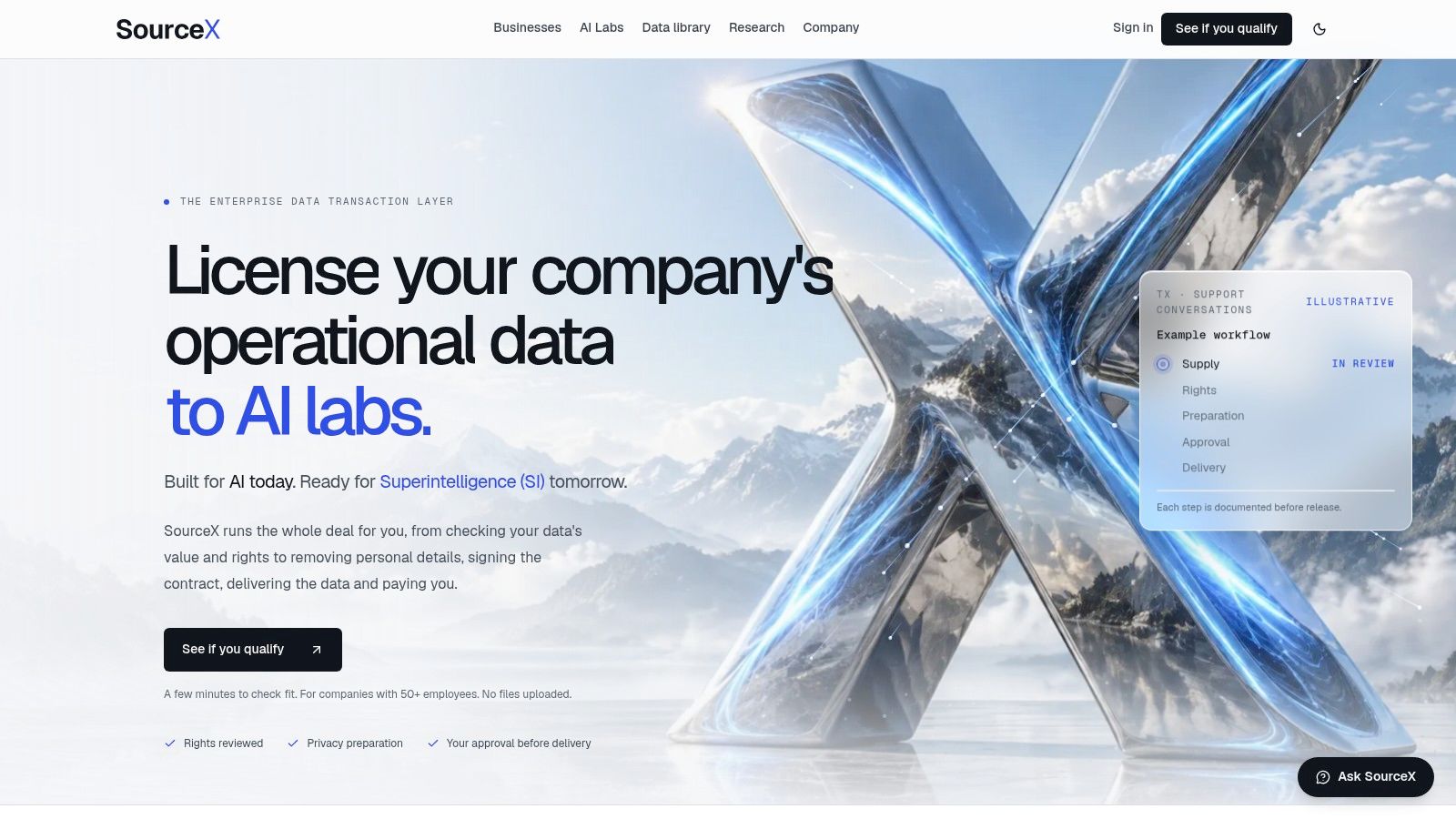
This is the right choice when an organization has valuable operational records but lacks the internal legal, privacy, sourcing, and buyer-management capacity to license them safely. It isn't a substitute for an internal governance program. It is a focused option for enterprises that need rights-cleared external transactions, supplier approval at every step, and a coherent route from messy system exports to buyer-ready datasets.
Organizations evaluating the buyer side can review SourceX's enterprise data marketplace resources to understand how cataloging, request handling, rights evidence, and delivery fit together.
Implementation Path and Best Practices
Implementation should begin with a business decision, not a platform purchase. Choose a domain where consumers have a visible problem, the source team can name an owner, and the organization can define what “good” looks like. A marketplace with hundreds of poorly documented products will create more confusion than a focused launch with a small set of dependable products.
Define the first consumer persona as precisely as the first domain. A fraud analyst, marketing manager, data scientist, and AI agent need different search results, explanations, access routes, and support. The executive sponsor should own the outcome, while the platform team owns the shared capabilities.
Build the minimum that creates a complete transaction
The minimum useful marketplace needs four connected capabilities:
- A product registry: Each product has an owner, definition, schema, lineage, quality signals, and lifecycle state.
- A discovery experience: Consumers can find products by business need and understand suitability before requesting access.
- A policy path: Identity, classification, purpose, approvals, and audit records connect to actual access.
- A feedback loop: Consumers can report issues, request changes, and show which products create repeated value.
Centralize common standards, but don't force every domain to surrender product ownership. Use data contracts to define the boundary. Keep quality checks close to the pipelines that produce the data, then expose the results through the marketplace.
Non-technical adoption needs deliberate support. Give business users examples, plain-language definitions, sample queries, approved templates, and a way to ask questions without bypassing the platform. For document-heavy workflows, a resource such as this full guide to document extraction with AI can help teams think through how unstructured products should describe formats, provenance, and extraction limits.
A staged rollout
A 30-60-90 structure creates decision points without pretending that implementation ends after the first launch.
| Phase | Decisions | Deliverables | Checkpoints |
|---|---|---|---|
| First phase | Select domain, sponsor, consumers, and initial products | Product definitions, owners, access principles, baseline measures | Can a target user find and understand an approved product? |
| Second phase | Validate contracts, quality checks, and policy workflows | Working registry, identity integration, request path, feedback channel | Can an authorized user obtain access without private intervention? |
| Third phase | Expand products, refine funding, and instrument usage | Usage dashboards, incident process, onboarding material, lifecycle rules | Are consumers returning, and can owners support demand? |
Don't treat the first release as proof of success. Treat it as a controlled test of ownership, semantic consistency, access latency, and user behavior. If employees still request spreadsheets through chat, interview them. The bypass often reveals a missing definition, a slow approval, a poor search result, or a pricing rule that makes legitimate exploration unattractive.
Monetization and Business Models
Charging for data changes behavior, so the pricing model should follow the marketplace's purpose. Internal reuse, cost control, and external revenue have different objectives. A model that works for partner licensing can damage internal discovery if applied to every exploratory query.
Model one, central cost recovery
A central budget funds product creation and platform operations. Consumers usually don't face a direct charge, although leadership tracks the cost of products and usage.
This model encourages experimentation and broad adoption. It also makes the platform easier to explain to employees because access isn't blocked by an internal invoice. The weakness is accountability. Producing domains may publish too many products, while consumers may request expensive capabilities without considering demand or support costs.
Use service expectations and portfolio reviews to control waste. Retire products with no meaningful consumers, and require a named business case for products that need substantial ongoing support.
Model two, internal chargeback
Consumer domains pay through usage, allocation, storage, compute, or a negotiated service arrangement. Chargeback can make demand visible and help finance high-cost products fairly.
The risk is that a price becomes a tax on learning. Analysts may return to spreadsheets or informal requests if small experiments require procurement-style approval. Chargeback also creates accounting questions about shared services, transfer pricing, and the treatment of cross-border activity.
A practical compromise is to keep standard discovery and low-risk internal access centrally funded, then meter exceptional compute, high-volume delivery, or dedicated service commitments.
Model three, external monetization
The enterprise sells or licenses products to partners, customers, research organizations, or AI buyers. This model requires stronger rights evidence, contractual terms, privacy preparation, buyer qualification, delivery controls, and incident response.
External revenue can justify investment in product quality, but it also creates liability. An inaccurate product may lead to contractual disputes. A dataset with unclear provenance can create reputational or legal exposure. Cross-border transactions add questions about sovereignty, residency, permitted processing, and applicable law.
The assumption that revenue proves value is dangerous. A product can sell once and still fail as a durable business if its support cost, validation burden, or liability exceeds the return.
Cross-enterprise data spaces and consortium models require a related but distinct design. No single organization may own the entire ecosystem, so participants need agreed terms for access, identity, data sovereignty, liability, change management, and transaction rules. The marketplace is then as much a contract network as a technology platform.
The adoption pressure is real, but operating maturity often lags. Surveyed data leaders expected 68% of their organizations to implement data marketplaces within the following year, while 53% reported manual governance and 62% said governance slowed data access, according to the 2025 State of Data Security Report. Funding and accountability should be designed before the marketplace creates demand that governance teams can't process.
KPIs, Pitfalls, and How to Keep the Marketplace Alive
A search count doesn't prove that a marketplace creates value. The meaningful measurement chain runs from discovery to authorization, consumption, reliability, and business use.
Track search-to-access conversion to see whether discovery leads to an approved request. Track time from discovery to authorization to identify workflow friction. Repeated-user consumption indicates that a product solved a recurring need rather than attracting one-time curiosity. Freshness-SLA compliance and quality-rule pass rates show whether owners meet their promises. Policy-denial rates reveal whether consumers are requesting unsuitable products or whether policies are too restrictive. Downstream incident frequency shows the operational cost of unreliable data.
What causes marketplaces to decay
The first failure is uncontrolled publishing. Teams add assets faster than they can document them, leaving consumers with a large inventory and little confidence. Require a minimum product contract and distinguish draft, approved, deprecated, and retired states.
The second is governance congestion. If every low-risk request requires the same manual review, consumers wait and then find another route. Automate routine decisions, route exceptions to specialists, and make denial reasons visible.
The third is weak producer incentives. Domain teams may be asked to maintain products without funding, recognition, or capacity. Give owners measurable service expectations and make product support part of operating plans.
The fourth is poor user experience. A technically correct marketplace still loses if its search terms don't match business language or if quality scores have no explanation. Test the interface with actual users, including people who aren't data specialists.
The fifth is unsafe AI retrieval. An agent that can search but can't see authorization context may expose restricted material or cite stale information. Return provenance, freshness, permitted-use metadata, and access decisions with the retrieved content.
| Signal | Healthy | Warning | Critical |
|---|---|---|---|
| Ownership | Named owner and steward for active products | Contacts are outdated or unclear | Consumers can't identify accountability |
| Access | Requests resolve through governed workflows | Approvals depend on manual intervention | Users routinely bypass the marketplace |
| Quality | Product checks and freshness status are visible | Incidents are resolved informally | Consumers discover failures after use |
| Consumption | Users return to products for recurring work | Searches rise but use remains low | Inventory grows without active consumers |
| Semantics | Shared definitions support combined products | Teams debate metric meaning | Reports produce conflicting business numbers |
| Funding | Costs and support obligations are assigned | Platform relies on temporary capacity | No team can sustain operations |
A quarterly review should ask whether products still have consumers, whether owners meet service expectations, whether access denials indicate a policy problem, and whether incident patterns point to a definition or quality issue. It should also review products approaching retirement. A marketplace stays healthy when it removes dead inventory as deliberately as it publishes new products.
The operating lesson is simple: measure the path to trusted use, not the size of the catalog.
Real-World Use Cases and What They Teach Us
In financial services, a risk domain can own fraud, KYC, and exposure products while approved models consume them through policy-enforced access. The lesson is that sensitive data needs product ownership and purpose controls together.
In retail, merchandising teams can subscribe to governed supplier, point-of-sale, and loyalty products through APIs or analytical tables. The value comes from consistent definitions across commercial functions, not merely from placing more sources in one search index.
In healthcare, a consortium can share de-identified clinical products with researchers under contracts and consent constraints. The marketplace must represent participant permissions and data sovereignty, because no central owner can waive every restriction.
In manufacturing, an operations domain can publish IoT telemetry as a plant-performance product for engineering and maintenance teams. Freshness, lineage, and incident status matter because consumers may use the product for operational decisions.
In software and AI, a governed retrieval product can expose documents and structured records with provenance, freshness, and authorization context. That pattern is especially useful for agents that need to cite enterprise information rather than guess.
Across these cases, the reusable pattern is the same: a named owner publishes a defined product for a known consumer, under explicit policies, with an observable outcome. The marketplace succeeds when it makes that relationship easier to manage than an email attachment or an undocumented query.
Choose one real data-sharing bottleneck in your organization, name the business owner and consumer, and document the product's definition, access rules, freshness expectation, and support cost. Then test the workflow with a small group before expanding the catalog. If your teams also need governed research, file analysis, and AI workflows in one workspace, explore Writingmate at writingmate.ai.
Frequently Asked Questions
Sources
- Fact.MR's data marketplace platform analysis
- Marketintelo's market assessment
- AWS guidance on enterprise data governance catalogs
- guidance on the best embedding models
- ISG reports that only 16% of organizations in its data-governance benchmark consider their data well trusted
- guide to shadow AI governance
- enterprise data marketplace
- full guide to document extraction with AI
- writingmate.ai

Written by
Artem Vysotsky
Ex-Staff Engineer at Meta. Building the technical foundation to make AI accessible to everyone.

Reviewed by
Sergey Vysotsky
Ex-Chief Editor / PM at Mosaic. Passionate about making AI accessible and affordable for everyone.