
A content lead's Tuesday can become a small operations crisis before the first meeting starts. Priya has thirteen tabs open, four documents mid-draft, a brief due by lunch, and a Slack message asking for “one more quick asset.” An AI tool can produce that asset in seconds, but it can't tell her whether the idea is differentiated, whether the claim is defensible, or whether publishing it will make the brand sound interchangeable.
That's the problem with most advice about how to use AI for content marketing. Teams add AI to drafting, then leave research, approvals, distribution, and measurement to a patchwork of manual habits. The better approach is an end-to-end workflow that uses AI to remove repetitive work while keeping humans responsible for meaning, evidence, and risk.
Table of Contents
- The Real Workflow Behind How to Use AI for Content Marketing
- What AI Can Actually Do for a Content Team
- A Stage-by-Stage AI Content Workflow You Can Run Today
- The Publish-Less-But-Prove-More Strategy
- A Risk-Tiered Review System That Actually Scales
- Mapping Each Stage to the Right Writingmate Feature
- Measuring Whether AI Content Marketing Is Paying Off
The Real Workflow Behind How to Use AI for Content Marketing
Priya's problem isn't a lack of effort. It's a broken production line. Research happens in one browser window, keyword notes sit in a spreadsheet, drafts live in separate documents, visual requests move through Slack, and performance data arrives after the team has already started the next campaign.
AI can make that fragmentation worse. A writer may generate an outline in one tool, rewrite it in another, create social copy somewhere else, and lose the sources that supported the original argument. The team appears faster, but every handoff creates another opportunity for unsupported claims, inconsistent positioning, and duplicated work.
Practical rule: Use AI to reduce handoffs, not to remove accountability.
A reliable workflow starts with a single editorial brief. That brief should identify the audience, business problem, search intent, point of view, evidence available, claims that need verification, desired action, and approval owner. AI can then work from a controlled source set instead of inventing context from a vague prompt.
Six stages from research to reporting
The workflow has six connected stages:
- Research and audience understanding: Collect current sources, customer language, competing perspectives, and unresolved questions.
- Strategy and briefing: Cluster related queries by user need and decide whether a topic deserves its own page, format, or campaign.
- Creation: Generate outlines, draft options, metadata, visual concepts, and channel adaptations from the approved brief.
- Editorial review: Check evidence, originality, tone, legal exposure, accessibility, and usefulness.
- Distribution and reuse: Adapt the finished asset for email, social channels, sales enablement, video, and internal circulation.
- Measurement and learning: Compare production effort with qualified attention, conversions, retention, and editorial rework.
The order matters. Drafting before research produces polished generalities. Distribution before editorial approval spreads errors across multiple channels. Measurement that tracks only output rewards the wrong behavior.
A disciplined team treats each AI output as a proposal. The editor decides what survives, the subject matter expert supplies what the model cannot know, and the analyst checks whether the finished work changed business outcomes. That structure turns AI from a text generator into a controlled layer inside the content operation.
What AI Can Actually Do for a Content Team
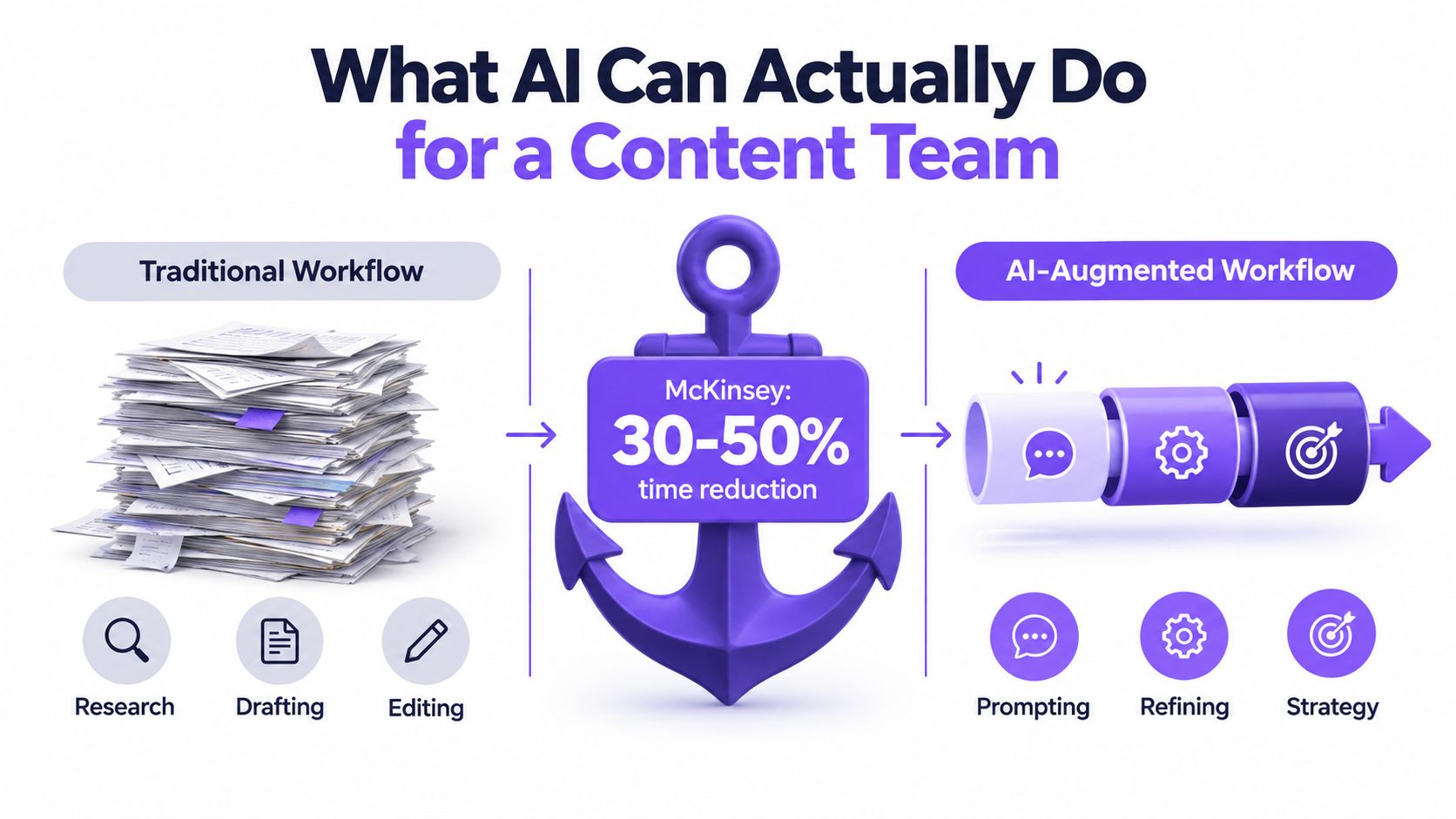
Generative AI is most useful when the work is repetitive, high-volume, and easy for a human to evaluate. It can cluster keywords, summarize search results, identify gaps in competing pages, generate outline alternatives, rewrite metadata, clean transcripts, create social variants, and turn one approved source into several formats.
It shouldn't own the parts of marketing that establish authority. Humans still need to define the audience, positioning, original argument, brand voice, product claims, editorial standards, and approval criteria. AI buys throughput, not authority.
McKinsey estimated that generative AI could raise marketing-function productivity by 5% to 15% of total marketing spending, representing approximately $463 billion in annual value globally. The analysis also placed marketing and sales among the four functions expected to capture about 75% of generative AI's economic potential, which McKinsey estimated at up to $4.4 trillion in annual productivity gains. Those figures describe potential productivity, not a guaranteed content return, so teams should validate them through workflow experiments rather than treat them as a publishing quota. McKinsey's analysis of generative AI's economic potential provides the right framing: use AI to compress busywork, then measure whether the saved time improves marketing decisions.
Give AI the queue, not the judgment
A practical division of labor looks like this:
- AI handles discovery: Cluster related queries, summarize competing pages, extract recurring customer questions, and surface missing subtopics.
- AI handles variation: Produce headline options, calls to action, introductions, email subject lines, and channel-specific adaptations.
- AI handles transformation: Convert a webinar transcript into a briefing, a newsletter, social posts, a short video script, and sales talking points.
- Humans handle evidence: Verify statistics, quotations, product assertions, legal statements, current events, and customer outcomes against authoritative sources.
- Humans handle differentiation: Add proprietary data, expert interpretation, customer language, practical experience, and a position the market can recognize.
- Humans handle release decisions: Decide whether the content is useful enough to publish, safe enough to approve, and specific enough to support the intended business outcome.
For a closer look at how different tools fit into the production process, see this guide to AI tools for content creation. The key is not to ask which model can write the longest draft. Ask which tool can complete a defined task while leaving a clear review trail.
The common mistake is turning a productivity estimate into a volume target. If a team saves time on outlining but spends that time editing generic drafts, it hasn't improved the system. Use the recovered capacity for customer interviews, source validation, stronger examples, and distribution decisions.
A Stage-by-Stage AI Content Workflow You Can Run Today
A useful AI workflow begins with a brief and ends with a measured distribution plan. The prompts below are deliberately constrained. They tell the model what to analyze, what not to assume, and where a human must intervene.
1. Start with a topic cluster
Give the model a topic seed, audience description, existing assets, and business objective.
“Cluster these queries by distinct user need. Name the likely intent for each cluster, identify overlapping questions, and recommend one primary page or format per cluster. Do not invent search volume or customer evidence. Flag assumptions separately.”
Use web research and file analysis to ground the clusters in current sources and internal material. The output should be a set of decisions, not a long list of possible article titles.
2. Find a defensible SEO angle
Ask AI to summarize competing search results, but require a differentiation recommendation.
“Review these competing pages. Summarize their shared claims, missing evidence, repeated structures, and unanswered user questions. Recommend an angle that adds original analysis or first-party evidence. Cite each factual observation to its source.”
Here many teams stop too early. A SERP summary isn't a strategy. The editor must decide whether the proposed angle is truly useful and whether the business can support it.
3. Build an evidence-led outline
Create an outline that assigns a purpose to every section.
“Create an outline for this audience and intent. For each section, specify the user question, evidence required, practical example, likely objection, and takeaway. Mark any claim that needs primary-source verification. Avoid repeating generic definitions.”
The outline should encode experience, expertise, authoritativeness, and trustworthiness through actual evidence and analysis, not by adding those words to a prompt. Store the approved outline with the source list so later revisions remain traceable.
4. Draft with model roles
Use one model for structure and another for challenge or refinement when the topic is important. A long-form model may develop the argument, while a faster model can identify omissions, awkward transitions, unsupported claims, and counterarguments.
Give the model the approved outline, source excerpts, audience details, and tone rules. Tell it to use placeholders for missing evidence instead of filling gaps with plausible language. Teams exploring personalized content at scale should apply the same control principle, personalization is only useful when the underlying facts and audience signals are reliable.
5. Edit against a fixed checklist
Ask AI to review the draft in separate passes rather than one vague “make it better” instruction.
- Claims pass: List every factual, numerical, product, legal, and comparative claim, then mark its supporting source.
- Voice pass: Flag generic phrasing, inflated promises, unnecessary jargon, and sentences that don't sound like the brand.
- Structure pass: Identify repetition, missing context, weak section logic, and calls to action that don't match reader intent.
- Originality pass: Highlight passages that resemble common category language and request a more specific example or analysis.
The editor accepts or rejects suggestions. AI should expose review work, not quietly rewrite the evidence.
6. Create and distribute the approved asset
Generate a hero-image concept, social cuts, alt text, email introduction, LinkedIn post, and short video script from the final version. Don't create channel variants from an unapproved draft, because one weak claim can multiply across the campaign.
Use automating content creation as a process question, not a license to remove editorial gates. Each adaptation should preserve the source argument while matching the channel's format and audience expectation.
The Publish-Less-But-Prove-More Strategy
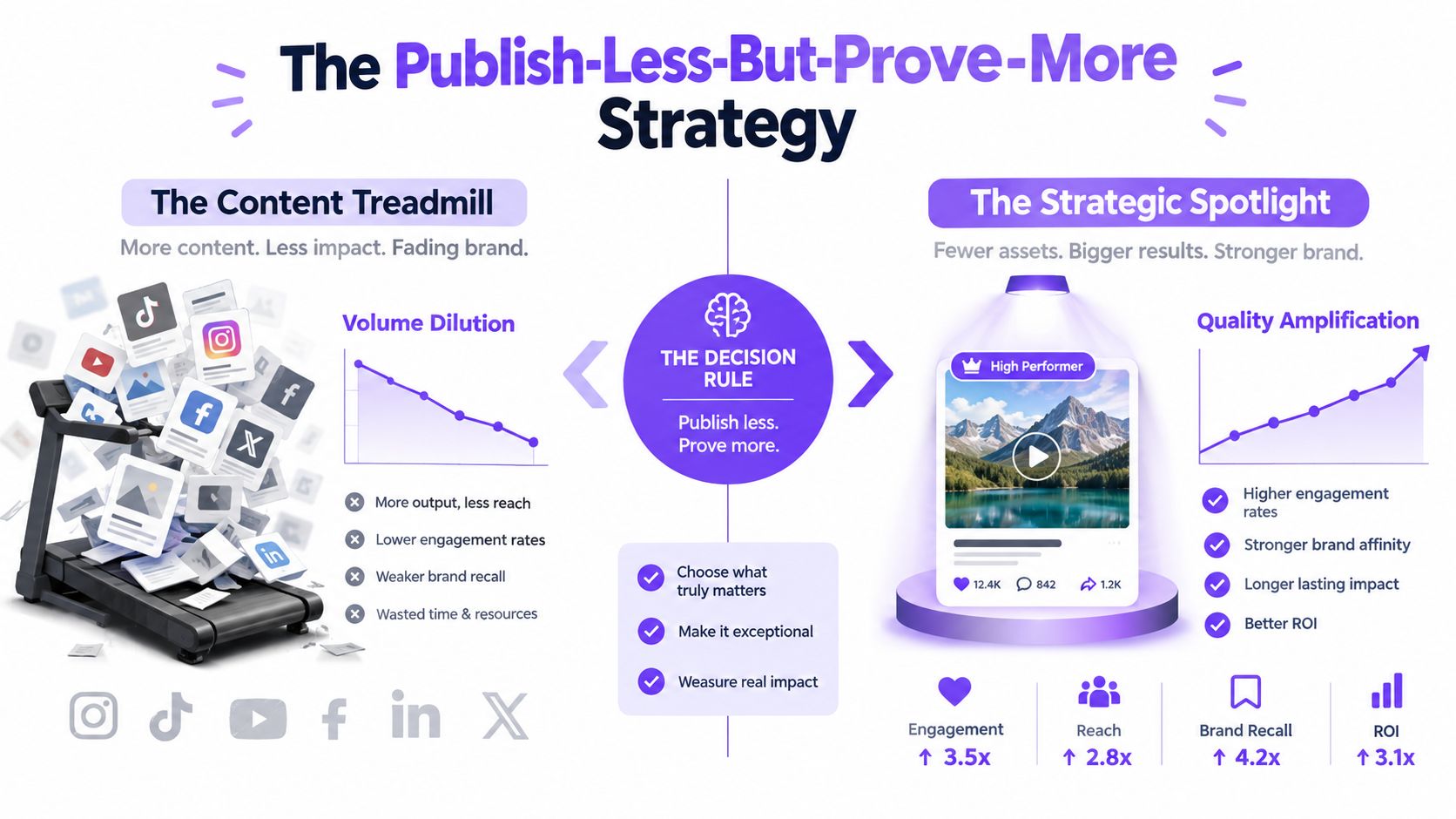
AI makes it easy to confuse activity with progress. A team can publish more pages, create more variations, and fill every social slot while giving buyers no new reason to trust the brand.
The adoption data points to a difficult contradiction. 81% of B2B marketers use generative AI tools, yet only 4% report high trust in AI outputs, and just 17% rate AI-generated content as excellent or very good, according to the Content Marketing Institute's B2B research. A separate 2025 survey found that 91% of marketers planned to increase content output, while 46% expected to produce three to five times more content than the previous year. More production is coming into a market where confidence in the output remains limited.
Two strategies with different consequences
A SaaS team can use AI to support three substantial case studies. Each one can include customer context, implementation detail, constraints, evidence, and sales-ready answers. The team may publish less frequently, but sales can use the assets in conversations because the content addresses real buying questions.
The same team can produce ten shallow listicles about broadly familiar software problems. That library may look productive, but it gives buyers little to remember, little to share, and little reason to believe the company understands the problem better than competitors. The extra editing and maintenance burden can consume the time that should have gone into customer research.
The strategic question isn't “How much can we publish?” It's “What can we prove that a generic summary cannot?”
Use AI aggressively when the topic is commodity-shaped and the goal is redistribution. Examples include turning an approved report into channel variants, adapting a finished webinar for different audiences, or generating headline options for a controlled test.
Restrict AI generation when the topic is opinion-shaped, regulated, tied to proprietary data, or dependent on a customer's specific experience. In those cases, AI can organize notes, challenge assumptions, and identify gaps, but the argument should come from accountable people and verifiable evidence.
A copycat check before approval
Reject or revise a draft when:
- The examples could belong to any competitor.
- The conclusion repeats the introduction without adding a decision.
- The claims have no named source or internal owner.
- The tone contains polished but empty phrases.
- The recommendations don't reflect the company's product, customers, or operating experience.
- The page answers the keyword but not the buyer's next practical question.
The strongest AI strategy may be to publish less, then spend the recovered capacity proving more.
A Risk-Tiered Review System That Actually Scales
“Human in the loop” is too vague to run a production team. A social caption and a regulated financial explanation shouldn't pass through the same approval path, and neither should consume the same review effort.
Deloitte's survey of 3,857 U.S. consumers found that nearly 40% had tried generative AI. Among respondents familiar with or using it, 70% agreed that AI-generated content makes online information harder to trust, 59% said they had difficulty distinguishing human-created from AI-generated content, and 84% supported mandatory labeling. These findings from Deloitte's 2024 consumer survey make provenance and accountability operational requirements, not abstract ethics language.
Four review tiers
| Tier | Content Type | Required Checks | Reviewer |
|---|---|---|---|
| Tier 1 | Social captions, internal notes, low-risk variations | Spelling, tone, basic context, obvious factual errors | Content producer |
| Tier 2 | Blog posts, newsletters, standard product education | Source verification, originality, structure, brand voice, links, accessibility | Editor |
| Tier 3 | Thought leadership, executive bylines, customer-facing research | Full fact-check, source provenance, voice review, claims review, stakeholder approval | Editor plus subject matter expert or executive owner |
| Tier 4 | Regulated, medical, financial, or legal content | Primary-source verification, documented evidence, risk review, disclosure decision, compliance approval | Subject matter expert plus compliance reviewer |
Tier 1 can use sampling because the downside is limited. Tier 2 needs a named editor before publication. Tier 3 requires someone who can confirm both the argument and the attributed voice. Tier 4 should never rely on model agreement as proof, even if several systems produce the same answer.
Put governance in the brief
Every project should record the AI tools used, source materials supplied, prohibited inputs, required disclosure, risk tier, reviewer names, unresolved questions, correction owner, and publication decision. Keep comments attached to the draft version that generated them, not in a separate chat thread that disappears after approval.
A simple governance template can include:
- Purpose: What business and reader outcome does the asset support?
- Risk tier: Which review path applies, and why?
- Evidence register: Which source supports each material claim?
- Human owner: Who is accountable for accuracy and usefulness?
- Disclosure decision: Is AI assistance material enough to label?
- Approval record: Who reviewed the draft and what did they approve?
- Correction path: How will the team handle a reported error?
Teams should also monitor correction rate, unsupported-claim rate, citation completeness, approval time, conversion quality, and post-publication complaints. A process that publishes quickly but creates repeated corrections isn't efficient.
Mapping Each Stage to the Right Writingmate Feature
A fragmented tool stack forces the team to copy briefs, source notes, drafts, and media prompts between applications. A unified workspace can reduce that friction, but the workflow still needs explicit ownership and fallback decisions.
| Lifecycle Stage | Writingmate Feature | Fallback |
|---|---|---|
| Keyword clustering | Web Search with citations and multi-model chat | Compare a second model's clusters and resolve differences manually |
| Brief writing | Chat with files, project workspace, prompt builder | Use approved source files and a human-owned brief |
| Long-form drafting | Document editor and multi-model chat | Run a parallel model pass for structure and missing claims |
| Editing | Reusable prompts, file analysis, side-by-side comparison | Ask another model to challenge tone, logic, and unsupported assertions |
| Image and video creation | Image and video generation models | Switch models when a visual style, format, or output fails review |
| Distribution repurposing | Prompt library, custom helpers, multi-model chat | Keep one approved source version as the canonical reference |
| Performance reporting | File analysis and reporting workspace | Export from analytics tools and reconcile against editorial records |
Writingmate brings text, image, video, web research with citations, file analysis, prompt reuse, side-by-side model comparison, and built-in fallbacks into one application. For high-stakes drafts, run two models in parallel, promote the stronger structure, and use the other response to flag missing evidence or suspicious certainty. Agreement between models is a review signal, not a factual guarantee.
Credit usage also belongs in the operating plan. Long research runs, repeated model comparisons, image generations, and video iterations consume resources differently, so assign a budget to each workflow and test prompts on a small source set before launching a full production run.
Measuring Whether AI Content Marketing Is Paying Off
AI should shorten the path from a sound brief to a useful published asset. It shouldn't merely increase the number of drafts in circulation.
The most useful measurement system combines operational efficiency with content quality and business value. Targets should be set against your existing baseline, because a fast process that produces weak leads is still a failed process.
| Metric | What it measures | Target threshold | Warning sign |
|---|---|---|---|
| Hours saved per published asset | Whether AI removes repetitive work | Savings remain after review and corrections | Drafting is faster, but editing consumes the difference |
| Draft-to-publish cycle time | Workflow speed from approved brief to release | Cycle time falls without lower quality | More drafts wait in approval queues |
| SERP integration rate | Whether search-led content earns meaningful visibility | Target pages show qualified search progress | Impressions rise without relevant visits or actions |
| Assisted-pipeline revenue | Whether content supports commercially valuable journeys | Content appears in qualified opportunities and influenced revenue | Engagement stays high while sales relevance stays low |
| Editorial rework rate | How much published copy requires substantial correction | Rework declines across comparable assets | Editors repeatedly repair the same claim or tone problems |
Writingmate reporting views can help consolidate project activity, source work, model usage, and output records, while analytics and CRM data must supply the business outcomes. Teams evaluating AI tools for website SEO should connect rankings with qualified conversions rather than treating visibility as the final result.
Pull the last 10 published assets, tag each by AI involvement tier, and compare these five metrics across the tiers. Re-measure quarterly, then retire or consolidate work that fails its quality or business threshold. That small review keeps the system from drifting back into tab-hopping and volume for its own sake.
Writingmate brings multi-model writing, cited web research, file analysis, image and video generation, reusable prompts, and model fallbacks into one workspace for content teams. Use it to build the controlled workflow described here, then visit Writingmate to test a research-to-publication process that prioritizes evidence, review, and measurable outcomes over raw content volume.
Frequently Asked Questions
Sources
Written by
Artem Vysotsky
Ex-Staff Engineer at Meta. Building the technical foundation to make AI accessible to everyone.

Reviewed by
Sergey Vysotsky
Ex-Chief Editor / PM at Mosaic. Passionate about making AI accessible and affordable for everyone.